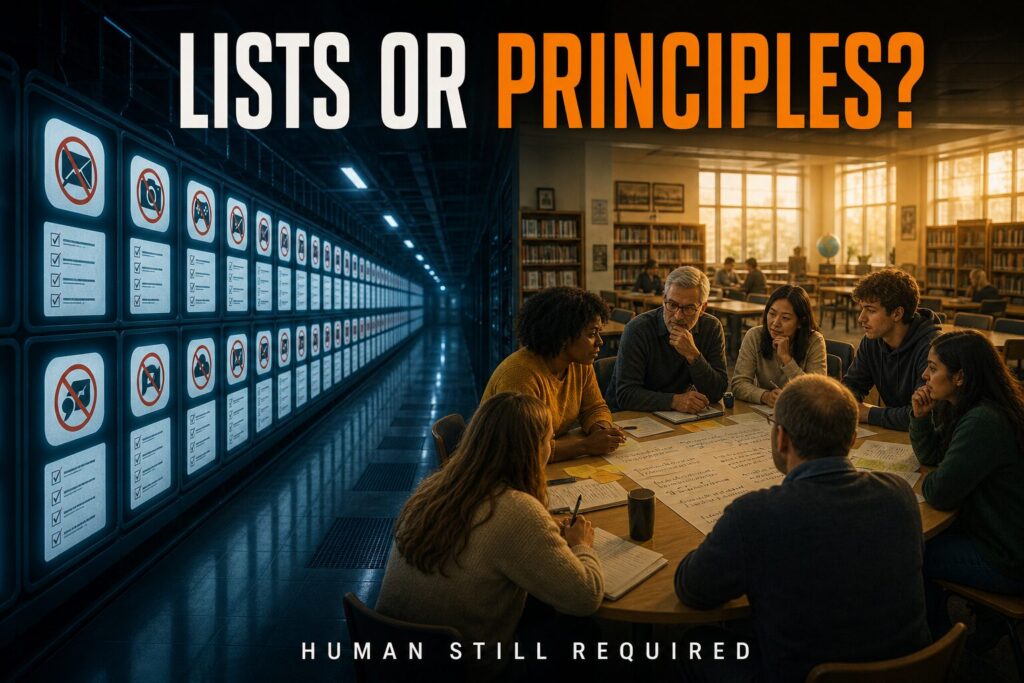
Two stories landed on the same day this week, and together they show the choice every district is making about school AI guidance. One district answered the question with a list of tools. The other answered it with a set of principles.
Both are trying to protect students. Both are taking AI seriously. But only one of them gives a teacher something to think with on a Tuesday afternoon when a new tool shows up that nobody has reviewed yet.
A list tells people what to avoid. Principles tell people how to decide.
Key takeaways
- A list of approved or banned AI tools answers “which tools” but not “what matters,” and it goes out of date as fast as products change.
- School AI guidance works best when it is built on a few clear principles that teachers and students can apply to tools no one has reviewed yet.
- When the criteria behind a decision are not explained, even a cautious decision costs trust with staff, families and vendors.
- Principles only work if leaders invest in the shared thinking behind them, which is professional learning, not a memo.
What’s happening
On October 23, Chalkbeat New York reporters Alex Zimmerman and Michael Elsen-Rooney published the list behind one of the year’s biggest AI decisions: the 38-plus AI tools New York City barred in its schools. Days before the school year began, Mayor Zohran Mamdani announced the city would disable the AI components of more than 38 previously allowed programs, but the city did not name them. Chalkbeat obtained the Education Department’s list after more than a month of requests.
The list includes widely used reading and math programs, student assessment tools and a chatbot the department built itself with Microsoft, which had been deployed in six schools last year. Amira, an AI reading tutor used in more than 200 city schools, was banned outright because officials said it cannot function without AI. The department says the restrictions target student-facing generative AI features, not necessarily whole products, and it is working case by case with companies. Some companies have already turned off their AI features and been approved to keep operating. Magma Math, for example, turned off its AI hints on September 4 and was approved to continue on October 5.
Several companies told Chalkbeat their products do not use the prohibited kind of AI and that they were unsure why they were flagged. According to Chalkbeat, the department did not explain how it determined which tools met its definition, including in cases where companies disputed it. Critic Leonie Haimson offered the other side of the worry: “You cannot trust the companies that they’re not using student-facing AI.”
The same day, GovTech republished a Detroit News story by Jennifer Pignolet on how Northville Public Schools in Michigan balances AI with other critical skills. A task force led by Assistant Superintendent of Instruction Emily Pohlonski spent last school year developing AI guidance, with students at the table. The result was four guiding principles, including “amplify human intelligence, not replace it.” The district considered a red-yellow-green “stoplight” system for AI use and rejected it after senior Malik Hadjit, a task force member, said it could be confusing across different classes.
In Northville classrooms, that looks like a 10th-grade English discussion with no phones, laptops or AI, teachers moving some work into class, and assignments where students write answers by hand and then compare them with AI responses. Instructional technology coordinator Jen Lawson sums up her approach as “Human in, human out.” The article also reports that in Oakland County, 22 of 28 districts have an AI task force, 19 have guidance and 13 have board-adopted policies, according to Justin Bruno, director of AI strategy for Oakland Schools.
Why school AI guidance needs principles, not just lists
I want to be fair to New York. Pausing student-facing AI while you sort out safety and oversight is a defensible call. Caution is not the problem. A list is not the problem either. Every district needs to know which tools are approved and which are not.
The problem is when the list becomes the guidance.
In Chapter 3 of Human Still Required, “The Illusion of Control,” I argue that restrictions often feel responsible because they are visible and certain. You can point to them. You can enforce them. But a list does not build understanding or judgment in the people who have to live with it. It ages the moment a vendor ships an update. And it leaves every teacher with the same question the companies in the Chalkbeat story are asking: why this tool and not that one?
Certainty is not clarity.
Human Still Required
A banned-tools list is certain. But if the criteria behind it are not explained, it is not clear. And when people cannot see the reasoning, they fill the gap themselves. Vendors feel blindsided. Teachers who built routines around a tool feel second-guessed. Families hear about it secondhand. That is how a cautious decision ends up costing trust it did not need to spend.
Northville’s approach starts from the other end. Instead of asking “Which tools?” it asked “What matters?” A principle like “amplify human intelligence, not replace it” travels. A teacher can hold it up against a tool released next month. A student can hold it up against their own choice at 10 p.m. the night before an essay is due. That is what I mean in the book when I say judgment scales and control does not.
Notice, too, why Northville dropped the stoplight system. A student pointed out it would be confusing across different classes. That is a real insight. Color codes look consistent on paper, but they ask every teacher to interpret the same color their own way. What students need is not identical rules in every room. It is a shared way of thinking about AI that shows up in every room. In Chapter 12, I describe that shift directly: the goal is no longer consistency of practice, it is consistency of thinking.
The scaffold is not the destination
One line from the Michigan story stuck with me. Bruno described the AI learning tools many Oakland County districts have adopted as “AI with training wheels.” I think that is exactly right, and it connects to Chapter 5, where I describe AI as a thinking scaffold, not a thinking replacement.
Training wheels are useful. They are also temporary by design.
The goal was never the scaffold. The goal was independence.
Human Still Required
That applies to guidance as much as to tools. A list is a scaffold for leaders. It buys time while a district figures out what it believes. That is fine. But if the list is still the whole plan two years from now, students will have learned what they are not allowed to use. They will not have learned how to decide what is worth using, which is the skill they will need the day they leave our buildings, where there is no list.
What leaders can do now
- Publish the criteria, not just the decisions. If your district keeps an approved or restricted tools list, put the reasons next to it in plain language. “Restricted because it gives students open-ended generative responses without teacher oversight” teaches people something. A name on a list does not.
- Write three to five principles before you write rules. Ask your leadership team, “What must stay human here?” Test each principle against a tool nobody has reviewed yet. If it does not help someone decide, rewrite it.
- Put students on the task force. Northville’s student member caught a design flaw adults missed. Students are the ones who have to apply your guidance across six different classrooms a day.
- Treat guidance as professional learning. Principles only work when staff have practiced using them together. Bring a real tool to a staff meeting and have teams reason through it out loud using your principles.
- Set a review date for any list. If you pause or restrict tools, say when and how you will revisit the decision, and who gets a voice when you do.
If your team wants to work through these questions together, the 5-Week Book Study is built for exactly this kind of shared thinking.
Frequently asked questions
Should our district have a list of approved AI tools?
Yes, most districts need one for privacy, contracts and safety. The mistake is treating the list as the whole of your school AI guidance. Pair it with a few clear principles and explain the criteria behind every decision on it.
What should school AI guidance principles include?
Strong principles name what must remain human, such as judgment, feedback and relationships, and what AI may support, such as drafting, practice and routine tasks. Northville’s “amplify human intelligence, not replace it” is a good example of a principle that applies to any tool. Keep the list short enough that a student could repeat it.
How do we keep AI rules consistent across classrooms?
Aim for consistent reasoning rather than identical rules. Teachers will have good reasons to allow different uses in different courses. What students need is the same set of questions in every room: Who did the thinking? Does this help me learn or just help me finish?
The list is the easy part
Any district can produce a list. It is quick, it is visible and it feels like action. The harder work is building a shared way of deciding that holds up when the tools change, which they will, again and again.
Lists protect students for a semester. Principles, practiced together, protect them for a career.
So here is my question for you: if every tool on your district’s list disappeared tomorrow, would your teachers and students still know how to decide?
Sources
- NYC barred 38 AI tools in schools. Some companies say their products shouldn’t be on the list. — Chalkbeat New York, October 23, 2026
- How Northville, Mich., Schools Balance AI With Other Critical Skills — The Detroit News, via GovTech, October 23, 2026