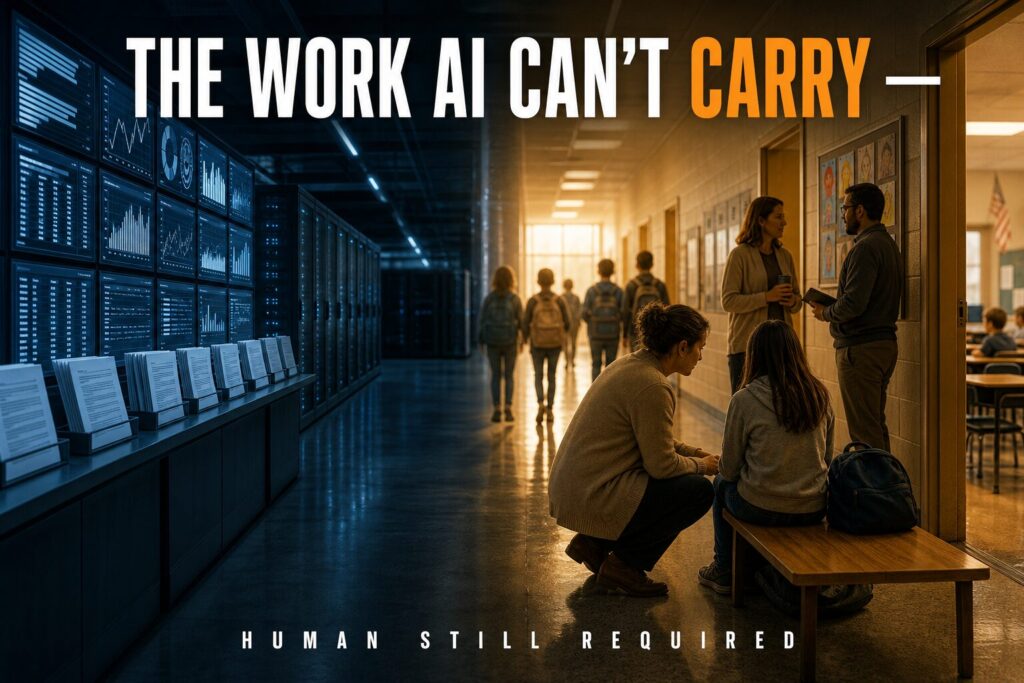
Here is a number every school leader should sit with this week: teachers spend about eight hours a week supporting student well-being. That is roughly a full school day, every week, spent checking in, noticing, listening and connecting kids to help.
We spend a lot of energy right now asking what AI can take off a teacher’s plate. That is a fair question. But this new research points to a harder one. What is on the plate that no machine can carry, and who is helping teachers carry it?
Because right now, too often, the answer is nobody.
Key takeaways
- A new RAND survey finds K-12 teachers spend about eight hours a week, roughly 17% of their working time, supporting student well-being.
- Half of teachers say that work has gotten harder since fall 2024, and those teachers report more stress and burnout.
- Student well-being support is relationship work. AI can help clear the paper around it, but it cannot do it.
- Leaders should test every AI use by what it might weaken, and build systems so teachers do not carry student well-being alone.
What’s happening
On October 21, RAND released Difficulty Supporting Student Mental Health Strains Teacher Well-Being, the latest findings from its 2026 State of the American Teacher Survey. Researchers Ashley Woo, Elizabeth D. Steiner and Sy Doan surveyed a nationally representative sample of 829 K-12 public school teachers in January and February 2026. The analysis was sponsored by the National Education Association and the American Federation of Teachers.
According to RAND’s summary of the findings, nearly all teachers provided at least one mental health or well-being support during the 2025-26 school year. They spent about eight hours a week on student behavior or mental health supports, about 17% of their working hours. More than 90% said their school faced at least one student well-being challenge, and half said providing support had become harder since fall 2024.
That last finding matters. Teachers who said the work had gotten harder were more likely to report job-related stress, difficulty coping, symptoms of depression and burnout. Among teachers who frequently provided more support, 62% reported high emotional costs from teaching, compared with 38% of teachers who did not.
K-12 Dive’s coverage of the report, published October 23, adds detail about what this work actually looks like. The most common supports are checking in on students, fostering empathy and peer relationships, and collaborating with school counselors or social workers. About two of those eight hours fall outside regular contract hours. And 77% of high school teachers cited student apathy as a challenge, compared with 57% of elementary teachers.
The same week, The 74 ran an op-ed by Amy McGrath of ASU Prep and John Bailey of the American Enterprise Institute arguing that educators need to use AI in their own work now. Their line is a good one: “You cannot govern what you have not used.” They describe how ASU Prep reviewed 22 staff ideas for AI in one year and moved six into use, and how the network weighs any AI proposal with three questions: what it makes easier, what it improves, and what it might weaken or damage. They also name a real tradeoff. AI can reduce human interaction if it is overused for feedback.
Put those pieces side by side and a picture comes into focus.
Why student well-being is the work AI can’t do
Look at that list of supports again. Checking in. Building empathy between kids. Working with the counselor down the hall. None of that is paperwork. All of it is relationship.
In Chapter 8 of Human Still Required, I argue that relationships are the real work of schools, not the extra work. AI scales information. Trust does not scale. A student who is struggling does not open up because the message was clear. They open up because an adult they know noticed.
Relationships aren’t a ‘soft skill.’ They’re the infrastructure everything else runs on.
Human Still Required
RAND’s numbers make that infrastructure visible. It is eight hours a week. It is 17% of a teacher’s working time. And for many teachers, it is getting heavier.
Chapter 9 goes one step further. Trust is built in the margins: the hallway conversation, the two minutes after class, the follow-up text to a family. Notice where some of this work is happening. About two hours of it fall outside contract time. That is the margin. Teachers are building trust there, often on their own time, and it is costing them.
AI can help leaders be available. It cannot help leaders be felt.
Human Still Required
The same is true for teachers. A chatbot can be available at midnight. Only a person can be felt. And only a person can be accountable for what happens next.
This is where I want leaders to be careful. When we talk about AI and teacher workload, it is easy to slide into a simple trade: AI saves time, teachers get the time back, problem solved. But this research is not mainly a time story. It is a weight story. RAND’s researchers are clear that teachers need resources and partnerships. As Ashley Woo put it, they need help meeting students’ needs “without carrying the responsibility alone.”
AI does not solve that. Leadership does.
What this reveals about how we use AI
I like the three-question test from the ASU Prep op-ed because it asks the question most AI rollouts skip. Not only what does this make easier, but what might it weaken?
In Chapter 4, I lay out the SAFE framework for what AI should handle: tasks that are Structured, Administrative, First-draft and Easily repeatable. Scheduling a referral. Drafting the first version of a family update for a human to revise and send. Summarizing notes before a student support team meeting. That is the paper around well-being work. Let the machine help with it.
But the check-in itself is not SAFE work. Neither is the decision about whether a student needs a referral, or the conversation with a parent who is scared. If an AI rollout quietly moves any of that from a person to a tool, it fails the third question, no matter how much time it saves.
The machine prepares the paper. The humans do the relationship work.
Human Still Required
There is a second lesson here. McGrath and Bailey are right that leaders need to use these tools to govern them well. I would add this: leaders also need to be close enough to the human work to see what the tools might crowd out. You cannot protect what you have not noticed.
What leaders can do now
- Name the work. Put student well-being support on the agenda at your next staff meeting as real work, not invisible work. Ask teachers where those eight hours go in your building and which parts feel heaviest.
- Look at the margins. Ask how much of this work is happening outside contract time. Then ask what you can take off teachers’ plates, through AI or through plain old reprioritizing, so more of it can happen inside the day.
- Add the third question to every AI decision. Before approving a tool, ask what it makes easier, what it improves, and what it might weaken. If the answer includes time with students, slow down.
- Point AI at the paper, not the people. Use AI for scheduling, first drafts and summaries that support student support teams. Keep check-ins, referral decisions and family conversations with people.
- Build the system so no one carries it alone. RAND recommends wraparound services and community partnerships. Map who teachers can hand off to today, and where the gaps are. That map is a leadership responsibility, not a teacher one.
If your team wants to work through these questions together, the 5-Week Book Study walks through Chapters 8 and 9 with prompts built for leadership teams.
Frequently asked questions
How much time do teachers spend on student well-being?
According to RAND’s 2026 State of the American Teacher Survey, released October 21, 2026, teachers spend about eight hours a week on student behavior or mental health supports. That is about 17% of their working hours. K-12 Dive reported that about two of those hours fall outside regular contract time.
Can AI help teachers support student well-being?
AI can help with the administrative work around well-being support, such as scheduling, drafting communications for a human to review, and summarizing notes. It cannot do the relationship work itself: noticing, checking in, and deciding what a student needs. Leaders should keep those human.
What can school leaders do about teacher burnout from student support work?
Start by naming the work and asking teachers where it is heaviest. RAND’s researchers recommend wraparound services, community schools and partnerships with community organizations so teachers are not carrying student needs alone. Leaders can also use AI to lighten administrative load, as long as it does not cut into time with students.
The question that matters
This research does not say teachers should do less caring. It says they are doing a great deal of it, and too much of it alone.
AI can take some of the paper. It cannot take the weight. That part is ours to share, and it is leaders who decide whether the system shares it or leaves it on one teacher’s shoulders.
So here is my question for you this week: in your school, who helps the teachers who are helping the kids?
Sources
- Difficulty Supporting Student Mental Health Strains Teacher Well-Being: Findings from the 2026 State of the American Teacher Survey — RAND Corporation, October 21, 2026
- Teachers Spend Eight Hours a Week Supporting Student Well-Being — RAND Corporation (news release), October 21, 2026
- Teachers spend about 8 hours per week on student well-being — K-12 Dive, October 23, 2026
- Educators Need to Engage With AI in Order to Learn the Best Ways to Use It — The 74, October 23, 2026