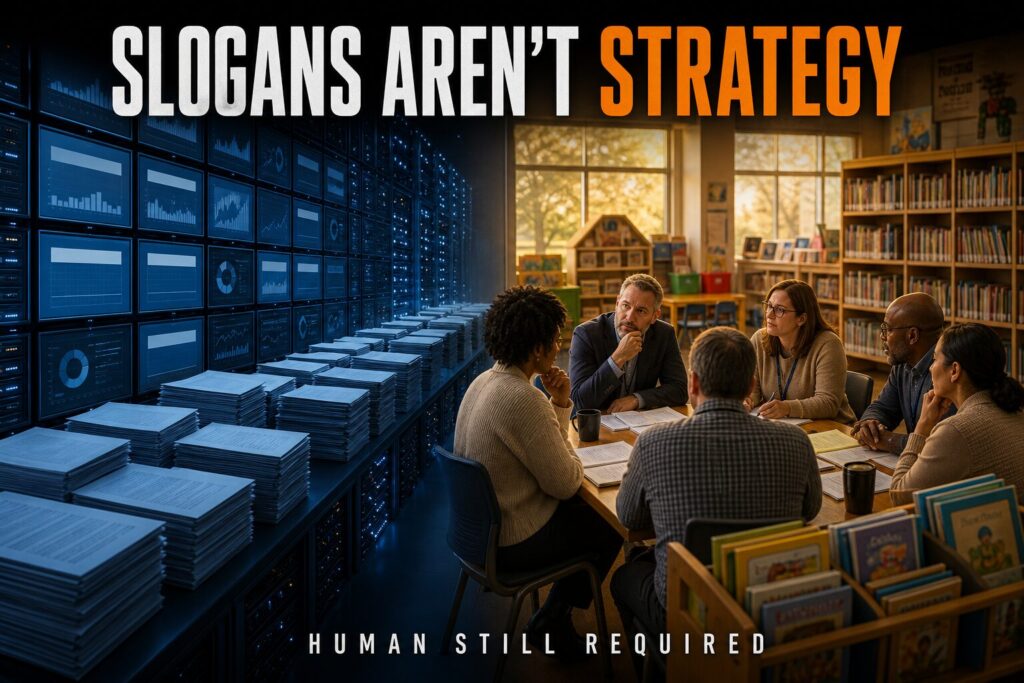
The ed-tech backlash in schools has officially become a campaign issue. Governors, gubernatorial candidates and school board hopefuls are now running on screen time and AI in classrooms. Some promise bans. Some promise guardrails. Almost all of them promise to do something.
I understand why. Parents are worried, and many of their worries are fair. But here is what concerns me as someone who has spent 27 years watching schools adopt and abandon technology: when a decision becomes a slogan, it stops being a decision. It becomes a position.
School leaders don’t get to lead by position. We have to lead by judgment. And this week gave us a clear example of what happens when a blunt rule meets real students.
Key takeaways
- The ed-tech backlash is now bipartisan campaign material: candidates from both parties are criticizing screen time and AI in schools, according to Chalkbeat.
- Blanket rules are easy to announce and hard to live with. Fairfax County’s kindergarten device restriction quickly needed an exception for students who need extra reading support.
- The better response is not a ban or a defense of everything. It is a tool-by-tool review of what each app costs, what it does for learning and who it serves.
- Leaders who can explain why each tool is in their schools will be in a far stronger position than leaders reacting to whatever the politics demand next.
What’s happening with the ed-tech backlash
On October 26, Chalkbeat national reporter Lily Altavena reported that the ed-tech backlash is showing up in the 2026 midterm elections, and that neither party has claimed it yet. In California, Republican gubernatorial candidate Steve Hilton has said he would ban AI in California schools on day one. In Texas, Democratic candidate Gina Hinojosa opposes AI use by elementary students, while Gov. Greg Abbott told a Moms for Liberty event that the state would be “eliminating and reducing screen time in classrooms for students.” Florida Gov. Ron DeSantis, meanwhile, supports “responsible AI” in classrooms with state guardrails.
The policy landscape is moving just as fast. According to the article, at least 13 states have passed laws on AI in education, about three-quarters have issued guidance to districts, and at least six states have enacted screen time legislation this year. The pressure reaches down to school board races too. In San Francisco, all but one of eight board candidates said they would support a policy limiting classroom technology and screen time.
AFT President Randi Weingarten summed up the odd coalition this way: “You have Moms for Liberty and AFT on the same side of screen time.”
Six days earlier, FFXnow reported on how the Fairfax County School Board is reworking its kindergarten technology policy. In July, the board barred issuing devices to pre-K and kindergarten students, with exceptions for students with IEPs, 504 plans, translation needs or multilingual education support. Then reality arrived. Lexia, a state-approved literacy program, is one way to provide the 2.5 weekly hours of additional reading support some kindergartners need. The district already covers about half that time with dedicated teacher support, but the budget has no money for more staff-led time.
So on October 8, in an 8-4 vote, the board approved an exception allowing kindergartners who need extra reading support to use Lexia this year. FFXnow reported that about 30% of kindergartners are affected. The board also directed Superintendent Michelle Reid to create an opt-out policy for Lexia and ST Math, and it voted unanimously to have her review the cost and instructional effectiveness of Lexia and all other instructional apps and software. One board member, Melanie Meren, asked the board to “slow down” and prioritize AI and tech policies.
What this reveals for school leaders
Put these two stories side by side and you see the pattern. At the top, the conversation is about broad positions: ban it, limit it, protect it. On the ground, the conversation is about a specific five-year-old who needs reading support and a budget that can’t hire another adult to give it.
That gap is where school leadership lives.
In the Introduction to Human Still Required, I wrote that this moment calls for something specific:
This moment requires neither panic nor passivity, but clarity, courage, and thoughtful restraint.
Human Still Required
A campaign promise to ban AI on day one is not restraint. Neither is a district that keeps buying apps because no one has asked whether they work. Both skip the hard part, which is deciding, tool by tool, what earns a place in front of students.
Fairfax’s decision to review the cost and instructional effectiveness of its software is the more interesting headline here. That is the work. In Chapter 14, I argue that many school systems carry practices forward simply because they exist. I suggest leaders put three questions to any compliance-driven practice: Who is this for? What decision does this inform? What would happen if this didn’t exist? Those same questions work just as well on an app library. Every tool in your district should be able to answer them.
Chapter 14 also makes a point that fits this political moment almost exactly:
AI doesn’t demand reckless change. It demands honest change.
Human Still Required
Honest change means admitting that some ed tech was adopted for convenience, not learning. It also means admitting that some of it does real work for kids who need it, which is exactly what Fairfax’s board discovered when its rule collided with reading intervention.
In Chapter 10, I describe a mindset I call balance over extremes. The new leadership skill isn’t knowing every tool. It is discernment: deciding what matters when everything looks important. One question from that chapter belongs in every board meeting about technology this fall:
What are we optimizing for here?
Human Still Required
The companion question in that chapter asks who benefits from a decision and who bears its cost. A ban can make adults feel better. If it quietly removes support from the students who need it most, those students bear the cost. A board member in Fairfax raised a related worry about the opt-out policy itself widening gaps. That is the kind of question that deserves time before a vote, not after.
What leaders can do now
- Inventory before you react. List every instructional app and AI tool in use, by grade level. You can’t defend or cut what you can’t see.
- Give every tool a purpose statement. For each one, write a sentence: what learning it supports, for which students, and what evidence you have that it helps. If no one can write that sentence, that’s your answer.
- Ask who loses before you limit. Before any blanket restriction, check who relies on the tool: students with IEPs or 504 plans, multilingual learners, students in intervention. Build exceptions into the design instead of discovering them after the vote.
- Separate the tool from the screen. Screen time, AI and instructional software are three different questions. Parents deserve a clear answer on each, not one rule that tries to cover all three.
- Get ahead of the campaign cycle. Brief your board and family groups now on what you use, why, and how you review it. If you explain your reasoning before the politics arrive, you’re far less likely to have a policy handed to you.
If your leadership team wants a structured way to work through these questions together, the Human Still Required leadership guide is a good starting point.
Frequently asked questions
What is the ed-tech backlash in schools?
It is growing pushback from parents, advocates and now political candidates against screen time, AI and digital programs in K-12 classrooms. Chalkbeat reported in October 2026 that candidates from both parties are campaigning on it. Many states have already passed AI or screen time laws.
Should our district ban AI to respond to parent concerns?
A blanket ban is easy to announce but often creates problems no one planned for, as Fairfax County found when its kindergarten device rule affected reading support. A stronger approach is to review each tool for purpose, cost and evidence, set age-appropriate limits and explain your reasoning to families.
How do school leaders decide which ed tech to keep?
Start with the purpose: what learning does the tool support, and for whom? Then look at cost, evidence of effectiveness and who would be affected if it went away. Tools that can’t answer those questions are good candidates to cut. Tools that serve specific students well deserve protection and a clear explanation.
The work behind the headlines
The politics of ed tech will keep getting louder through November and beyond. Some of that pressure is healthy. It is forcing a conversation many schools should have had years ago.
But a slogan can’t tell you which kindergartner needs reading support. Only people who know that child can. That is why this decision can’t be outsourced to a campaign, and it can’t be left on autopilot either.
So here’s my question for you: if a parent asked you tomorrow why each tool in your schools is there, could you answer?
Sources
- As midterm elections loom, the ed-tech backlash isn’t a Republican or Democratic issue — yet — Chalkbeat, October 26, 2026
- Fairfax school board refines policy limiting kindergarten tech use, orders app reviews — FFXnow, October 20, 2026