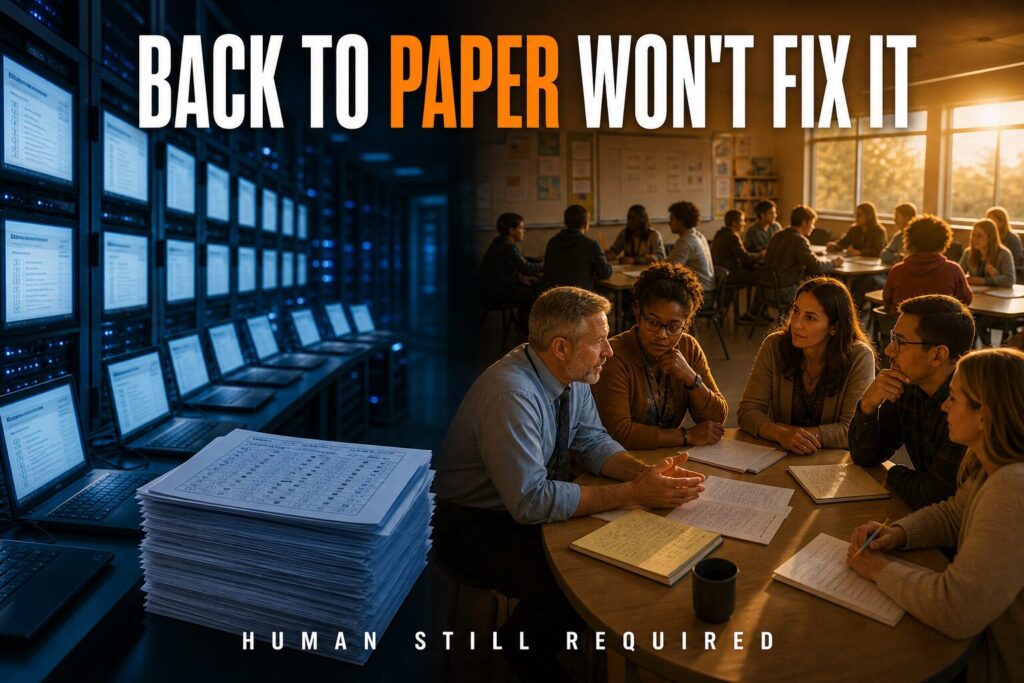
This week, a Maryland school board voted to ban student use of AI from pre-K through 12th grade. The same week, more than half of New York City’s council members asked the state to bring back paper-and-pencil standardized tests. A school AI ban and a push for paper tests are different decisions, made for different reasons. But they share an instinct I understand completely: when the ground keeps shifting, go back to what feels solid.
I don’t think that instinct is wrong. I think it’s incomplete.
Paper can slow things down. It can’t answer the question AI is actually asking schools.
Key takeaways
- Frederick County Public Schools in Maryland voted 6-1 to ban student AI use in every grade, citing cheating and students relying on the technology instead of building critical thinking.
- In New York City, a push to return grades 3-8 state tests to paper reflects a wider backlash against screens, AI and other ed tech.
- Bans and paper can buy time. They don’t redesign the work, and AI exposed a design problem, not a digital one.
- The leadership job is to name what students must still do themselves, then build assignments and assessments that make that thinking visible.
What’s happening: a ban in Maryland, a paper push in New York
On October 8, FOX 5 DC reported that the Frederick County School Board voted 6-1 to ban student AI use from pre-K through 12th grade. The board first considered limiting the ban to younger students, then extended it through high school. FOX 5 DC called it one of the strictest student technology restrictions in the DMV region. It also reverses course only weeks after the district began piloting Google’s Gemini with middle and high school students.
The concerns behind the vote are ones every leader I know shares: cheating, and students leaning on the technology instead of building critical thinking skills. The policy is not absolute. According to the report, it includes exceptions for specific classroom lessons, such as instruction about AI itself, and accommodations for students with disabilities. District leaders had not yet determined how the ban will be enforced or how those exceptions will work in classrooms.
Two other details stood out to me. The local teachers union president, Justin Heid, told FOX 5 DC, “We have not received many messages from educators about artificial intelligence in the classroom,” and reported that several educators are returning to traditional paper-and-pencil assignments because of worries about AI use. And the lone dissenting board member opposed the ban out of concern that limiting AI access could leave older students less prepared for college.
A day later, on October 9, Chalkbeat New York reported that state officials are considering a request to let New York City schools return to paper state tests in grades 3-8. Council Member Eric Dinowitz sent the letter, signed by more than half the City Council, to State Education Commissioner Betty Rosa. Chalkbeat’s Alex Zimmerman notes that the state only fully moved to digital exams in spring 2026, and that the broader backlash to artificial intelligence and other ed tech tools has intensified the debate. State officials, for their part, argue digital tests are more convenient, score faster and adapt to students’ skill levels.
Two places. Two decisions. One direction of travel: back toward paper.
What a school AI ban can and can’t do
Let me be fair to the Frederick County board. Its concerns are real. In Chapter 5 of Human Still Required, I argue that the deeper risk with AI isn’t cheating at all. It’s atrophy: students, and adults, handing off the thinking they need to build. A board that worries about students relying on AI instead of developing critical thinking is worried about the right thing.
A ban can buy time. It can signal what a community values. It can give teachers breathing room while a policy gets built.
What it can’t do is redesign the work.
In Chapter 2, I write about the pull to outsmart AI by retreating to harder tasks or to paper and pencil. I understand why teachers do it. When you can’t tell who did the thinking, a handwritten in-class essay feels like certainty. But if the assignment itself only asked for a finished product, moving it to paper doesn’t change what it measures. It changes where the product gets made.
AI doesn’t expose a digital problem. It exposes a design problem.
Human Still Required
That line is the heart of it for me. AI made it easy to produce the kind of work many assignments asked for. That’s uncomfortable. It’s also useful information. When a task can be completed by a machine in seconds, it’s worth asking whether that task was ever strong evidence of learning. In Chapter 6, I call this out directly: output is cheap now, and the evidence that still counts is what a student can explain, defend and transfer to a new situation. That’s the thinking behind the D.E.C.I.D.E.R. framework.
None of that requires a screen. A conference, an oral defense, a draft revised in front of a teacher. These are some of the oldest moves in teaching. Done well, they work whether the tools in the room are pencils or chatbots.
Why the pendulum matters for leaders
Here is what concerns me about pendulum swings. A district pilots a tool in September and bans it in October. A state moves fully to digital tests in the spring and considers paper in the fall. Each decision may be defensible on its own. Together, they tell teachers and families that the ground is still moving, and that the next swing is coming.
In Chapter 14, on what schools must change, I make the case that change should happen without panic, in either direction. Rushing in and rushing out are both forms of reacting.
Tradition deserves respect—but not immunity.
Human Still Required
Paper-and-pencil assessment deserves respect. So does a board’s caution. Neither should be immune from the harder question: what do we want students to be able to do, and how will we know they did the thinking?
There is also a quieter signal in the Frederick County story. The union president said the union had not received many messages from educators about AI in the classroom, even as some teachers were quietly moving back to paper. In Chapter 11, I write that fear isn’t the problem in these moments. Silence is. When teachers change practice in response to AI without a shared conversation about why, every classroom ends up solving the same problem alone.
What leaders can do now
Whether your district is tightening AI rules, loosening them or still deciding, these moves hold:
- Name what must stay human before you name what’s banned. Write down, in plain language, the thinking students must do themselves in each grade band. A policy that starts with tools ages fast. A policy that starts with thinking lasts.
- Audit one assignment per department. Ask teams: if AI can complete this in seconds, what was it really measuring? Redesign one task so students must explain, critique or apply their thinking out loud.
- Treat paper as a tool, not a strategy. In-class handwritten work can be a smart choice. Pair it with a reason: what will the teacher learn about student thinking that they couldn’t see before?
- Close the silence gap. If teachers are quietly changing practice because of AI, bring that into the open. Ask staff what they’re seeing and what they’re trying, and share what works across classrooms.
- Plan for the next swing. Build a review date into any AI decision, ban or pilot, and tell families what evidence you’ll look at before changing course.
If your leadership team wants to work through these questions together, the 5-Week Book Study is built for exactly that kind of conversation.
Frequently asked questions
Does a school AI ban stop students from using AI?
A ban controls what happens on school devices and in school assignments. It does not control what students use at home or on personal phones. That’s why many leaders pair any restriction with clear teaching about what students must do themselves and why.
Is returning to paper-and-pencil assignments a good response to AI?
It can be one useful tool, especially for capturing in-class thinking. On its own, it doesn’t change what an assignment measures. The stronger move is redesigning tasks so students explain, defend and revise their thinking, whether on paper or on a screen.
What should a district AI policy focus on first?
Start with the learning, not the tool. Define which thinking must remain human, how teachers will see that thinking, and how decisions will be reviewed as tools change. Tool lists and rules can follow from that foundation.
The question underneath the pendulum
I’m not here to tell any board it voted wrong. I’m here to point at the question a ban, a pilot or a paper test can’t settle on its own.
AI didn’t make student thinking harder to see. It made it obvious when our assignments weren’t asking for it.
So before the next swing, ask your team this: if every screen in your building disappeared tomorrow, would your assignments still show you who did the thinking?
Sources
- Frederick County School Board votes to ban AI use for pre-K through 12th grade students — FOX 5 DC, October 8, 2026
- Could NYC schools return to paper standardized tests? State officials are considering it — Chalkbeat New York, October 9, 2026