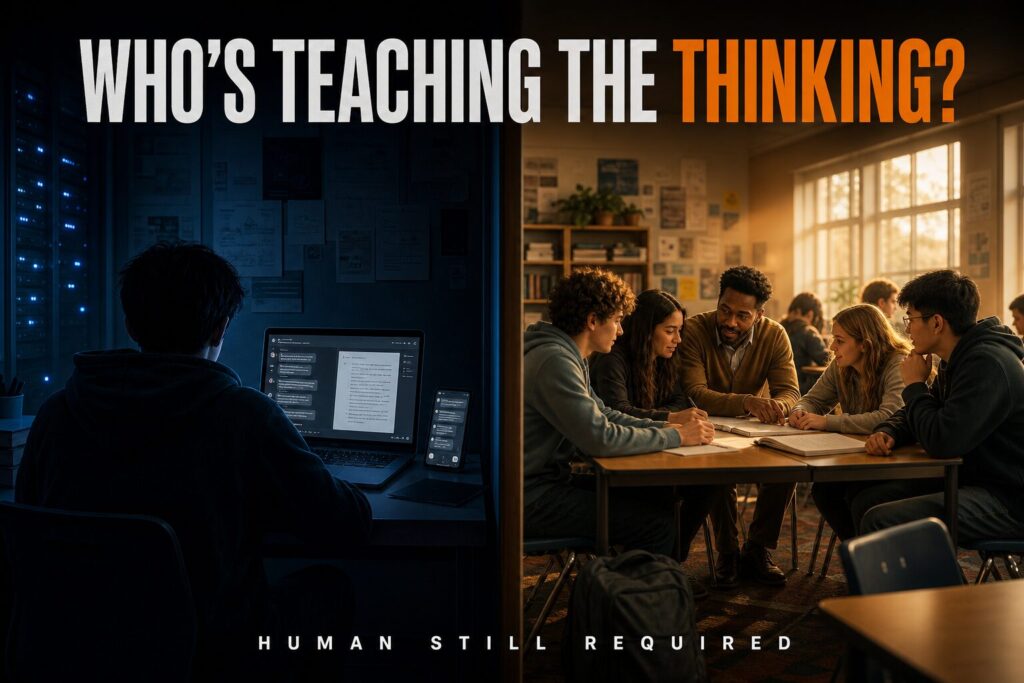
Student AI use is growing whether schools are ready or not. And according to new national survey data, most high school students are learning how AI works the same way many of us learned the internet in the late 1990s: on their own, by trial and error, outside of class.
That’s not a scandal. It’s a signal.
The question for school leaders isn’t whether students will use these tools. They already are. The question is whether anyone at school is teaching them the thinking that has to come with them.
Key takeaways
- Project Tomorrow’s latest Speak Up data shows more high school students learn about AI through independent experimentation (46%) than in class (30%).
- Only 11% of teachers in the same survey said they feel very comfortable letting students use AI resources.
- The real test of student AI use is whether students are getting better at the skill or just getting a better finished product.
- Blocking tools can buy time, but it doesn’t teach judgment. Leaders need a plan for teaching the thinking, not just managing the tools.
What’s happening with student AI use
On October 28, GovTech’s Center for Digital Education reported on Project Tomorrow’s 2025-26 Speak Up National Report, which draws on more than 95,000 K-12 students, parents, educators and administrators at 1,023 schools. A few numbers stood out to me.
- 46% of high school students said they learned about AI through independent experimentation, compared with 30% who said they learned about it in class.
- High school students using AI daily or weekly for studying and research rose from 23% in 2023-24 to 40% in 2025-26. Weekly or daily use for writing and idea generation rose from 21% to 29%.
- Only 11% of teachers said they feel very comfortable allowing students to use AI resources.
- Among high schoolers, 48% wanted lessons tied to real-life situations and 41% wanted teachers to act on student suggestions.
The students who spoke at Project Tomorrow’s webinar weren’t asking for unlimited access. A Pennsylvania senior named Tharun wanted to understand the mechanics: “What happens behind the scenes? Where is AI getting this answer from?” His point was that if students understand where answers come from, they can understand why those answers can be wrong. A Virginia seventh grader, Eloise, described tracing AI answers back to sources and checking them for bias, and she pushed for clear rules that are enforced consistently. The students, in other words, framed this as boundaries and opportunity. Not access versus prohibition.
A day earlier, GovTech republished a Dallas Morning News story by Silas Allen on how Texas schools are trying to enhance, not replace, learning with AI. Districts there are moving at very different speeds. Dallas ISD blocks AI tools for elementary and middle school students, while high schoolers can use AI for research or studying but not to complete tests or assignments. Houston ISD plans to expand its AI-powered model to more campuses, including a Foundations of AI course for high schoolers.
The most useful line in the piece came from Aroutis Foster, dean of American University’s Baker School of Education. He framed the whole issue as one question: “Are they getting better at the skill, or are they getting a better finished product?” His example was simple. A tool that helps a student find the flaw in their own math reasoning builds skill. A tool that just hands over the solution produces a correct answer and no learning.
What this reveals for school leaders
Put those two stories side by side and you see the gap. Students are experimenting. Many teachers aren’t yet comfortable guiding that experimentation. And districts are making very different calls about access. In between, a lot of students are figuring out on their own what “good use” looks like.
In Chapter 1 of Human Still Required, I argue that AI didn’t break school. It exposed what was already fragile. One of the things it exposes is how often we measured the product and assumed the learning.
AI exposes the difference between activity and learning.
Human Still Required
Foster’s question is that line in practice. A polished essay, a correct answer, a clean slide deck are all activity. Whether the student got better at reasoning, writing or problem-solving is the learning. When students are teaching themselves AI, the default they land on is usually the fastest route to a finished product. That’s not a character flaw. It’s what any of us would do when the system rewards completion.
Chapter 5 is where this gets practical. The book’s position is that AI should work as a thinking scaffold, not a thinking replacement. Scaffolds help students generate questions, test counter-arguments, explore options and reflect. They’re also temporary by design.
The goal was never the scaffold. The goal was independence.
Human Still Required
Notice what Kennedy, a California eighth grader in the Speak Up webinar, described doing: using AI to rephrase hard concepts and comparing its math solutions with her own work. That’s a scaffold. Notice what Tharun asked for: understanding why answers can be wrong. That’s the beginning of judgment. Students can get there. Some already are. The issue is that right now it depends on which student, which teacher, and which district.
That 11% teacher comfort number matters here too. In Chapter 12, I make the case that tool-centered training doesn’t build adaptive professionals. Teachers don’t need another walkthrough of features. They need room to practice the thinking themselves, with colleagues, before they’re asked to guide students through it. Chapter 5 says it plainly:
If adults outsource their thinking, students will too.
Human Still Required
What leaders can do now
- Ask students how they learned AI. Survey or hold a short listening session with a few classes. If your students look like the national numbers, most of what they know came from experimentation, not instruction. Find out what habits they’ve built.
- Use the “skill or product” test. Put Foster’s question in front of teacher teams when they design AI-allowed tasks: will this help students get better at the skill, or just get a better finished product? Redesign the tasks that fail the test.
- Teach how the tool works, not just how to use it. Students asked for this directly. Build in short lessons on where AI answers come from, why they can be wrong, and how to check them against sources.
- Close the comfort gap before the access gap. If only a small share of your teachers feel very comfortable guiding student AI use, start there. Give them time to use the tools on their own work and to share what worked with peers.
- Make your boundaries clear and consistent. Whatever your access decision by grade level, students said consistency matters. A rule enforced differently in every classroom teaches students to guess, not to think.
If your leadership team wants to work through these questions together, the 5-Week Book Study is built for exactly that kind of conversation.
Frequently asked questions
How are high school students learning to use AI?
According to Project Tomorrow’s 2025-26 Speak Up National Report, as reported by GovTech, 46% of high school students said they learned about AI through independent experimentation, compared with 30% who learned about it in class. Most students are building habits on their own before schools teach them.
Should our district block AI for younger students?
Some districts, like Dallas ISD, block AI tools for elementary and middle school while allowing limited high school use. Blocking can be a reasonable decision for a given age, but it doesn’t replace teaching. Whatever you decide, pair it with a plan for how and when students will learn to use AI with judgment.
How can teachers tell if AI is helping students learn?
Ask whether the student is getting better at the skill or just producing a better finished product. Have students explain their reasoning, compare their own work to AI output, and find errors in it. If a student can’t explain the work, the tool did the learning.
The thinking still has to be taught
Students are going to learn AI. Many already have. That part is out of our hands.
What’s in our hands is whether they learn it as a shortcut or as a scaffold. Whether they come away with a better product or a better mind. That doesn’t get decided by a filter setting. It gets decided by what leaders choose to teach, model and protect.
So here’s my question for you: if you asked ten of your students tomorrow who taught them to use AI, what would they say?
Sources
- Students Call for AI Literacy, Purposeful Tech Use in Schools, GovTech (Center for Digital Education), October 28, 2026
- How Texas Schools Are Enhancing, Not Replacing, Learning With AI, GovTech / The Dallas Morning News, October 27, 2026