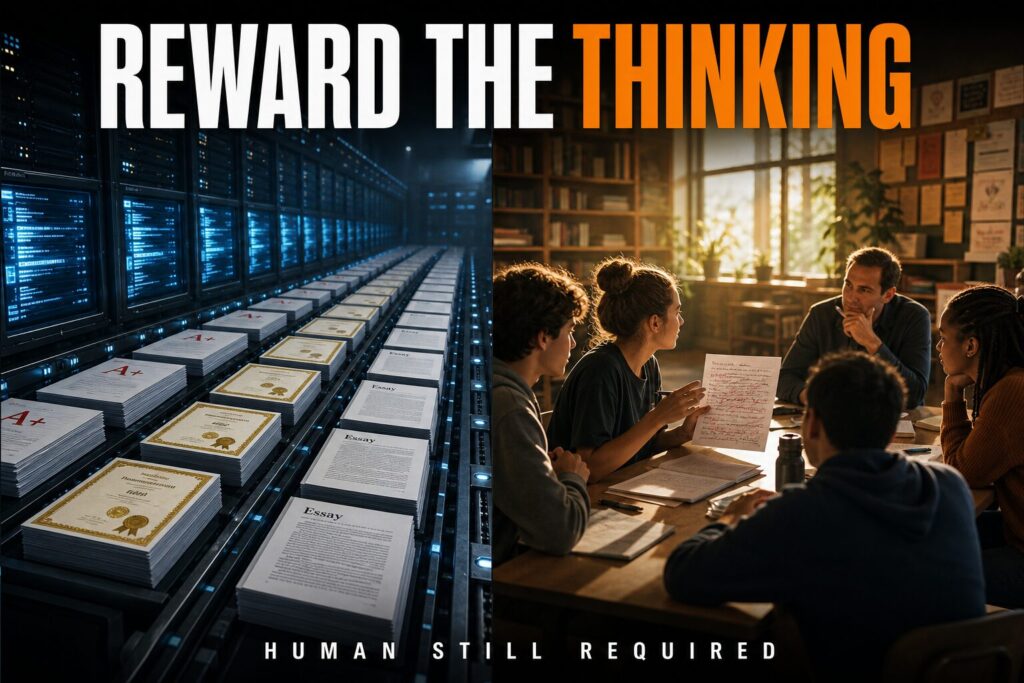
For generations, schools have handed out recognition for finished products: the right answer, the polished essay, the 4.0. The conversation about AI and student achievement keeps circling one uncomfortable fact. A chatbot can now produce most of those products in seconds.
So here is the question I want school leaders sitting with this week. If a machine can produce the thing we reward, what exactly have we been rewarding?
AI didn’t take achievement away from our best students. It exposed how much of what we called achievement was polish.
Key takeaways
- When AI can produce a polished product in seconds, a polished product stops being reliable evidence of achievement.
- Two pieces published this month argue the same thing from different angles: schools need to reward the thinking behind the work, not just the work.
- High-achieving students are not immune. Some are starting to check their own ideas against AI before they trust them.
- Leaders, not individual teachers, need to define what human achievement looks like in their schools when AI is present.
What’s happening: two warnings about how we reward learning
On October 21, EdSurge published an essay by educator Melinda Medina titled “How AI Is Breaking the Way We Reward High-Achieving Students”. She opens with a line every principal should recognize: “For generations, schools have rewarded the correct answer, the polished essay and other finished products of learning.”
Her concern is not the struggling student. It is the student who already has the A. She describes students checking AI to confirm whether their own interpretations are right, trusting AI-polished wording over their own ideas, and shrugging at questions before going straight to a chatbot. She cites an August 2026 Common Sense Media survey in which 70% of U.S. teens reported using AI for schoolwork, and among teens who use AI, 38% said its availability leads them to generate fewer ideas of their own.
Her proposal is direct. Assess the thinking, not just the product. Ask students how they reached a conclusion, which sources changed their mind, and where they rejected an AI suggestion. One line from her piece stuck with me: “Let me see you change your mind.” And she puts the responsibility where it belongs, writing that “Schools and districts need shared language about what human achievement looks like when AI is present.”
A week earlier, on October 15, Forbes contributor Ray Ravaglia published “AI In Education Is Forcing Schools To Explain Why Learning Matters”. He uses a weightlifting comparison: the benefit comes from the lifting, not from the weight ending up overhead. He interviewed Leah Belsky, OpenAI’s vice president of education, who described AI as “almost like a curiosity amplifier” and warned that “there is a real risk out there in the world that AI could enfeeble the next generation.” Belsky also said that motivation and curiosity are, right now, “very distinctly human abilities.”
Ravaglia also describes a Duke Fuqua accounting course where unrestricted AI use led teams to split up the work and meet less, while still turning in polished projects. When the professor, Scott Dyreng, analyzed recorded team meetings, he found that “Students used the vocabulary of the framework, but very few of them actually understood the framework deeply.” That is a university example, not a K-12 one. But every high school teacher I know has seen the same pattern. Polished output. Thin understanding.
Two different writers. One a classroom educator, one a Forbes contributor. Same conclusion: the product is no longer the proof.
What AI and student achievement reveal about our systems
In Chapter 14 of Human Still Required, I write about the grading systems schools must change, including systems that confuse precision with learning. One sentence from that chapter keeps coming back to me:
Grades were never meant to carry this much weight.
Human Still Required
Think about everything we stack on top of a grade. Honor roll. Class rank. Valedictorian. Scholarships. Advanced course placement. Every one of those rewards was built on the assumption that a finished product was a fair signal of the thinking behind it. That assumption was always shaky. AI just made it impossible to ignore.
This is why I keep saying that AI didn’t break school. It exposed it. The high-achieving students Medina describes did exactly what our systems taught them to do. They learned that the polished product is what earns recognition. Now a tool offers that polish on demand, and some of them are no longer sure their own thinking is good enough. That is not a student failure. That is a design outcome.
Chapter 6 makes the same point from the assessment side:
Output is cheap now. Insight is not.
Human Still Required
That chapter introduces the D.E.C.I.D.E.R. framework for what still counts as evidence of learning: Decision-making, Explanation, Critique, Inference, Development, Evaluation and Relocation, meaning transfer to new contexts. Look at Medina’s list of what she wants to see from students. How did you arrive here? What changed your thinking? Where did you reject the AI? Defend your conclusion. That is Explanation, Critique, Development and Evaluation. It is already a practical rubric for what achievement can mean now.
There is a human side to this too. In Chapter 11, I write about the questions students are quietly asking in this moment, including whether effort still matters. When a tool can produce an A-level essay, a student who has built their identity around being the one who writes A-level essays is going to wonder where they fit. Leaders should not dismiss that. It is a real question, and silence will not answer it.
And this is where Belsky’s point matters most. If curiosity and motivation are distinctly human, then no tool will solve this for us. A teacher who sits next to a student and says, in the words of Chapter 13, “Here’s what I noticed about your thinking,” is doing work the machine can’t. That kind of feedback is how students learn that their thinking is the thing we value.
What leaders can do now
- Audit what you reward. List every honor, award and recognition your school gives. Next to each one, ask: could AI produce the evidence we use to award this? If the answer is yes, that is diagnostic data, not a crisis.
- Write shared language for human achievement. Medina is right that this cannot be left to individual teachers. Bring a team together and draft a one-page description of what achievement looks like in your school when AI is present. Use D.E.C.I.D.E.R. as a starting point if it helps.
- Make thinking visible in at least one recognized task. Choose one assignment that feeds an honor or a grade that matters and add a conversation: a short conference, an oral defense or a revision discussion where students explain what changed and why.
- Talk to your high achievers. Ask a small group of strong students how AI is changing how they feel about their own work. Listen more than you talk. Their answers will tell you more than any policy draft.
- Protect feedback time. If AI is saving teachers time on drafting and paperwork, be explicit that some of that time goes to the human feedback that tells students their thinking counts.
If your leadership team wants to work through these questions together, the 5-Week Book Study is built for exactly this kind of conversation.
Frequently asked questions
How is AI affecting student achievement in K-12 schools?
AI can now produce many of the finished products schools have used as evidence of achievement, such as polished essays and correct answers. That makes those products less reliable as proof of learning. Some educators also report that strong students are starting to check their own ideas against AI before trusting them.
Should schools stop rewarding grades and GPA because of AI?
No. But leaders should look honestly at how much weight grades carry and what evidence sits underneath them. Adding visible thinking, such as conferences, oral explanation and revision discussions, makes grades and honors more meaningful, not less.
What should count as achievement when students can use AI?
Evidence that a student did the thinking: explaining a conclusion, critiquing a source or an AI response, revising an argument and transferring an idea to a new context. In Human Still Required, the D.E.C.I.D.E.R. framework names seven of these signals.
The work only humans can reward
I don’t think the answer is to protect our high achievers from AI. I think the answer is to be honest with them about what achievement means now. Curiosity. Judgment. The willingness to be wrong and change your mind in front of someone.
Those were always the things we hoped our grades were measuring. Now we have to measure them on purpose.
So, here is my question for you: if you removed every finished product from your school’s honor roll criteria, what evidence of real achievement would be left?
Sources
- How AI Is Breaking the Way We Reward High-Achieving Students, EdSurge (Melinda Medina), October 21, 2026
- AI In Education Is Forcing Schools To Explain Why Learning Matters, Forbes (Ray Ravaglia), October 15, 2026