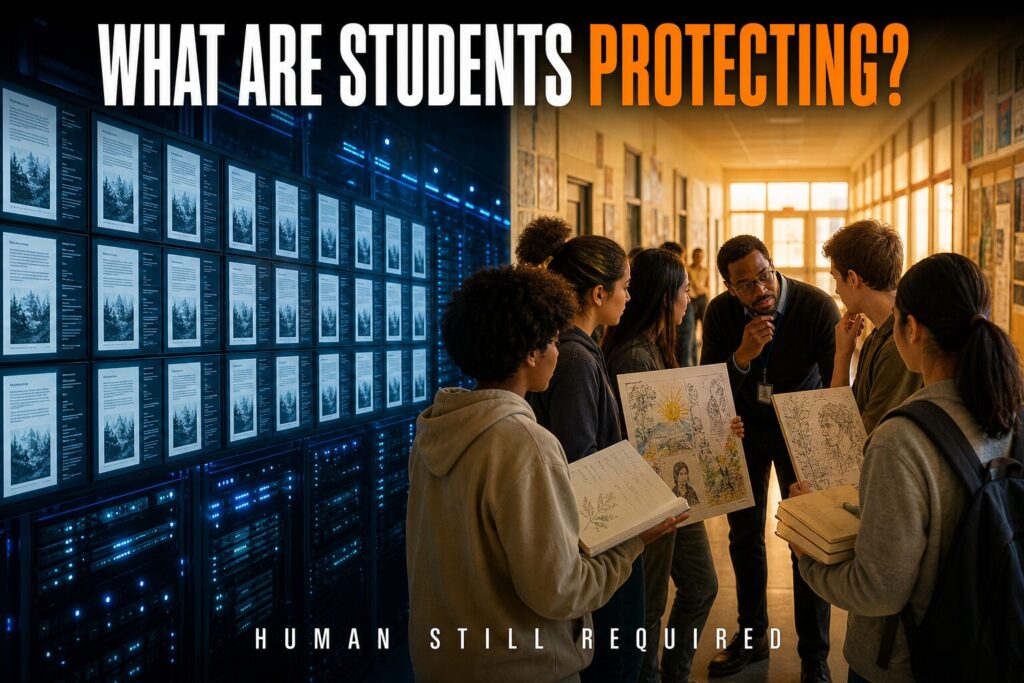
This week, a group of high school students in Manhattan walked out of class to protest AI. Student AI concerns are no longer a quiet undercurrent in our schools. They are marching down the street.
It would be easy for leaders to read that as resistance to manage. I read it differently. When students and teachers push back on AI, they are telling us what they think school is for. That is not a problem to contain. It is information we need.
The fear is already in the room. The question is whether we are willing to talk about it.
Key takeaways
- Student AI concerns are showing up in public, including a walkout of nearly 100 students at a New York City high school on October 20, 2026.
- Teachers in Connecticut are raising a related worry: students are reading less, and AI makes it easier to skip the thinking altogether.
- The concerns are less about the technology and more about what students are afraid of losing: their learning, their creativity and their future.
- Leaders should treat these concerns as guidance about what schools must protect, and bring students into the conversation instead of deciding around them.
What’s happening
On Tuesday, October 20, nearly 100 students at LaGuardia High School, the Manhattan arts school, walked out of class and marched to Lincoln Center to demand a freeze on AI, according to New York Daily News reporting republished by GovTech. The walkout was part of a national day of anti-AI protests that also included several colleges. Students said they were worried about what AI means for their careers and their learning. They chanted, “Who’s future? Our future!” One senior, Mieke Nievergelt, put it plainly: “I think it’s pretty telling that the people who have to protest against AI are the children, the students.” Another student’s message to his peers was simple: “Everybody has a story. Do not let generative AI write yours.”
The context matters. According to the same report, New York City has paused generative AI through eighth grade for one year. High schools can use AI with restrictions, principals can apply for pre-approved pilot programs, and all high schoolers must complete AI literacy training. Students also pointed to AI showing up in their own school community, including AI-generated posters for school events.
The same day, the Hartford Courant reported on a Connecticut Education Association survey of 113 teachers about student reading. More than half of the teachers agreed it is harder to get students to finish a chapter book than it was five years ago. Teachers pointed to screens and to AI. CEA President Kate Dias said, “AI is a replacement of human capacity, and that’s a mistake.” One teacher wrote, “It has become difficult to convince students that it matters to be able to think for oneself.”
And on October 21, GovTech reported that the nonprofit Day of AI is expanding its Students First Tour, an effort to bring K-12 students into AI policy conversations with educators, administrators and officials. It builds on a July gathering where 98 students representing all 50 states developed and approved the STUDENT FIRST Act, a proposed framework for responsible AI use in schools. AASA, The School Superintendents Association, will share the framework with its network of more than 10,000 school leaders.
Three stories. One message. The people closest to learning are telling us what they are worried about.
What student AI concerns reveal for school leaders
In Chapter 11 of Human Still Required, “Staff, Students, and the Fear Question,” I argue that fear is not something leaders introduce when they bring up AI. It is already there. AI touches identity. For teachers, the question is whether they still matter. For students, it is whether effort still matters, and whether they are allowed to use these tools or just expected not to get caught.
What I see in this week’s news is students asking those questions out loud. A walkout is not a policy proposal. But it is a signal that students do not feel the adults have been clear with them about what school is protecting.
Fear isn’t the problem. Silence is.
Human Still Required
When leaders say nothing, students fill the gap. Some fill it by quietly using AI for everything. Others fill it by protesting. Both responses tell us the same thing: the expectations are not clear, and the reasons behind them have not been explained.
The second idea is from Chapter 13, “What Schools Must Protect.” There I write that schools need to protect critical thinking, productive struggle and reflection, along with human feedback that matters. Look at what the students and teachers in these stories are actually defending. Their own stories. Their creative work. The ability to sit with a book long enough to understand it. The habit of thinking for yourself.
That is not anti-technology. That is a list of things worth protecting.
What schools protect reveals what they value. What they automate reveals what they’re willing to lose.
Human Still Required
Here is the part I want leaders to sit with. The students at LaGuardia were not only reacting to a policy. They were reacting to small choices, like AI-generated posters in their own school community. Those choices may seem minor to adults. To students, they send a message about whose work counts. Every decision about where AI shows up is also a decision about what we value. Students are paying attention to those decisions, even when we are not.
I also want to be careful here. Not every concern is a reason to stop. Chapter 11 is about separating fear from refusal. Leaders do not need to freeze everything because a group of students asked. They also cannot wave it off. The work is to take the concern seriously enough to explain what we are protecting, where AI fits and where it does not, and why.
What leaders can do now
- Name the fear before you write the rule. Hold a short conversation with a student group and a teacher group this month. Ask one question: “What are you worried AI will take away from school?” Write down what you hear before you share any policy.
- Make your “protect list” public. Draft three to five things your school will protect no matter what tools are available, such as sustained reading, original student writing and creative work, and feedback from a human who knows the student. Share it with staff, students and families.
- Audit the adult use of AI. Look at where AI is already showing up in school-facing work: event flyers, newsletters, announcements. Ask whether each use saves time on busywork or replaces work students and staff would value doing themselves.
- Bring students into the policy, not just the rollout. If you are revising AI guidance, give students a real seat. The Day of AI student senate resources are one structure to look at. Students who help shape the expectations are far more likely to understand them.
- Explain the why, consistently. When a teacher allows AI for brainstorming but not for a final draft, students should hear the reason, and they should hear the same reasoning from classroom to classroom.
If your leadership team wants to work through these questions together, the 5-Week Book Study walks through the fear question and what schools must protect, chapter by chapter.
Frequently asked questions
Why are students protesting AI in schools?
In the New York City walkout reported on October 20, 2026, students said they were worried about AI’s effect on their learning, their creative work and their future careers. Some also objected to AI-generated materials appearing in their own school community. The concerns were about what students feel they could lose, not only about the technology itself.
Should school leaders ban AI when students and teachers raise concerns?
Not automatically. Concerns are information, not a verdict. Leaders should listen first, name what the school will protect, and then decide where AI helps and where it does not. A ban without that conversation tends to replace clarity with control.
How can principals include student voice in AI policy?
Start small: a student advisory conversation, a survey, or a student seat on the group revising AI guidance. Structured efforts like the Day of AI Students First Tour offer resources for running student policy discussions. The goal is for students to understand the reasoning behind the rules, not just the rules.
Leading through the fear
Students walking out over AI is not a sign that schools have failed. It is a sign that students care about their learning enough to fight for it. That should encourage us.
But it also puts the responsibility back where it belongs. With us. Students should not have to march down the street to find out what their school is protecting.
So here is my question for you: if your students were asked what your school will never hand to a machine, would they know the answer?
Sources
- LaGuardia High Students Stage Walkout in Protest of AI — New York Daily News via GovTech, October 20, 2026
- Connecticut Teachers Lament Tech’s Impact on Student Literacy — Hartford Courant via GovTech, October 20, 2026
- National Initiative to Give Students a Voice in School AI Policy — GovTech, October 21, 2026