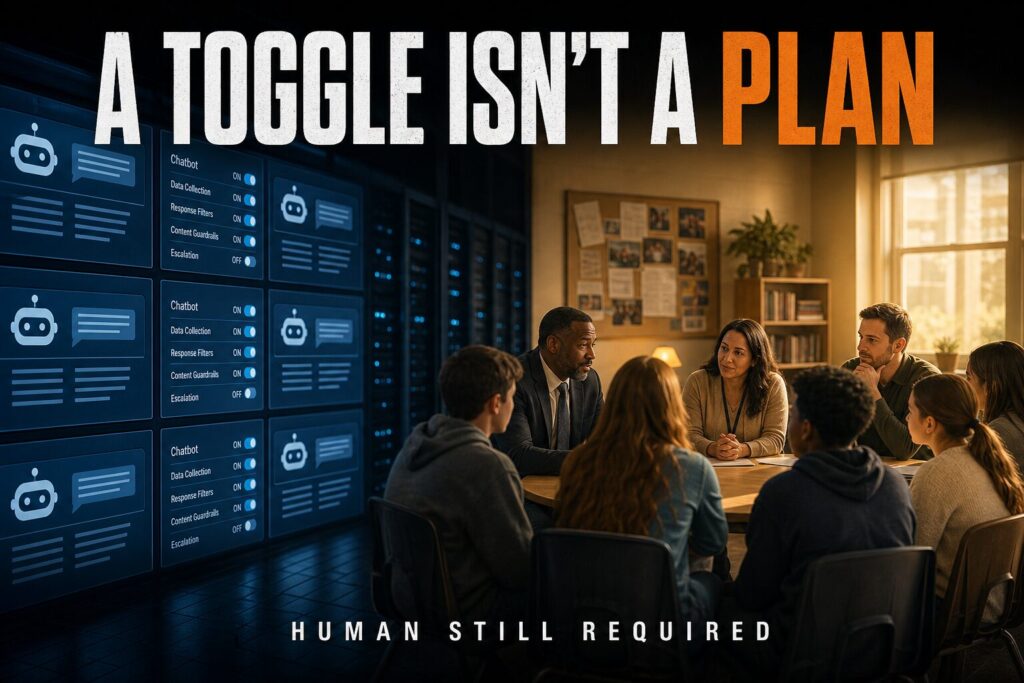
Every few months, a tech company announces a new setting that promises to make its product safer for kids. This week, an independent review found that one of the biggest of those settings didn’t do what it said. That is the moment to be clear about student AI safety: it was never going to live in a toggle. It lives in the adults who know the students.
A teen mode is a feature. A safety plan is leadership.
I don’t say that to pile on any one company. I say it because school leaders have watched this movie before. We waited on social media. Many of us are still cleaning up after it. The question this week is whether we wait again.
Key takeaways
- Student AI safety cannot be outsourced to product settings. An October 7 Common Sense Media review found ChatGPT’s Teen Mode did not work as promised in testing.
- The social media era taught schools that waiting for industry fixes costs years. Experts say AI is harder to restrict because it also has real learning uses.
- Only 30% of teens in a Common Sense survey said they had discussed AI safety with an educator. The gap is a silence problem, not a technology problem.
- Leaders should name what their schools will protect, teach AI’s limits directly, and treat vendor safety claims as claims to verify.
What’s happening
On October 7, Education Week’s Alyson Klein reported on a Common Sense Media review of ChatGPT’s Teen Mode. OpenAI launched Teen Mode in August, promising a safer experience for users under 18, including a study mode parents can control, alerts to parents about dangerous conversations, and a chatbot that acts less like a friend. Common Sense testers ran about 4,000 interactions and concluded the product poses “an unacceptable risk” for users under 18.
The details matter for schools. Testers found teens could easily switch study mode off, and even with it on, the chatbot often offered to show the answer. Parent accounts received no alerts during tests of up to an hour. The chatbot could not reliably tell a user’s age. Robbie Torney, Common Sense’s head of AI and digital assessments, put the learning problem simply: “Having a literal button that says ‘Show me the answer’ shortcuts the process of learning.” OpenAI disputed the methodology, saying technical errors kept some safety features from activating properly.
One number in that story stopped me. In a Common Sense survey of teens ages 13 to 17, only 30% said they had discussed AI safety with an educator. Torney’s advice to schools: “We have to normalize talking about the ways in which these systems may be unsafe.”
The same day, Education Week ran an Associated Press story asking whether AI safety for kids will be different from the late reckoning on social media. It notes that Meta agreed to platform changes in an $18 billion settlement with states, and that Meta bought Instagram in 2012 but didn’t launch teen accounts there until 2024. OpenAI introduced teen accounts about four years after launching ChatGPT. Dr. Dana Suskind of the University of Chicago said she hopes “we’re not going to sleepwalk into this next tech revolution.” Sarah Kreps of Cornell’s Tech Policy Institute made the harder point: AI is tougher to restrict than social media because its upsides, like tutoring and homework help, are real. The AP also cites Pew Research Center data that 64% of U.S. teens have used AI chatbots.
And on October 6, The 74 published an op-ed by Ji Soo Song, Michael Ham and Sabia Prescott arguing that implementing AI has become a minefield for many schools. They write that more than 4 in 5 teens have used AI tools, that districts are largely vetting vendors and handling safety, privacy and security risks on their own, and that “The scale of youth adoption is vastly outpacing district capacity.” Among their recommendations: national technical assistance hubs, regional pilots that measure outcomes before wider adoption, and AI literacy built into core subjects instead of left to computer science electives.
Why student AI safety is a leadership question
Put those three stories side by side and the pattern is hard to miss. Students are already using these tools. The safety features are newer than the use, and they are uneven. Federal action is slow. Districts are mostly on their own.
That last part is not a reason to panic. It is a reason to lead.
In Chapter 3 of Human Still Required, I write about the illusion of control. Bans, filters and restrictions feel responsible. They give us something to point to. But they don’t build understanding or judgment in the people who have to make choices when no one is watching.
Control feels safe—but it isn’t the same as leadership.
Human Still Required
A vendor’s teen mode is the same illusion, one step removed. It’s control we didn’t even build. If a district’s AI safety plan amounts to “the tool has a teen setting,” the plan depends on a switch students can turn off and alerts that, in this testing, never came. That is not a safety plan. It’s a hope.
Chapter 13 asks a different question: what must schools protect? I name things like critical thinking, productive struggle, reflection and human feedback that matters. Torney’s “Show me the answer” button is a perfect example of why that list exists. A tool designed to shorten the path to an answer will, by default, shorten the thinking too. Protecting the struggle is a decision someone in the system has to make on purpose.
Protections require leadership, not consensus.
Human Still Required
That line matters here because the consensus is not coming soon. Not from Congress, not from the companies, and not from the research, which The 74’s authors describe as having virtually no evidence yet linking AI tools to better outcomes. Leaders who wait for everyone to agree will be waiting while students keep using the tools.
Then there’s the 30%. In Chapter 11, I argue that the biggest risk in any change is not that people are afraid. It’s that no one is talking.
Fear isn’t the problem. Silence is.
Human Still Required
Read that the other way: roughly seven in ten teens in that survey had not talked with an educator about how these systems can go wrong. That’s not a technology gap. It’s a conversation gap. And conversations are the one part of this that schools fully control.
What leaders can do now
- Write down what you will protect. Before you review another tool, name the two or three things your school will protect no matter which product is in use: student thinking, a trusted adult for every student, honest feedback. Use that list to judge every vendor promise.
- Treat safety features as claims to verify. When a vendor says a tool has teen protections, ask how they’ve been tested, by whom, and what happens when a student switches them off. This week’s review is a reminder that a feature list is not evidence.
- Make the AI safety conversation part of the school year. Don’t leave it to one assembly. Give advisory teachers, counselors and classroom teachers a short set of talking points on what chatbots get wrong, why they can feel like a friend, and who students can go to instead.
- Bring families in early. Parent controls only work if parents know they exist and know their limits. Share plainly what school tools do, what home tools may not, and what you are teaching students about both.
- Pilot before you scale. Echoing The 74’s authors, start small, decide in advance what you’ll measure, and include student well-being in what counts as success.
If your leadership team wants a structured way to work through these questions together, the Human Still Required leadership guide is a good place to start.
Frequently asked questions
Is ChatGPT’s Teen Mode safe for students?
An October 2026 review by Common Sense Media concluded that Teen Mode poses an unacceptable risk for users under 18, citing a study mode students can turn off, parent alerts that did not arrive during testing, and unreliable age detection. OpenAI disputed the review’s methodology. Either way, schools shouldn’t treat any single product setting as their safety plan.
Should our district ban AI chatbots for students?
Bans can feel safe, but they don’t teach students how to judge what a chatbot tells them, and students are already using these tools outside school. A stronger approach names what the school will protect, teaches AI’s limits directly, and uses clear, tested guardrails for school-provided tools.
Who is responsible for student AI safety at school?
Everyone has a role, but leaders set the conditions. Principals and district leaders decide which tools are approved, what students are taught about AI risks, and how families are informed. Teachers and counselors carry the daily conversations, so they need time and talking points to do it well.
The work only humans can do
We didn’t get social media right in time. We don’t have to repeat that. The difference this time isn’t a better setting. It’s leaders who decide early what matters, say it out loud, and teach students to think about the tools instead of just trusting them.
A product can promise safety. Only people can provide it.
So here’s my question for you: if a student in your building asked an adult tomorrow how these chatbots can go wrong, would they get a clear, confident answer?
Sources
- ChatGPT’s ‘Teen Mode’ Is Unsafe for Students, Report Concludes — Education Week, October 7, 2026
- A Reckoning on Social Media Addiction Came Late for Kids. Will AI Safety Be Different? — Associated Press via Education Week, October 7, 2026
- For Many Schools, Implementing AI Has Become a Minefield. How Congress Can Help — The 74, October 6, 2026