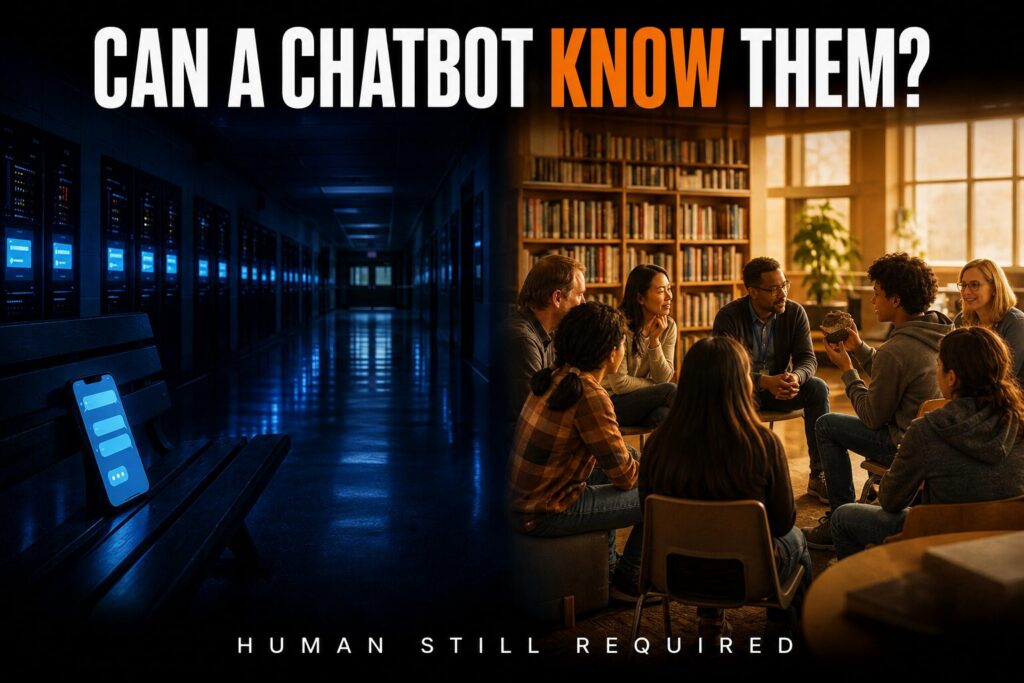
Most of the AI conversation in schools is still about homework. Who wrote the essay. Which tool is allowed. How to catch it. Meanwhile, a growing number of teenagers are using AI companions for something very different: someone to talk to.
That’s not a cheating problem. It’s a relationship problem. And it lands squarely on the desk of school leaders.
Two stories this week, read side by side, make the point better than any policy memo could. One is about teens turning to chatbots. The other is about what students actually need from the adults around them.
Key takeaways
- Teens are using AI companions for advice and emotional support, often without telling any adult.
- A chatbot can be available at 2 a.m. It cannot know a student, and it cannot receive what a student has to give.
- New research on “mattering” shows students need to feel valued and to add value, and that both happen with real people.
- School AI conversations focused only on cheating are missing the bigger question: who in our building knows each student?
What’s happening
On October 5, a Gray TV news team reported on teens turning to interactive AI and the experts raising concerns about it. The story describes a health advisory from the American Psychological Association on interactive AI and adolescent well-being, which expands on the APA’s earlier advisory on social media. It cites a study in the Journal of the American Medical Association finding that nearly 1 in 5 young people used AI for mental health advice in the past year, and that 63.3% of those participants did not tell anyone they were doing it. The report also notes that about 70% of adolescents who tried AI companion apps use them at least monthly.
The most useful voices in the piece were the teenagers. A 17-year-old at the Boys and Girls Club of Greater Kansas City put it plainly: “This robot knows nothing about me. It doesn’t know my dynamics with people.” A mental health program manager in the story named the line clearly: the problem starts when the tool becomes a teen’s sole confidant.
The same day, Education Week covered an OpenAI forum on stronger teen safety measures. Panelists, including the CEO of the American Psychological Association, argued that teens need education on responsible use rather than outright bans, and that AI tools need age-appropriate design. One researcher on the panel warned that design choices can either build a young person’s autonomy toward mastery, or leave them in a place where they “learn around AI” and can’t do it once the tool is removed.
Then on October 7, The 74 published an interview with Georgetown researcher Anna Johnson on student “mattering”. Johnson describes mattering as having two dimensions: “both feeling valued and adding value.” She draws a sharp distinction from belonging. A student can belong to a school and still not feel known or valued by the people there. In her study of nearly 600 sixth graders in Tulsa, students with a stronger sense of mattering reported lower loneliness, anxiety and depression, greater engagement, and somewhat higher reading and math scores. Johnson also notes that mattering grows through conversations with key caregivers, including teachers and school leaders.
Why AI companions are a leadership issue, not a tech issue
Put those stories together and the picture is clear.
A chatbot can make a student feel heard. It answers instantly. It never gets tired. It never has 30 other kids waiting.
But look at Johnson’s two dimensions. Feeling valued requires being known, and the teenager in Kansas City already understood the limit: the robot knows nothing about her. Adding value requires someone on the other side to receive it. A chatbot doesn’t need anything from a student. There is nothing to give back.
That’s the gap. AI can simulate attention. It cannot offer mattering.
In Chapter 8 of Human Still Required, I argue that AI scales information but trust doesn’t scale, and that presence is the currency of leadership. The same is true for students. When a teen chooses a chatbot over an adult, it’s worth asking an honest question before we reach for a filter: was an adult actually available? And would that student have felt known if they’d come to us?
Relationships aren’t a ‘soft skill.’ They’re the infrastructure everything else runs on.
Human Still Required
Chapter 9 makes the distinction I keep coming back to. There is a difference between being accessible and being present. A school can have an open-door policy, a counseling sign-up form and a wellness app, and still have students who feel like no one in the building really knows them.
AI can help leaders be available. It cannot help leaders be felt.
Human Still Required
Chatbots are the ultimate in availability. That’s exactly why they’re attractive to a lonely teenager, and exactly why availability alone isn’t enough. The answer isn’t for schools to compete with a machine on speed. It’s to do the thing the machine can’t.
This also connects to the argument in Chapter 3 about the illusion of control. Blocking companion apps on the school network may feel responsible. It won’t change what happens on a phone at midnight. The panelists in the Education Week story landed in the same place: teens need education and judgment, not just bans. What a school can control is the quality of the human relationships it offers during the day.
What leaders can do now about AI companions
- Widen your AI literacy beyond academic integrity. If your student AI lessons only cover citation and cheating, add a conversation about using AI for advice and emotional support: what it can do, what it can’t, and when to bring a person in. Ask students to explain the difference in their own words.
- Ask students directly. In a student advisory group or focus group, ask how peers are using AI outside of schoolwork. Listen without judgment. The JAMA finding that most teens using chatbots for mental health advice told no one is a signal about silence, not just technology.
- Build in ways for students to add value. Johnson’s research says mattering is two-way. Look for structures where students contribute something real: peer roles, sharing their culture and expertise in class, leading part of a meeting, helping a younger student. A chatbot can’t offer that. A school can.
- Spend reclaimed time on presence. If AI is saving your team time on paperwork, decide on purpose where that time goes. Hallways, lunch, the end of a class, a two-minute check-in with a student who has gone quiet. That’s where students learn they are known.
- Get your counselors and teachers on the same page. Make sure staff know what to do if a student mentions relying on a chatbot for support, and that the response leads with curiosity and connection, not discipline.
If your leadership team wants to work through questions like these together, the 5-Week Book Study is built for exactly that kind of conversation.
Frequently asked questions
Should schools block AI companion apps?
Blocking on school networks may be appropriate under your existing policies, but it won’t reach students’ phones at night, which is when many of these conversations happen. Pair any restrictions with education and, more importantly, with stronger adult relationships during the school day. Control alone doesn’t build judgment.
What is student mattering, and how is it different from belonging?
As Georgetown researcher Anna Johnson describes it in The 74, mattering has two parts: feeling valued and adding value. A student can belong to a school and still not feel known by anyone there. Mattering is the deeper measure, and in her Tulsa study it was associated with better well-being and engagement.
How should principals talk to staff about students using AI for emotional support?
Start with what the research shows and keep the tone calm. Make clear this is not a discipline issue. Ask staff to notice students who seem isolated, to respond with curiosity if a student mentions a chatbot, and to know how to connect that student with a counselor or trusted adult.
The question underneath the technology
Every new technology in schools raises the same question in a new form. The internet asked whether we were teaching students to think about information. Social media asked whether we were paying attention to how students felt. AI companions are asking something even more direct.
Does every student in your building have at least one adult who knows them well enough that a chatbot would feel like a poor substitute?
That’s not a question a tool can answer. It’s the work only humans can do.
So here’s my question for you: if one of your students had a hard night this week, who in your school would they want to tell, and would they know that person wanted to hear it?
Sources
- ‘This robot knows nothing about me’: As teens turn to tech, experts sound alarm on interactive AI — KFVS12 / Gray TV (Sharon Chen and Gabe Swartz), October 5, 2026
- At OpenAI Forum, Discussion Focuses on Stronger Teen Safety Measures — Education Week (Lauraine Langreo), October 5, 2026
- Taking School Climate and Student Belonging One Step Further With ‘Mattering’ — The 74 (Jessika Harkay), October 7, 2026