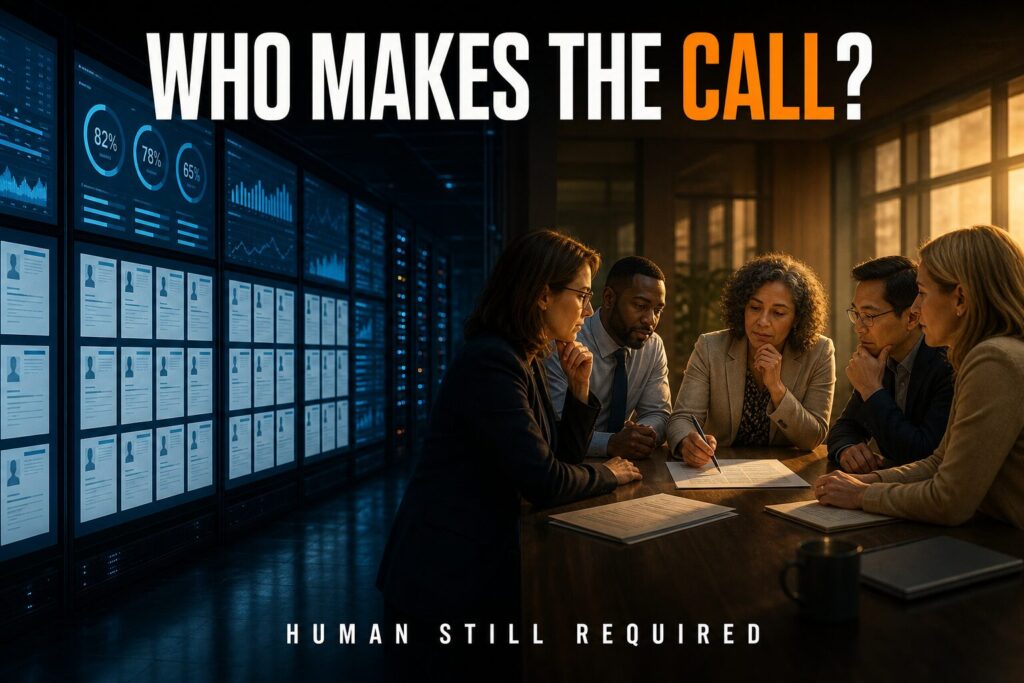
Most AI school policy conversations start with the tools. Which apps are approved. Which grades get access. Which chatbot runs on district devices. Those questions matter, but they change every semester. This week, a state law in Oklahoma pointed at a better place to draw the line: not around the tools, but around the decisions.
Who decides whether a student is retained? Who decides a grade? Who decides discipline?
Those calls belong to people. Policy should say so, plainly.
Key takeaways
- The most durable AI school policy protects human decisions, not a list of approved tools that will be out of date by spring.
- Oklahoma’s new law bars schools from using AI as the primary basis for high-stakes calls like retention, promotion, discipline, placement and grading.
- AI detection scores are a high-stakes decision in disguise; Oklahoma’s state education department says detectors are too unreliable to use.
- Leaders should name the decisions only humans make, then build tool guidance and data rules around them.
What’s happening
On October 5, Oklahoma Watch reporter Jennifer Palmer, in a story published by KGOU, described how Oklahoma schools are setting guardrails for AI in the classroom. Oklahoma is one of 13 states with AI education laws, and its new law requires every district to adopt an AI policy by next school year. One provision stands out. Under the Oklahoma Responsible Technology in Schools Act, schools cannot use AI as the primary basis for high-stakes decisions such as retention or promotion, discipline, placement or grading.
The same story reports that Karen Leonard, who directs the state Education Department’s Office of AI and Digital Learning, says AI detection software is so unreliable it shouldn’t be used. The department recommends that teachers set AI boundaries for each assignment, use a rating scale for appropriate AI use, and ask students to cite AI and link to their chat logs. District leaders are still working it out. Epic Charter Schools superintendent Shaun Ross called it “building the airplane while it’s flying.” Districts also disagree on age: Epic limits Google Gemini to students 13 and older, while Owasso Public Schools starts in third grade.
In Wyoming, a Natrona County School District policy committee took up AI tools and student privacy, as reported by Allison Allsop of the Casper Star-Tribune and shared by GovTech on October 2. Teachers there can optionally use Turnitin, Grammarly and GPTZero to check for plagiarism and AI-generated work. Trustee Alex Petrino asked a sharp question: “The systems that teachers are using to check to see if AI is used, are those closed systems or open systems?” According to the report, Google Gemini on district-owned computers is the only closed system; other tools may be open systems where student data could be used to train models. The committee plans to hear from school groups at its October 26 meeting before deciding on policy changes.
And in Louisiana, Patrick Wall of The Times-Picayune | The New Orleans Advocate reported, in a story shared by GovTech on October 5, that Louisiana educators and parents are mixed on rising tech use. Last school year nearly 1 in 3 K-8 students worked with Amira, an AI reading tool, and more than 23,000 high school students used Khanmigo. State Superintendent Cade Brumley said educators should be open-minded about AI but “skeptical of every product.”
Why AI school policy should protect decisions, not tools
Put those three stories side by side and you see two different kinds of policy. One kind chases tools: which app, which grade level, which product. That work is necessary, but it never ends. A new feature ships, a vendor changes its terms, and the list is out of date.
The other kind names decisions. Oklahoma’s provision doesn’t care which product a district buys. It says that when a student’s grade, placement, promotion or discipline is on the line, AI cannot be the main reason. That line holds no matter what tool shows up next year.
In Chapter 4 of Human Still Required, I make a distinction I come back to often: decision-support is not decision-making. AI is very good at the SAFE work, tasks that are Structured, Administrative, First-draft and Easily repeatable. It can pull data together, summarize a pattern, draft the letter. It should not be the one deciding.
Let AI prepare you to decide. Do not let AI replace the act of deciding.
Human Still Required
Chapter 7 goes further. Judgment can’t be automated, because context is lived. A dashboard can flag a student. It cannot know that the student’s family moved twice this year, or that a quiet kid finally spoke up in class last week. The people in the building know that.
Data informs. Humans decide.
Human Still Required
Here is where AI detection gets interesting. Many schools treat a detector score as a neutral piece of information. It isn’t. When a score leads to an accusation, a zero or a referral, a machine has become the primary basis for a grading or discipline decision. Oklahoma’s education department reached the same practical conclusion from a different direction: the tools aren’t reliable enough to use. Natrona County’s trustees are asking a related question about where student work goes when it is run through those tools. Both are the right instincts. Any tool that judges student integrity deserves the hardest look, both for accuracy and for what happens to the data.
The student data question is part of the same line. In Chapter 4 I suggest a simple guardrail: no sensitive student data goes into tools the district hasn’t approved. A detection check, a grading assistant or an AI-drafted IEP goal all involve student information. If leaders don’t know whether a system is open or closed, they don’t yet know enough to approve it.
In Chapter 2, I ask a question that every policy committee should put at the top of the page:
What work should only humans be trusted to do?
Human Still Required
Answer that first. The tool list gets much easier after.
What leaders can do now
- Write the human-decision list. Before your board approves another tool, name the decisions in your district that AI can inform but never make: grades, retention, placement, discipline, special education plans. Put it in policy language.
- Audit how detection tools are used. Find out which detectors teachers use, whether a score has ever been the main evidence in an academic integrity case, and what the follow-up process is. A conversation with the student should come before any consequence.
- Ask the open-or-closed question. For every AI tool touching student work, find out where the data goes and whether it can be used to train models. If no one knows, that is your first task.
- Make the human step visible. When AI supports a decision, document who reviewed it and what they weighed. Accountability should sit with a named person, not a product.
- Separate tool guidance from decision policy. Keep the approved-tools list as a living document your tech team updates. Keep the decision rules in board policy, where they belong and where they won’t need rewriting every semester.
If your leadership team wants a structured way to work through these questions together, the Human Still Required leadership guide is a good place to start.
Frequently asked questions
Can schools use AI to help grade student work?
AI can support grading by drafting feedback or flagging patterns, but a teacher should make the final call. Oklahoma’s new law, for example, bars schools from using AI as the primary basis for grading. A good rule of thumb: AI drafts, the teacher decides and signs off.
Should our district use AI detection software?
Be very cautious. Oklahoma’s state Education Department says AI detection tools are too unreliable to use and recommends clear AI boundaries for each assignment and student citation of AI use instead. If detectors are used at all, a score should never be the main evidence for a consequence.
What should a district AI policy include?
Start with the decisions that must remain human, such as grading, discipline, placement and retention. Then add rules for student data, guidance on approved tools, and expectations for how students disclose AI use. Tool lists change quickly; decision rules should not.
The line that holds
Tools will keep changing. Next year’s version will be faster and more confident than this year’s. That is exactly why the line can’t be drawn around the tools.
Draw it around the decisions. Then let the machine help with everything on the other side of it.
Which decisions in your district are already being shaped by a machine, and has anyone said out loud who is accountable for them?
Sources
- “Building the airplane while it’s flying”: Oklahoma schools set guardrails for AI in the classroom — Oklahoma Watch / KGOU, October 5, 2026
- AI Tools Raise Privacy Questions at Natrona County Schools — Casper Star-Tribune via GovTech, October 2, 2026
- Louisiana Educators, Parents Mixed on Rising Tech Use — The Times-Picayune | The New Orleans Advocate via GovTech, October 5, 2026