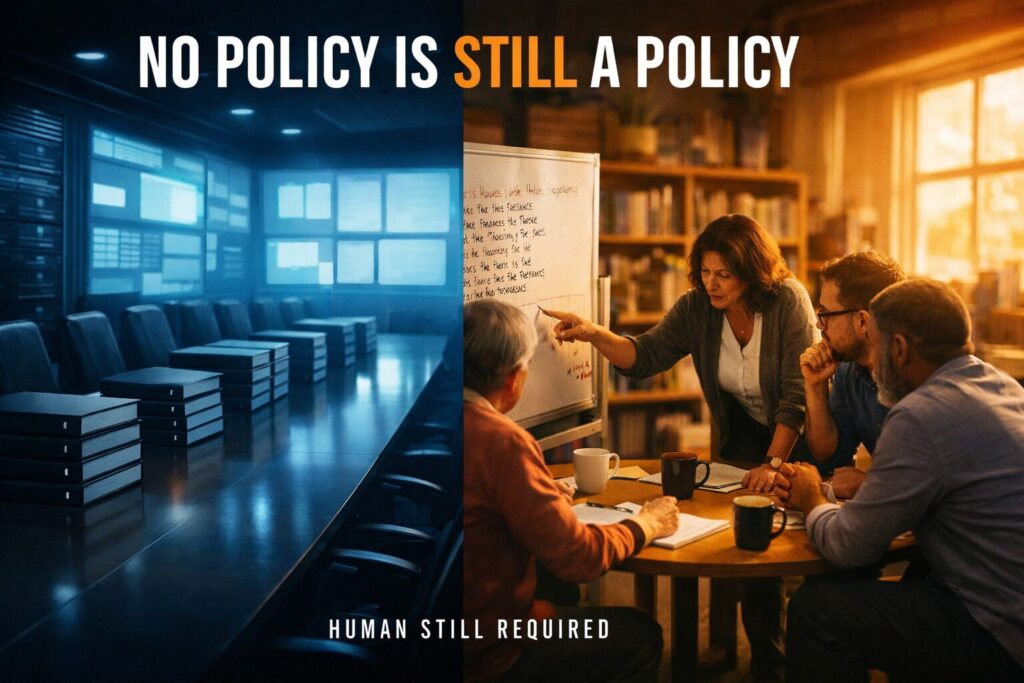
More than half of New York’s school districts have no board-adopted district AI policy. That was the headline this week. But a missing policy doesn’t mean a district has said nothing about AI. It means the district has said it quietly, one classroom at a time.
Teachers are still deciding what’s allowed. Students are still guessing. Parents are still asking. The decisions are being made. They just aren’t being made together.
No policy is still a policy. It’s just one nobody wrote down.
Key takeaways
- A New York Focus analysis published October 13, 2026 found that more than half of New York’s 678 school districts lack a formal, board-adopted AI policy.
- States are moving in different directions at once: some are requiring districts to write AI policies, others are proposing limits or bans on classroom AI.
- A district without an AI policy still has AI rules. They are just inconsistent, invisible and decided classroom by classroom.
- The goal of a district AI policy is not uniform practice. It is shared thinking that staff can actually use when the policy doesn’t answer the question.
What’s happening
On October 13, New York Focus reporter Melissa Manno published an analysis of AI policies across all 678 New York school districts. The newsroom built an AI tool to scan district websites and school board platforms, then fact-checked the results and called districts where it found nothing. More than half of districts lack a formal, board-adopted AI policy. More than 70 districts confirmed they have no board policy, and 39 of those said they plan to develop one this school year. Some districts without a board policy do have internal guidelines for staff and students.
The voices in the story are worth reading closely. Yonkers Superintendent Anibal Soler Jr. told New York Focus, “Banning it is the easy way out because it doesn’t force us to have tough conversations.” Victor Lee of Stanford’s AI and education initiative noted that district policies tend to focus on broad principles, which fits a fast-changing technology but can leave staff confused. Bree Dusseault of the Center on Reinventing Public Education said district policies “are all over the place.” The state education department told the outlet it is developing statewide guidance.
Two days later, Newsweek published a state-by-state look at efforts to limit AI in schools (October 15). It shows how scattered the national picture is. New York City has a one-year moratorium on student-facing generative AI through eighth grade, and a separate state bill would bar most classroom AI before ninth grade. Meanwhile, citing FutureEd’s tracker, Newsweek reports that Idaho, Maryland, Oklahoma and Virginia passed education AI laws in 2026. Oklahoma will require districts to adopt written AI policies before the 2027-28 school year and disclose which AI tools they use and what student data those tools collect. Maryland’s law calls for aligned district policies, AI coordinators and teacher training. The article also notes that the U.S. Department of Education’s August guidance encouraged schools to focus on instructional value, educator judgment and transparency for parents.
Put the two stories together and you get a clear picture. Some districts are writing policy because the law now requires it. Some are waiting for the state. Some are reaching for bans. And many are doing nothing in writing at all.
Why the district AI policy gap matters for leaders
In Chapter 10 of Human Still Required, I write about the new leadership skill set. Part of that work is not mistaking a quiet staff for a settled one. Leaders need to build cultures:
Where silence means uncertainty, not agreement.
Human Still Required
A district with no AI policy has a lot of silence in it. Teachers who aren’t sure whether they can use AI to draft feedback. Students who aren’t sure whether a brainstorm with a chatbot counts as cheating. Families who hear about a moratorium in one district and a pilot in the next and wonder which one is right. None of that uncertainty goes away because the board hasn’t voted. It just moves into individual classrooms, where every teacher ends up writing their own policy.
That’s the part I want leaders to sit with. The absence of a district AI policy doesn’t create freedom. It creates inconsistency, and inconsistency is where trust starts to thin. A student who is praised for using AI in one class and accused of cheating for the same thing in another doesn’t experience that as academic freedom. They experience it as unfair.
But the answer is not simply to write a long policy and post it. Victor Lee’s point in the New York Focus story is the real tension. Broad principles hold up as the technology changes. They also leave staff asking, “Okay, but what do I do on Tuesday?” A policy can’t answer every Tuesday question. Nothing can.
This is why, in Chapter 12, I argue that professional learning has to change its goal:
The goal of professional learning is no longer consistency of practice. It’s consistency of thinking.
Human Still Required
The same is true of AI policy. A good district AI policy isn’t a list of every allowed and forbidden use. It’s a shared way of reasoning that staff can carry into situations the policy didn’t anticipate. What are we protecting? Who did the thinking? When does a human have to review the output? Where does student data go? If teachers can answer those questions the same way, the district has a policy that works, whether it’s two pages or twenty.
And it’s also why Soler’s quote stuck with me. Bans and moratoriums can be a reasonable pause. But a ban that replaces the conversation instead of creating time for it is the move I describe in Chapter 3:
Control feels safe—but it isn’t the same as leadership.
Human Still Required
Whether a district is writing its first policy because the state requires it, waiting for state guidance or pausing student use, the leadership work is the same. Make the thinking visible. Make it shared. Make it something people can use.
What leaders can do now
- Find out what your district is actually doing. Ask a sample of teachers and students what they believe the AI rules are. If you get five different answers, you have five policies. That is your starting data.
- Write principles and examples together. Broad principles keep a policy durable. Concrete examples from your own classrooms make it usable. Pair every principle with two or three real scenarios: what this looks like in a 4th grade writing block, a high school lab report, a teacher drafting parent emails.
- Decide where a human must stay in the loop. Grading decisions, discipline, special education, family communication and student data deserve explicit lines. Name them clearly so teachers aren’t left guessing on the high-stakes calls.
- Treat the policy as a professional learning plan, not a document. Build time in staff meetings and PLCs to work through cases together. The goal is that two teachers facing the same situation reason through it the same way.
- Talk to families before the news does. Parents are reading about bans and moratoriums elsewhere. Tell them plainly what your district believes, what you are trying and what you are still figuring out.
If your leadership team wants a structured way to work through these questions together, the 5-Week Book Study is built for exactly that kind of shared thinking.
Frequently asked questions
Does every school district need an AI policy?
Every district already has AI rules, whether they are written or not. Some states, including Oklahoma under a 2026 law, now require districts to adopt written AI policies. Even where it isn’t required, a written policy reduces the inconsistency students and teachers experience from classroom to classroom.
Should a district AI policy be broad or specific?
Both. Broad principles keep the policy relevant as tools change, but staff also need concrete examples to apply them. The strongest approach pairs a short set of principles with real classroom scenarios and ongoing professional learning so teachers build shared judgment.
Is banning AI a safe choice while we write a policy?
A pause can buy time, but it does not build understanding on its own. If a district restricts student AI use, leaders should use that time for the conversations with staff, students and families that a lasting policy requires. Otherwise the ban becomes the policy by default.
The real work behind the paper
The New York numbers will change. More districts will adopt policies this year, some because they want to and some because the state will tell them to. That’s good. But a board vote is the beginning of the work, not the end of it.
A policy nobody understands is just a document. A shared way of thinking about AI is a culture. One of those is a box to check. The other is leadership.
So here’s my question for you: if I asked three teachers in your building what your AI policy is, would they give me the same answer?
Sources
- More Than Half of NY School Districts Don’t Have an AI Policy — New York Focus, October 13, 2026
- Map Shows States That Are Trying to Limit AI in Schools — Newsweek, October 15, 2026