This week, the biggest marketplace for teacher-made classroom materials said it will ban AI-generated teaching resources. I understand why. Chalkbeat had found worksheets for sale with obvious errors, including an alphabet coloring sheet missing a letter. Nobody wants that in front of kids.
But here’s the problem with the fix. “AI-free” describes how something was made. It doesn’t tell you whether it’s any good.
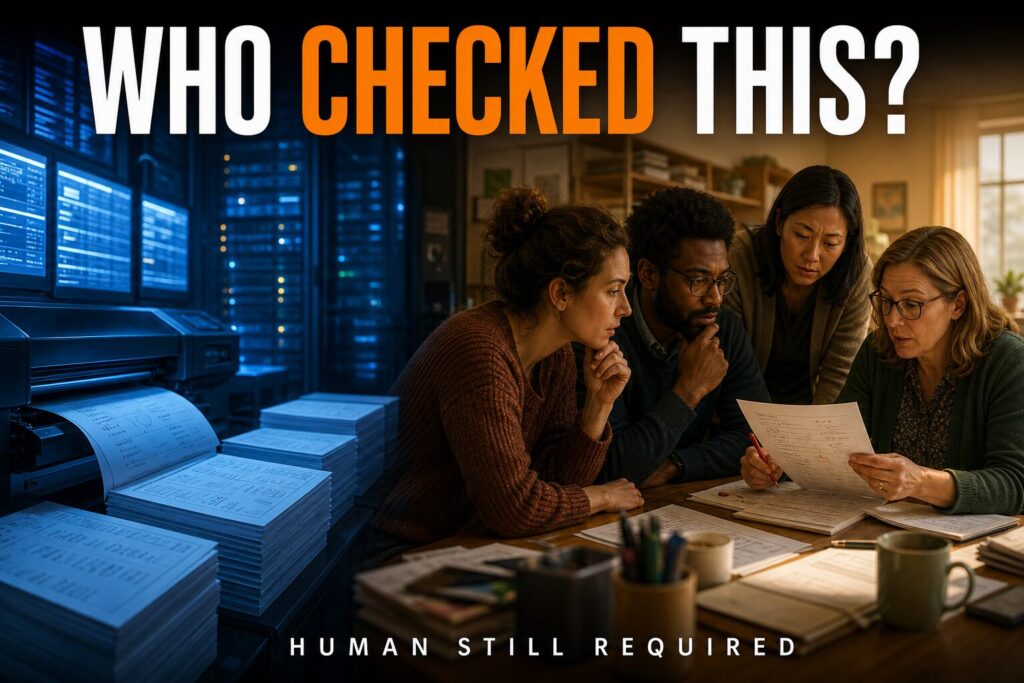
A careless human can make a bad worksheet. A thoughtful teacher can use AI to make a better one. The line that matters isn’t between human and machine. It’s between work someone checked and work no one did.
Key takeaways
- Teachers Pay Teachers plans to ban AI-generated resources after Chalkbeat reported low-quality, error-filled AI materials for sale on the platform.
- Most educators now use AI at work, and creating learning and assignment materials is one of the most common uses, according to a Walton Family Foundation and Gallup survey.
- Whether AI was used is a weak signal of quality. Whether a skilled educator reviewed, adapted and stood behind the material is a strong one.
- School leaders should set a quality standard for AI-assisted materials in their own buildings instead of relying on bans or labels.
What’s happening with AI-generated teaching resources
On October 15, Chalkbeat national reporter Lily Altavena reported that Teachers Pay Teachers plans to ban AI-generated teaching resources. The company announced the change at a town hall the week before. TPT spokeswoman Sarah Lehman told Chalkbeat the policy is meant to keep “teachers’ expertise at the heart of the marketplace,” that seller materials “should be unique, expertly crafted, and AI-free,” and that the company is “building tools that will speed up our ability to identify and remove AI-generated resources.”
The announcement followed Chalkbeat’s August reporting on AI slop in the marketplace. Chalkbeat reviewed six AI-generated resources with obvious mistakes: the alphabet worksheet missing the letter F, a poster about the Black inventor of the potato chip illustrated with a firefighter and a stoplight, and numerous typos. The October story also notes that some teachers say AI helps with lesson planning, while skeptics argue it trades instructional value for efficiency. An online petition is already asking TPT to reconsider.
The same week, K-12 Dive covered a Walton Family Foundation and Gallup survey of more than 1,900 educators, released October 14. Nearly 3 in 5 educators used AI tools for their work in 2025-26. Among the uses reported: creating learning and assignment materials, grading, giving feedback and handling administrative tasks. K-12 Dive also pointed back to an earlier Gallup and Walton finding from May: just under half of teachers had received no guidance on using AI to create assignments or adapt materials to student needs.
And in Larry Ferlazzo’s Education Week Classroom Q&A column on AI with English learners, published October 15, English-language-development teacher Kelly Cray describes using AI to build scaffolded materials and multilingual versions of important documents, and to rewrite math word problems with culturally relevant contexts. Her test for one of those rewrites: “It maintains the mathematical integrity while reducing unintended bias.” That’s a teacher using AI and still owning the result.
Put those three pieces side by side. Most educators are using AI. Many are using it to make materials. A lot of them got no guidance on how. And one of the most visible responses in the market is a ban.
Why “AI-free” is the wrong quality standard
In Chapter 3 of Human Still Required, I write about the illusion of control. Bans and restrictions feel responsible. They’re easy to announce and easy to explain. But they don’t build the understanding or the judgment people need to make good choices on their own.
Control feels safe—but it isn’t the same as leadership.
Human Still Required
TPT is a private company, and it can set whatever rules it wants for its store. My concern is what happens when schools borrow the same logic. If “AI-free” becomes our stand-in for quality, we end up policing the process and ignoring the product. We spend energy trying to detect AI instead of asking whether the worksheet is accurate, aligned and right for these students.
The errors Chalkbeat found weren’t caused by AI existing. They were caused by nobody checking. That’s a review problem.
In Chapter 4, I describe the SAFE framework for tasks AI can handle well: Structured, Administrative, First-draft and Easily repeatable. A first draft of a worksheet or a scaffold fits. But the guardrail that comes with it is just as important: drafts are starting points, and nothing AI produces should reach people without a human read.
Tools can help you move faster. They can also help you make mistakes faster.
Human Still Required
That missing letter F is what making mistakes faster looks like. The answer isn’t to slow everyone down by banning the tool. It’s to make sure the human step never gets skipped.
Chapter 5 carries the same idea from the student side. AI should be a scaffold, not a replacement, and the thinking that counts has to stay human. Kelly Cray’s culturally relevant math problems are a good picture of that. AI drafted the change. A teacher decided whether the math still held up.
Drafts are allowed. Final thinking must be human.
Human Still Required
That’s a standard you can hold people to. “Was AI involved?” is a question people can hide from. “Did you check it, and would you stand behind it?” is a question a professional answers.
What leaders can do now
- Write a quality standard, not a provenance rule. Define what every classroom resource must be, whoever or whatever drafted it: accurate, aligned to what students are learning, appropriate for the students in front of you, and reviewed by the teacher who uses it.
- Close the guidance gap on materials. If just under half of teachers had no guidance on using AI to create or adapt materials, start there. Give teams a short, shared checklist for reviewing AI drafts before they reach students.
- Look at what’s already in your classrooms. Materials from online marketplaces, curriculum add-ons and teacher-made resources all deserve the same scrutiny. Ask a team to review a sample this month and talk honestly about what they find.
- Make good practice visible. Ask teachers who use AI well to show colleagues how they review and adapt what the tool gives them. The process is the professional skill, not the prompt.
- Ask one question in every walkthrough or planning meeting: “Who checked this, and what did they change?” It moves the conversation from suspicion to professional judgment.
If your leadership team wants to work through these questions together, the 5-Week Book Study is a good place to start.
Frequently asked questions
Should our district ban AI-generated teaching resources?
A ban is easy to announce but hard to enforce, and it doesn’t guarantee quality. Human-made materials can have errors too. A stronger approach is a clear quality standard that applies to every resource, with teacher review as the non-negotiable step.
How can teachers check AI-generated worksheets and lesson materials?
Treat every AI output as a first draft. Check facts, images and answer keys, confirm alignment to the learning goal, and adapt it for your students. If a teacher wouldn’t put their name on it, it isn’t ready for students.
Is it OK for teachers to use AI to create classroom materials?
Yes, with judgment. The Walton Family Foundation and Gallup survey found creating learning and assignment materials is one of the ways educators use AI. The point isn’t to avoid the tool. It’s to make sure a professional reviews and owns what students receive.
The question underneath the ban
I don’t blame TPT for wanting the slop gone. I want it gone too. But schools can’t outsource quality to a label, a detector or a policy line. Quality has always come from a professional who looked closely at the work and decided it was good enough for kids.
AI didn’t change that. It just made it impossible to skip.
So here’s my question for you: in your school, who decides whether a resource is ready for students, and how would you know if that step was being skipped?
Sources
- Teachers Pay Teachers curriculum marketplace to ban AI-generated curriculum resources — Chalkbeat, October 15, 2026
- Educators who use AI say it frees up time to interact with students — K-12 Dive, October 16, 2026
- How to Use AI With English Learners Without Encouraging Cognitive Offloading (Opinion) — Education Week, October 15, 2026