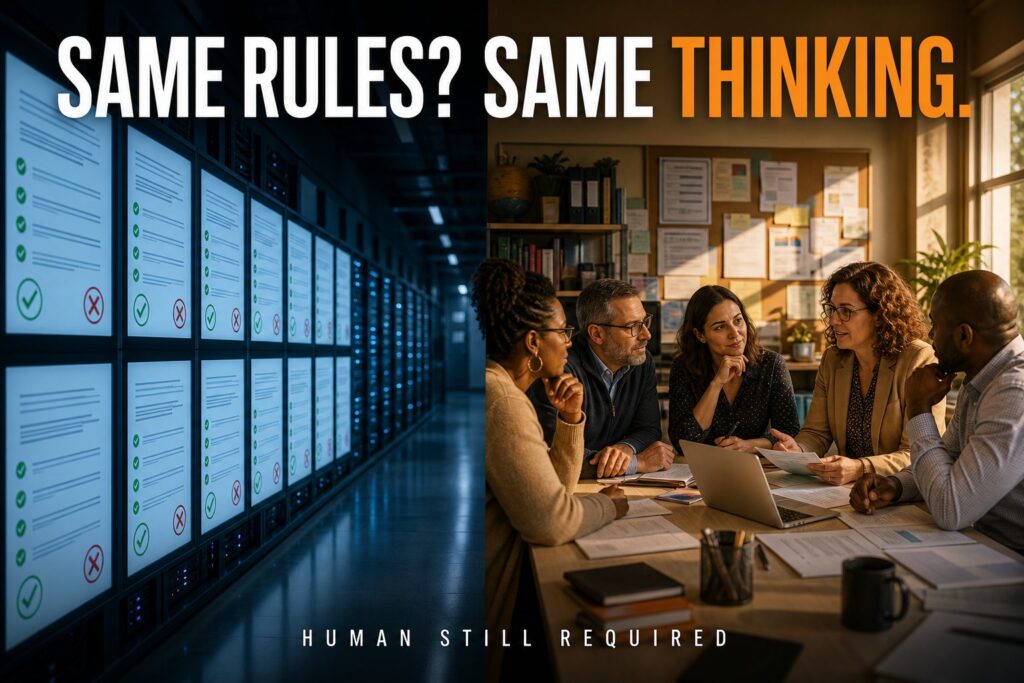
Ask a high school student what the AI rules are at their school, and you may get an honest answer: it depends on the teacher. That is the real state of district AI guidance in a lot of places right now. Not a policy. A patchwork.
A patchwork isn’t a scandal. It’s what happens when a technology moves faster than a system can learn.
But it is a signal. And leaders should read it carefully.
Key takeaways
- In many districts, what students are allowed to do with AI still depends on which classroom they walk into.
- A ban or moratorium can buy time, but it does not tell teachers what to do with that time. A plan does.
- Inconsistent classroom rules are usually a professional learning problem, not a compliance problem.
- The goal for district AI guidance is not identical practice in every room. It is shared thinking behind every decision.
What’s happening
On September 22, WBUR’s Suevon Lee published a look at how Massachusetts districts are slowly building guidance for AI in classrooms. The picture is uneven. Boston blocks ChatGPT on district networks while approving Google Gemini for teenagers. Lexington built a rubric that allows AI for personalized tutoring and organizing notes but not for unverified facts in reports. Medfield allows cautious use for summarizing complex material but restricts it for self-reflection, independent brainstorming and building arguments without teacher permission. Hingham now asks students to cite AI when they use it to generate ideas or edit part of their work. Newton superintendent Anna Nolin said the district has its AI policy on the agenda “again for the third year in a row” because “everything’s moving so quickly.”
The line that stayed with me came from a Brookline High School senior, William Koyfman, describing how it actually works for students: “it’s the express permission of the teacher. Some teachers who are anti-AI will reject it completely, and other teachers who are more pro-AI or more willing to experiment will assign you work to do with AI.”
The same story notes that, according to a Common Sense Media poll, nearly one in five kids ages 9 to 17 say they use AI for school daily, yet half said they weren’t taught by their schools or teachers whether the AI information they receive is accurate. Boston launched a teacher training program this year, backed by a million-dollar philanthropic donation, as part of a new policy to build foundational AI knowledge at all grade levels. Medfield Superintendent Jeff Marsden described his district’s stance this way: “Instead of locking it down, which we don’t think is the right idea, we work in concert with the staff and the students.”
A day earlier, on September 21, The 74 ran an opinion piece by Randy Sparkman contrasting the NYC and Los Angeles moratoriums with Alabama’s approach. His argument fits in five words: “A line is not a plan.” Alabama builds digital literacy and computer science standards starting in kindergarten, adds a computer science requirement beginning with the class of 2032, and moves AI concepts through a developmental progression. Sparkman notes that early-grade teachers “are not being told they must suddenly put general-purpose AI in front of children.” His framing is worth repeating: “A moratorium can create time. A framework can help schools decide what to do with it.”
And on September 25, Education Week’s Alyson Klein reported on a United Nations discussion of AI safety for children, where Erin Mote, CEO of InnovateEdu and a former educator, urged districts toward clear AI usage policies rather than blanket bans, alongside banning AI companion chatbots in schools and creating incident plans for deepfake images.
What district AI guidance reveals about leadership
Here is what I see when I put these stories side by side. The patchwork isn’t mainly a policy failure. It is a learning failure.
When one teacher bans AI entirely and the teacher next door builds assignments around it, both are usually acting in good faith. They are doing what they think is right with the understanding they have. What’s missing isn’t a stricter rule. What’s missing is a shared way of thinking about the decision.
In Chapter 12 of Human Still Required, I argue that one-size PD is over, and that tool-centered training was never going to be enough anyway.
Professional learning that centers on tools produces trained technicians. Schools need adaptive professionals.
Human Still Required
Adaptive professionals don’t all make the same call. They make calls for the same reasons. That’s the difference between a district where AI use looks random to students and one where it looks different room to room but still makes sense.
This is also why the “line versus plan” framing matters. In Chapter 3, I write about the illusion of control. A ban can feel responsible. It can even be the right short-term move for a specific age group. But a line only tells people what not to do. It doesn’t build the judgment teachers need when the next tool shows up inside the software they already use. Newton updating its policy three years running is not a sign of weakness. It’s a sign that policy alone can’t keep pace. Thinking can.
The goal of professional learning is no longer consistency of practice. It’s consistency of thinking.
Human Still Required
Consistency of thinking means a student in Room 204 and a student in Room 212 might get different permissions, but both teachers can explain why. The history teacher allows AI for summarizing a dense primary source and not for the argument itself. The English teacher keeps AI out of a personal reflection. Those aren’t contradictions. They’re the same principle applied to different learning goals: protect the part of the work where the thinking lives.
Students can live with variation. What erodes trust is variation nobody can explain.
What leaders can do now
- Ask students first. Before revising any guidance, ask a group of students to describe the AI rules they actually experience across a school day. Their answer is your baseline, not the policy document.
- Write down the thinking, not just the rules. Name two or three shared questions every teacher uses when deciding on AI use, such as: Where does the thinking live in this assignment? What would AI replace, and does that part matter for learning? Can the student explain and defend the final work?
- Make permission visible. Ask every teacher to state AI expectations on each major assignment, in plain language, with the reason. Hingham’s citation requirement is one simple way to make use visible instead of hidden.
- Shift PD from tools to decisions. Instead of another demo, bring teams real assignments and have them decide together what AI should and shouldn’t touch, then compare reasoning across departments. The disagreements are the professional learning.
- Teach verification on purpose. If half of students say no one taught them whether AI information is accurate, that’s a gap leaders can close this semester, in every subject, not just in a single tech lesson.
If your leadership team wants a structured way to build that shared thinking, the 5-Week Book Study is designed for exactly that kind of conversation.
Frequently asked questions
Should every teacher in a district have the same AI rules?
Not necessarily. Different subjects and assignments have different learning goals, so identical rules can do more harm than good. What should be consistent is the reasoning teachers use and the clarity they give students about why a rule exists.
Is an AI ban or moratorium a bad idea for schools?
A moratorium can be a reasonable way to buy time, especially for younger students. The problem comes when the ban becomes the whole plan. Leaders need to use that time to build teacher understanding, AI literacy and shared decision-making.
What should AI professional development for teachers focus on?
Focus less on how to use specific tools and more on how to make decisions about them. Teachers need practice deciding where AI supports learning, where it replaces the thinking that matters, and how to explain those choices to students and families.
The patchwork of AI rules across classrooms isn’t something to be embarrassed about. It’s diagnostic. It shows leaders exactly where shared understanding hasn’t been built yet.
The fix isn’t a longer policy. It’s a learning culture where teachers think through these decisions together, out loud, often.
If a student asked you tomorrow why AI is allowed in one of your classrooms and not the next, could every teacher in your building give a reason that sounds like the same school?
Sources
- School districts, slowly, build guidance around AI learning in classrooms — WBUR, September 22, 2026
- While NYC and LA Schools Draw a Line on AI, Alabama Has a Plan — The 74, September 21, 2026
- An Educator Banned Social Media in Her School Years Ago. What About Banning AI? — Education Week, September 25, 2026