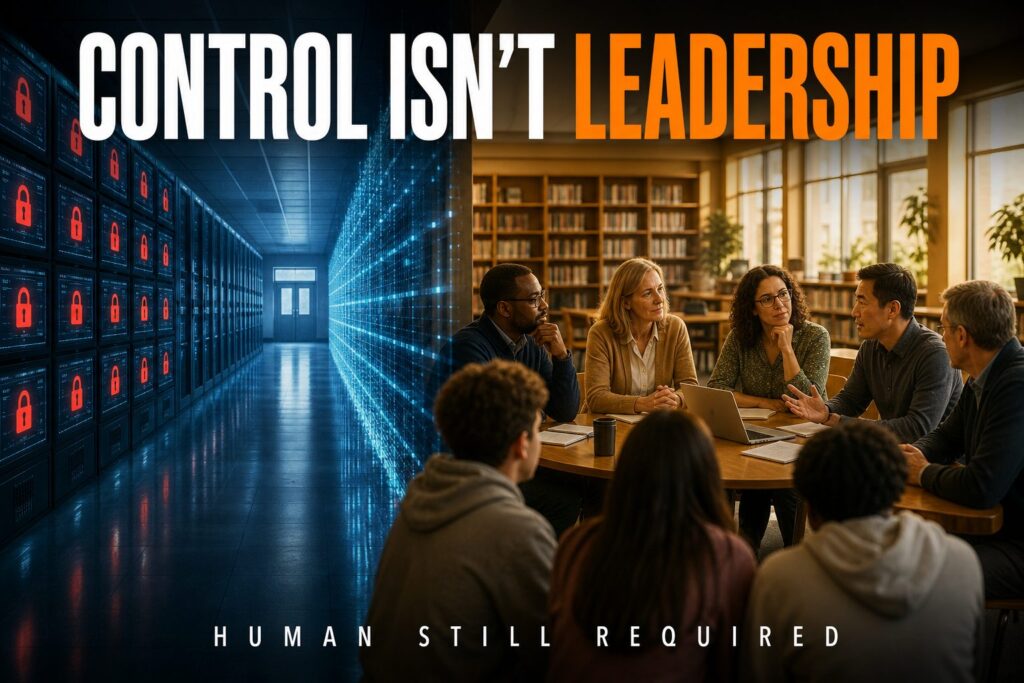
School AI bans went from a fringe idea to district policy in a single summer. The two largest school systems in the country, New York City and Los Angeles, started this school year with restrictions on student use of generative AI. Other districts are watching closely, and many superintendents are quietly asking the same question: should we do this too?
I understand the pull. When the headlines are loud and the tools are moving faster than anyone can vet them, a ban feels like the responsible thing to do.
But feeling responsible and being responsible are not the same thing.
Key takeaways
- School AI bans are a response to real concerns from parents, teachers and communities about privacy, safety and learning. Those concerns deserve to be taken seriously.
- A ban can buy time. It cannot build the judgment students and staff will need when the tools show up anyway, inside search, slides and accessibility apps.
- The strongest district responses this fall pair clear limits with honest conversation, including asking students what they think.
- Leaders should treat any pause as a planning window, not a finish line: define what matters most, say it out loud, and decide how you will know when to revisit.
What’s happening with school AI bans
In a September 17 roundup titled “A summer of AI bans in schools”, K-12 Dive’s Anna Merod reports that New York City Public Schools and Los Angeles Unified put AI bans in place for the 2026-27 school year after grassroots advocacy from parents, teachers and community members. The concerns driving that advocacy are specific: protecting student data and well-being, and open questions about whether AI actually improves learning.
The same roundup pulls together the numbers behind the moment. An NPR/Ipsos poll found that more than half of teachers believe AI is harming students’ critical thinking, even as 3 in 5 teachers use AI on the job. A Century Foundation survey found that a majority of respondents across the political spectrum want clear guardrails on classroom technology. At least one state has prohibited AI’s use for grading, discipline and other high-stakes decisions, and four more states now require districts to adopt AI policies. K-12 Dive also notes that ed tech experts are worried about the ripple effects these policies will have in other districts, and that experts testified at a June congressional hearing that federal resources to help districts implement AI well are lacking.
Then on September 22, Education Week’s Alyson Klein asked a sharper question: Headlines Warn of an AI Apocalypse. How Should Schools Respond? Her reporting captures the tension leaders are living in. Justin Reich of MIT’s Teaching Systems Lab argues that educators should focus on the harms happening now rather than speculative future ones, saying educators and families have “plenty to be concerned about, just addressing the harms that are caused today by these systems.” Rebecca Winthrop of the Brookings Institution recommends narrow, well-defined uses of AI while cautioning against agentic AI, which remains untested in schools. Jeremy Roschelle of Digital Promise expects more pressure to ban or pause generative AI tools.
The piece also describes a different approach in Oregon’s Umatilla School District, where Superintendent Heidi Sipe involved student advisory boards in shaping policy. Those students argued for keeping AI out of writing classes except for brainstorming, while supporting chatbot tutors. That is a nuanced position. It came from asking.
What this reveals: the illusion of control
In Chapter 3 of Human Still Required, “The Illusion of Control,” I argue that bans and restrictions feel responsible but don’t build understanding or judgment. That is not a criticism of the people pushing for these policies. Parents who worry about their kids’ data are right to worry. Teachers who see critical thinking slipping are right to say so. The concern is legitimate.
The question is what the response actually builds.
Control feels safe—but it isn’t the same as leadership.
Human Still Required
A ban answers the question “What’s allowed?” It doesn’t answer the harder one: “What do we want students to be able to do when AI is everywhere?” And AI will be everywhere. It is already showing up inside search results and everyday productivity and accessibility tools. A policy can switch off a chatbot on a district device. It cannot switch off the world a student walks into after 3 p.m.
This is where I keep coming back to a line from Chapter 3:
Instead of asking, ‘What’s the rule?’ Leaders ask, ‘What matters most here?’
Human Still Required
Look at the Umatilla example through that lens. Students did not ask for a free-for-all. They drew a line around writing and made room for tutoring. My read is that this is exactly the right instinct: protect the place where thinking happens, and accept support where it helps. That is judgment. And judgment, unlike control, scales. A rule has to be enforced in every room. A shared understanding of what matters travels with people into rooms you’ll never see.
Why school AI bans also raise the fear question
There’s a second layer here, and it connects to Chapter 11, “Staff, Students, and the Fear Question.” The loudest headlines about AI right now are about fear: fear of harm, fear of losing something essential about learning, fear of moving too fast. Leaders can’t wish that fear away, and they shouldn’t try.
What they can do is refuse to let fear become silence. A ban announced without explanation can leave teachers unsure what they are allowed to model, leave students guessing about what counts as cheating, and leave families with the impression that the problem is solved. A pause explained well, with a clear purpose and a date to revisit, does the opposite. It tells people their concerns were heard and that the thinking is still happening.
Fear isn’t asking leaders to stop progress. It’s asking for clarity, consistency, and care.
Human Still Required
Whether your district restricts, pauses or permits, that is the standard. The policy is the easy part. Explaining it, living it and revisiting it honestly is the leadership work.
What leaders can do now
- Name the concern before you name the policy. Write down, in plain language, what specific harm you are trying to prevent: data privacy, academic integrity, well-being, loss of critical thinking. If you can’t name it, you can’t tell whether a ban is working.
- If you pause, put a purpose and a date on it. Treat a moratorium as a planning window. Decide now what you will learn during the pause, who will be involved and when the board will revisit it.
- Ask students before you decide for them. Umatilla’s student advisory boards produced a more nuanced position than many adult policies. Convene a group of students and ask where AI helps their learning and where it gets in the way.
- Separate the tool from the task. Rather than a single rule for “AI,” identify the learning moments that must stay human, such as drafting an argument or explaining your reasoning, and protect those clearly. Then decide case by case about narrower uses, as Brookings’ Rebecca Winthrop suggests.
- Talk to staff about what they’re allowed to model. Teachers are already using AI. Make sure your policy tells them how to talk with students about it, not just what students can’t do.
If your leadership team wants to work through these questions together, the 5-Week Book Study is a good place to start.
Frequently asked questions
Should our district ban AI for students?
There’s no single right answer, and a ban can be a reasonable short-term decision when a district lacks vetted tools or data protections. The key is to be clear about what problem the ban is solving and how you’ll know when to revisit it. A ban without a plan for building student and staff judgment only delays the harder work.
Can school districts actually enforce an AI ban?
Districts can restrict AI on the devices and platforms they control. They can’t remove AI from search engines, productivity tools or students’ personal devices. That’s why any restriction needs to be paired with teaching students how to think about AI, not just whether they may use it.
How can school leaders involve students in AI policy?
Start with a student advisory group and ask specific questions: Where does AI help you learn? Where does it tempt you to skip the thinking? What would feel fair? Education Week reported that students in Oregon’s Umatilla School District recommended keeping AI out of writing classes except for brainstorming while supporting AI tutoring, a practical position that came directly from asking.
The work a ban can’t do
I don’t think the districts pausing AI this fall are wrong to take the concerns seriously. I think the risk is mistaking the pause for the answer.
Rules can hold a line for a while. Only people can explain why the line is there, notice when it needs to move, and help students develop the judgment to hold it themselves.
So here’s the question I’d ask any leadership team this week: if your AI policy disappeared tomorrow, would your students and staff still know what matters most?
Sources
- A summer of AI bans in schools, K-12 Dive, September 17, 2026
- Headlines Warn of an AI Apocalypse. How Should Schools Respond?, Education Week, September 22, 2026