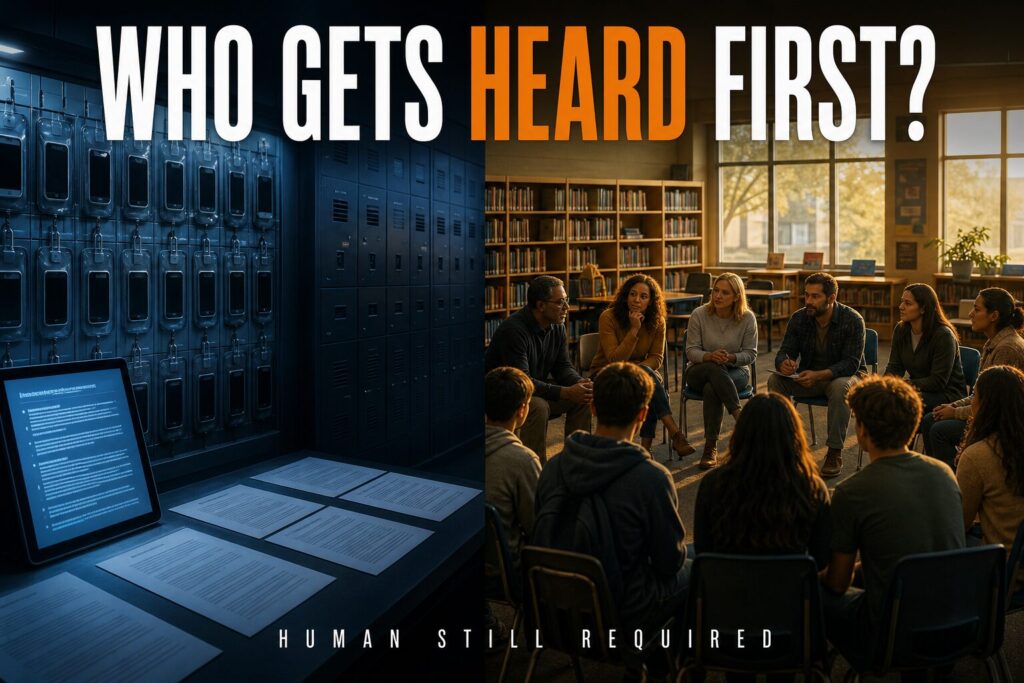
Every cellphone ban policy is a test of leadership. Not because phones are the problem, and not because bans are wrong. Because the way a school makes this decision tells students, staff and families exactly how it will make the next one.
And the next one is already here. It’s AI.
This week, three stories landed side by side. A national poll found most high schoolers support limits on phones in class but oppose all-day bans. A California district heard the same message from its own students. And Boston proposed a full bell-to-bell ban, with listening sessions planned before a vote. Same issue. Very different starting points for the conversation.
Key takeaways
- The cellphone ban policy debate is a rehearsal for AI policy: the process leaders use now teaches people how future decisions will be made.
- Students in this week’s surveys are not asking for no limits. Most support in-class restrictions; their objections center on safety and family connection.
- Listening before deciding is not a soft step. It is how leaders find the exceptions, enforcement problems and trust gaps a rule alone will miss.
- A rule nobody can enforce consistently is not control. It is a promise the adults can’t keep.
What’s happening with student voice and phone bans
On October 20, K-12 Dive reported on new Hopelab and Data for Progress polling on high schoolers and cellphone bans. The survey covered nearly 1,500 young people ages 13 to 24. Among the findings: 80% of high school students attend a school with a cellphone ban, and 42% have full-day bans. While 64% of students supported an in-class ban, 80% opposed all-day bans. The main reason was safety during emergencies. The report recommends that restrictions include clear emergency protocols and formal accommodation pathways, including for students who use assistive technology like translation apps or reading aids.
One day earlier, The Almanac reported that high schoolers urged California’s Sequoia Union High School District not to adopt a full-day phone ban. The district surveyed 1,267 students, 273 staff and 1,077 parents. Ninety-four percent of students opposed a full-day ban. Most staff supported one. So did 62% of parents. Staff also described enforcement of the current rules as inconsistent and burdensome, and told the board about workarounds like decoy phones. As Jarett Dooley, the district’s executive director of student services, put it, “Staff want clearer rules, consistent enforcement.” The board is gathering more information on enforcement, and staff will bring a revised policy recommendation in November.
Meanwhile, GBH News reported that Boston Public Schools has proposed a bell-to-bell ban on cellphones and other personal devices starting in fall 2027. The proposal covers phones, laptops, tablets, smartwatches and smart glasses, and each school leader would choose how to secure devices. Administrators plan to hold listening sessions with students, families and teachers before a School Committee vote in January 2027.
Three districts and a national poll. The details differ. The underlying question is the same: who gets heard before the rule is written?
Why this matters for school leaders
In Human Still Required, Chapter 3 is about the illusion of control. Bans and restrictions feel responsible. Sometimes they are the right call. But control on its own doesn’t build understanding or judgment, and it scales poorly. The Sequoia story shows what that looks like on the ground: a policy on paper, uneven enforcement in practice, and teachers carrying the weight of the gap.
That is not a reason to drop limits. It is a reason to ask a better question before setting them. In Chapter 3, I suggest leaders stop asking what the rule is and start asking what matters most here. Students in these surveys answered that question for us. They care about safety in an emergency. They care about reaching family and coordinating rides. Some rely on phones for translation or reading support. Those are not excuses. They are design requirements.
Listening is the decision-making process.
Human Still Required
That line from Chapter 8 is the heart of this. Listening is not the courtesy you extend after the decision is made. It is how you find out what the decision actually needs to account for. A listening session held to defend a plan already written is not listening. People can tell the difference, and that is where trust erodes.
Chapter 10 adds a hard question every leader should put on the table before a board vote:
Who benefits from this decision—and who bears the cost?
Human Still Required
With phones, the honest answer is mixed. Teachers may gain focus time in class. Students who need assistive apps, or who worry about emergencies, may bear a real cost unless the policy plans for them. Staff may bear the enforcement burden. None of that means the answer is “no ban.” It means the answer has to be built with the people who will live with it.
Your cellphone ban policy is practice for AI policy
Here is why I care about this as an AI leadership issue. Students are learning how their school makes decisions about technology. If the phone conversation teaches them that adults decide first and explain later, they will bring that lesson to every AI conversation that follows. If it teaches them that their concerns shape the exceptions, they will be more likely to tell you the truth about how they actually use AI.
The same is true for teachers. Sequoia’s staff asked for clearer rules and consistent enforcement. That is a request for clarity, not just more restriction. AI guidance will run into the exact same wall if it is written without the people who have to apply it every period of every day.
And a quiet room should never be mistaken for consensus. Chapter 10 describes the culture leaders need to build as one “Where silence means uncertainty, not agreement.” If students and teachers aren’t speaking up in your process, that is information, not approval.
What leaders can do now
- Ask before you draft. Survey students, staff and families separately, the way Sequoia did, so you can see where the groups disagree instead of averaging them away.
- Write the exceptions first. Emergency protocols, assistive technology and family contact are not loopholes. Build them in from day one, as the Hopelab report recommends.
- Talk to the people enforcing it. Before revising any device or AI rule, ask teachers what enforcement looks like in their classroom today. If it’s inconsistent now, a stricter rule won’t fix that by itself.
- Close the loop. After listening sessions, tell people what you heard, what changed because of it, and what didn’t and why.
- Name the connection to AI. Tell your community plainly that the process you use for phones is the process you intend to use for AI. Then keep that promise.
Frequently asked questions
Should schools ban cellphones bell-to-bell or only during class?
There isn’t one right answer for every school. The national poll K-12 Dive covered found most high schoolers support in-class limits but oppose all-day bans, while Boston is proposing a full-day ban and Sequoia’s parents and staff leaned toward one. The best decision comes from weighing your own community’s needs, enforcement capacity and safety concerns.
How should principals include students in a phone ban decision?
Start before a plan is final. Use surveys and student advisory councils, ask what students need for safety and access, and report back on how their input shaped the policy. Students can tell the difference between being consulted and being informed.
What does a cellphone ban policy have to do with AI policy?
Both are decisions about how technology fits into the school day, and both depend on trust and consistent enforcement. How leaders handle the phone conversation sets expectations for how they will handle AI. A process that listens now makes the next policy easier to build.
If your leadership team wants to work through questions like these together, the 5-Week Book Study is built for exactly that kind of conversation.
Phones are a familiar problem. AI is a newer one. The leadership work is the same: decide what matters most, listen to the people who will live with the decision, and be honest about who pays the cost.
The rule matters. How you arrive at it matters more.
So before your next technology vote, ask yourself: who in your school community hasn’t been heard yet?
Sources
- High schoolers oppose full-day cellphone bans amid safety concerns — K-12 Dive, October 20, 2026
- High schoolers discourage Sequoia district from full-day phone ban — The Almanac, October 19, 2026
- Youth leaders back proposed cellphone ban in Boston Public Schools — GBH News, October 15, 2026