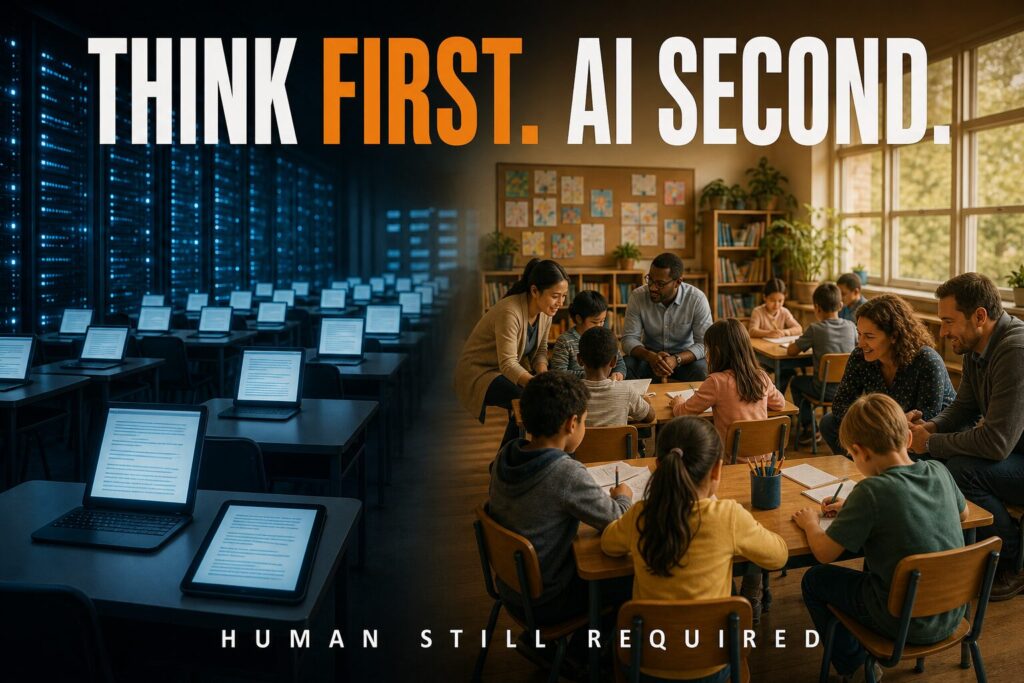
Most student AI policy debates are stuck on one question: yes or no. Ban it or allow it. Block it or roll it out. This week, a report from 30 learning researchers made the news with a better question. Not whether students should use AI. When.
That one word changes the conversation. It moves us from a fight about tools to a decision about learning. And it puts the decision where it belongs: with the people who know what a child needs to build before a machine can help them build more.
A student AI policy that only answers “whether” will keep swinging between extremes. One that answers “when” and “in what order” has a chance to hold.
Key takeaways
- A University of Minnesota expert consensus report says generative AI’s promise and pitfalls are most precarious in the elementary grades, and recommends that student access be developmentally sequenced.
- Experts in that report found AI helps most in the middle of learning, such as practice and feedback, and poses the most risk to first learning and higher-order thinking.
- Howard County, Md., just adopted a policy that treats every assignment as AI-free unless a teacher allows it, joining a wave of required district policies.
- A strong student AI policy sets an order: students think first, AI supports second, and humans decide when a student is ready for more.
What’s happening
On October 28, MPR News reporter Elizabeth Shockman covered a University of Minnesota report warning that careless student AI use can threaten learning. The report itself, Expert Consensus Report: Ways Generative AI Can Support and Threaten Learning in K-20 U.S. Education, was led by Panayiota Kendeou, Jeffrey A. Greene and Nia Nixon, with 27 contributing scholars in the learning sciences, educational psychology and educational technology.
The method matters here. Thirty experts used a consensus process to rate 65 learning processes, from memory and critical thinking to collaboration, motivation and sense of belonging. They reached consensus on 42 of them. They also rated 11 recommendations for both impact and how realistic they are to implement.
A few findings stood out to me:
- The report calls it a “GenAI Paradox.” AI is most likely to disrupt initial learning and higher-order thinking, but it can help with consolidation, the middle step. In the report’s words, “GenAI works best in the middle.”
- The strongest positive signals were for study strategies like self-testing, tutoring, scaffolding and learning from feedback.
- Experts flagged critical thinking, creativity, agency, persistence and several collaboration processes, including sense of belonging, as vulnerable.
- The report’s headline on age is direct: “GenAI’s promise and pitfalls are most precarious in the elementary grades.” One recommendation, “Competency-Gated GenAI Use,” says access “should be developmentally sequenced.”
Kendeou put it plainly in the MPR interview. If her goal as a teacher were for students to develop certain skills, she said, “I would definitely not provide access to my students.” She would provide access once students “already have developed a certain level of those skills.” She also said, “we cannot afford to get it wrong.”
Two other details from the report are worth every leader’s attention. The experts rated the evidence behind these processes as weak. And the recommendations they found hardest to implement included competency-gated use and authentic assessment redesign. In other words, the most important work is also the hardest work.
Then, on October 30, GovTech republished Baltimore Sun reporting by Kiersten Hacker that Howard County, Md., students now need teacher permission to use AI. The board’s new policy treats all assignments as AI-free by default. When a teacher allows AI, students must stay within set boundaries and disclose or cite their use. Staff may use AI for lesson planning, drafting communications and translation, but not for grading or counseling, or with personally identifiable information. The district will provide AI literacy instruction for students and professional development for staff.
Howard adopted the policy a week after a state deadline. Maryland’s Artificial Intelligence Ready Schools Act required every school system to adopt a policy aligned with state guidelines by October 22, and Howard was one of four systems that missed it. The board’s student member, Mark Li, said students find AI guidelines unclear and hard to access, urged AI literacy beyond simply telling students to avoid AI, and noted that when students see teachers using AI, they may conclude it is acceptable for them too.
Maryland isn’t alone. On October 29, GovTech’s Abby Sourwine reported on SETDA’s 2026 State EdTech Trends Report: 23% of states now require AI guidance, up from 4% in 2024, and Ohio became the first state to require every district to adopt an AI use policy. The same survey found 62% of state leaders name professional learning as a top unmet need, up from 47% in 2025.
So more districts are writing student AI policy, often on a deadline. The question is what those policies are built on.
Why sequence matters more than permission in student AI policy
In Chapter 5 of Human Still Required, I argue that the real risk with AI isn’t cheating. It’s atrophy. The worry isn’t that students will get away with something. It’s that they will skip the thinking that builds the capacity to think.
That’s why I describe AI as a thinking scaffold, not a thinking replacement. And scaffolds have one defining feature. They are temporary by design.
The goal was never the scaffold. The goal was independence.
Human Still Required
The Minnesota report gives that idea research language. Think first. Then use AI to practice, test and extend. That’s a scaffold. Handing a powerful tool to a learner who hasn’t yet built the underlying skill isn’t a scaffold. It’s a shortcut around the very thing school is for.
This is also why “AI-free by default” policies like Howard’s can be a reasonable starting point, but only a starting point. A default protects the first stage of learning. It doesn’t, on its own, answer the next question: when is a student ready for more, and who decides? If the answer is “each teacher, alone, with no shared picture of readiness,” students will experience the policy exactly as Mark Li described it. Unclear. Hard to find. Different in every room.
Chapter 13 makes the same case from a different direction. Schools have to protect critical thinking, productive struggle and reflection. Not because struggle is noble. Because it’s where learning happens. The experts in this report flagged agency, persistence and critical thinking as vulnerable, and recommended preserving productive struggle and avoiding shortcuts that bypass essential effort. That’s a list of what schools must protect.
Protections require leadership, not consensus.
Human Still Required
Notice that this report was a consensus process, and even so, the experts said competency-gated use is hard to implement. That’s the leadership gap. Research can tell us the order matters. It can’t sit in a grade-level meeting and decide what “ready” looks like for your fourth graders. People have to do that.
And there’s one more line from Chapter 5 that Howard’s student board member reminded me of:
If adults outsource their thinking, students will too.
Human Still Required
Students watch what we do more closely than they read what we write. A policy that says “think first” lands better when students can see adults thinking first, too.
What leaders can do now
- Write the sequence, not just the rule. For each grade band, name the foundational skills students should show before AI is used for a task, and the kinds of AI support that fit next, such as practice, hints and feedback.
- Protect “think first” moments. Build an expectation that students put their own ideas down before they consult AI, especially in writing and problem-solving. This is the report’s first recommendation, and it costs nothing to start.
- Treat the elementary grades differently. If your district is considering student-facing AI for young learners, ask what specific learning it supports and what it might replace. The report is clear that this is where the risk is highest.
- Make teacher permission consistent, not arbitrary. If assignments are AI-free by default, give teachers shared criteria for when to allow AI, so students aren’t guessing room to room.
- Invest in the people deciding. Readiness calls are professional judgment. Give teachers time to look at student work together and calibrate what “ready” means. A policy without that learning is just a document.
If your leadership team wants a structured way to work through questions like these together, the 5-Week Book Study is built for exactly that kind of conversation.
Frequently asked questions
Should elementary students use AI in school?
A University of Minnesota expert consensus report released in October 2026 says AI’s promise and pitfalls are most precarious in the elementary grades, and recommends sequencing access by developmental stage. That doesn’t mean never. It means leaders should be clear about which foundational skills young students need to build on their own first, and cautious about tools that do that work for them.
What should a student AI policy include?
At minimum, clear rules on when AI is allowed, how students disclose its use, privacy protections and training for staff and students. Howard County’s new policy, for example, treats assignments as AI-free unless a teacher allows it and requires disclosure. The stronger policies also describe the order of learning: what students do independently first, and how AI supports them after.
Where does AI help student learning the most?
The experts in the Minnesota report saw the strongest benefits for study strategies such as self-testing, tutoring, scaffolding and learning from feedback. They saw the most risk to first learning and to higher-order skills like critical thinking and creativity. As the report puts it, “GenAI works best in the middle.”
The order is the policy
For the last few years, a lot of school AI conversations have been about access. Who gets the tool. Which tool. When to turn it on.
Access was never the hard part. Order is. What does a student need to build on their own before a machine can help them go further? That’s not a technology question. It’s a teaching question, and it’s a leadership question.
So here’s mine for you: if a parent asked how your district decides when a student is ready to use AI, what would you say?
Sources
- Expert Consensus Report: Ways Generative AI Can Support and Threaten Learning in K-20 U.S. Education — University of Minnesota College of Education and Human Development, October 2026; covered by MPR News, October 28, 2026
- Howard County, Md., Students Need Teacher Permission to Use AI — GovTech (Baltimore Sun), October 30, 2026
- SETDA: States Shift From Ed-Tech Adoption to Accountability — GovTech, October 29, 2026