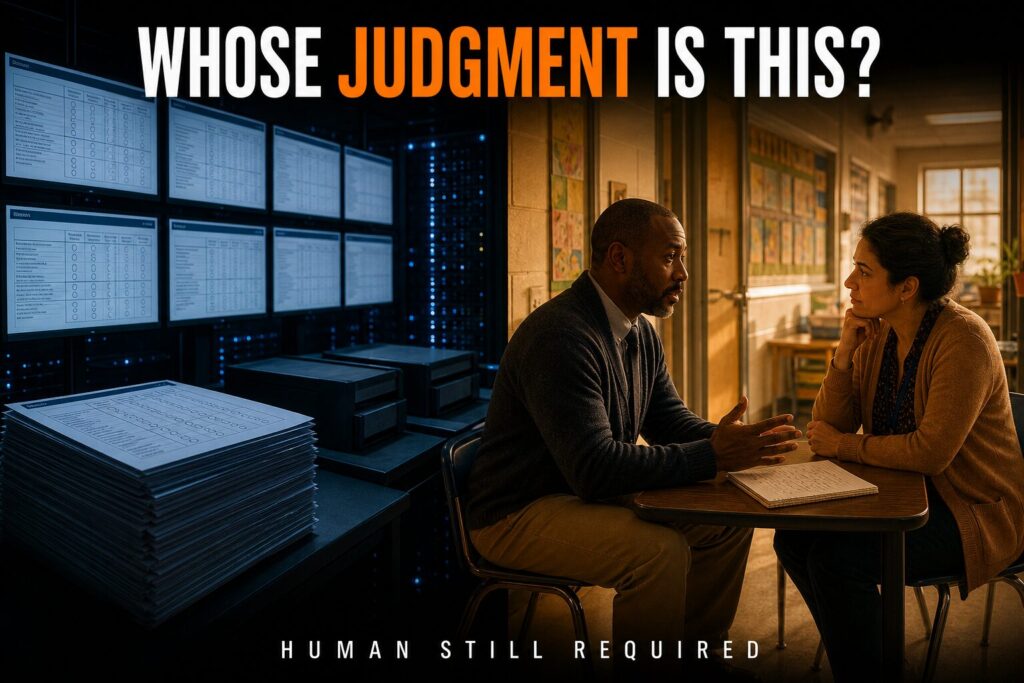
A kindergarten teacher in Concord, Massachusetts, is in court arguing that her principal leaned on AI to write the evaluation that ended her career there. The district says only a grammar checker was used. An arbitrator gave the AI claim no weight. But the question is now on the record, and it will not be the last time a school hears it. AI teacher evaluations are no longer a hypothetical policy discussion. They are a trust question, and in this case a legal one.
I am not here to judge that case. I don’t know what happened, and neither does anyone reading the coverage. What I do know is that every leader who uses AI to help write about a person should be ready to answer one question with confidence: whose judgment is this?
Key takeaways
- AI teacher evaluations raise a trust question before they raise a technology question: staff need to know the judgment in the document is the leader’s own.
- New survey data from England shows school leaders’ use of AI for parent communication has grown far faster than predicted, while use for marking and data analysis lags.
- AI can help prepare an evaluation. It cannot carry the responsibility for one.
- Leaders should set clear, public norms for how they use AI in evaluations and communication before a dispute forces the issue.
What’s happening
On October 18, Boston.com reported on a Concord kindergarten teacher’s lawsuit alleging her principal used AI to write her dismissal evaluation. The teacher, who had taught at Thoreau Elementary for more than 20 years, was dismissed in 2025. She alleges the summative evaluation recommending her firing refers to parts of the teacher evaluation rubric that do not exist, and that an AI detection tool, GPTZero, flagged several of the principal’s reports as likely written by AI. Her court filing argues the principal “failed to base his ratings on his own professional judgment.”
The district and principal say only an AI grammar checker was used and that the dismissal followed a series of poor performance reviews. After hearings that ran from January to May, an arbitrator upheld the dismissal in August, found the district followed proper procedure, and gave the AI allegation no weight, while calling the errors in the evaluation “troubling.”
There is one more detail worth slowing down on. According to the reporting, the arbitrator assessed GPTZero’s reliability by querying two AI models, whose output said the detector “isn’t always accurate.” The teacher’s lawsuit, filed September 28, argues the arbitrator investigated outside the hearing record without telling either party. So AI shows up on every side of this story: in the allegation, in the evidence, and in the review of the evidence. None of these claims has been settled by the court.
A few days earlier, on October 15, EdTech Innovation Hub reported new Teacher Tapp survey data comparing what teachers in England predicted they would use AI for with what they actually do. In April 2023, about 28% of primary senior leaders predicted they would use AI for parent communications. In September 2026, about 56% reported doing so. Meanwhile, use for judgment-heavy work came in well below predictions: about 7% of secondary teachers reported using AI for marking, against roughly 31% who expected to, and about 7% of primary teachers reported using it to analyze attainment data, against an expected 34%.
Put those two stories side by side and a pattern appears. AI is moving fastest into the writing leaders do about and to people. That is exactly where trust is built or lost.
Why AI teacher evaluations are a judgment question
In Chapter 7 of Human Still Required, I argue that information has scaled but responsibility has not. A tool can produce a polished paragraph about a teacher’s classroom management in seconds. It cannot have been in that classroom. It cannot know what that teacher tried in October, what changed in January, or what the conversation after the last observation felt like. Context is lived, not labeled.
Judgment isn’t about being right. It’s about being accountable.
Human Still Required
An evaluation is one of the most accountable documents a leader writes. It shapes someone’s livelihood and their sense of whether they still matter in the building. When a teacher reads it, she isn’t only reading ratings. She is reading whether her leader actually saw her. If she suspects a machine wrote it, the ratings almost stop mattering. The relationship has already taken the hit.
That is why the Concord case matters even if every allegation in it turns out to be wrong. The damage of suspicion doesn’t wait for a verdict. In Chapter 8, I write about why staff believe some messages and not others:
They trust leaders because the message sounds like it came from someone who knows them.
Human Still Required
Evaluations and parent letters both live or die on that sentence. And the Teacher Tapp data suggests that, at least in England, leaders are handing the first draft of parent communication to AI at twice the rate they predicted.
The line between preparing and deciding
I am not saying leaders should never use AI anywhere near an evaluation. Chapter 4 is about letting the machine do the busywork, and the SAFE framework (Structured, Administrative, First-draft, Easily repeatable) describes the kind of tasks where AI can help. Organizing observation notes, checking that evidence maps to the right rubric language, cleaning up grammar: those can be legitimate supports.
But Chapter 4 also draws a hard line. Decision-support is not decision-making.
Let AI prepare you to decide. Do not let AI replace the act of deciding.
Human Still Required
The ratings, the narrative about a person’s practice and the recommendation are the decision. Those have to be built from what the leader observed, weighed and is willing to defend face to face. And one of the guardrails in that chapter applies directly here: no AI-written communication goes out without a human read. Personnel documents deserve at least that standard. A reference to a rubric element that doesn’t exist is exactly the kind of error a careful human read is supposed to catch, whatever produced it.
Notice too that the people closest to judgment work seem to sense this already. In the survey, the clearest growth is where AI helps teachers create, adapt and communicate, while use for marking and data analysis sits well below what teachers expected. That isn’t resistance. It may be an instinct about where the human has to stay in the loop. Leaders should pay attention to that instinct in their own work.
What leaders can do now
- Write down your own norm before anyone asks. Decide, in plain language, what AI may and may not do in evaluations and personnel documents in your school or district. For example: AI may organize notes and check grammar; ratings, narratives and recommendations are written by the evaluator.
- Tell staff how you use AI. Disclosure doesn’t weaken trust. Surprise does. A short note at the start of the year explaining how you use AI, and how you don’t, removes the guessing.
- Check every evaluation against the actual rubric. Make a final read against the official framework a non-negotiable step, especially for any document tied to employment decisions.
- Be careful with AI detectors. The Concord case shows how detector results end up as contested evidence. Don’t build personnel or student discipline decisions on a detector score alone.
- Audit your parent communication. Pull five recent messages that went to families. Ask whether each one sounds like it came from someone who knows that community. If not, revise your process, not just the message.
If your leadership team wants a structured way to work through norms like these, the Human Still Required leadership guide is a good place to start the conversation.
Frequently asked questions
Can principals use AI to write teacher evaluations?
Whether it is allowed depends on your state, your contracts and your district policy, so check those first. In my view, AI can help organize notes or check grammar, but the ratings, narrative and recommendations must reflect the evaluator’s own observation and judgment. If you couldn’t explain and defend a sentence in person, it shouldn’t be in the evaluation.
Should school leaders disclose AI use to staff?
Yes. Being open about how you use AI, and where you draw the line, prevents the kind of suspicion that damages trust long before any dispute. A simple, consistent statement of practice is usually enough.
Are AI detectors reliable enough for school decisions?
Treat them with caution. In the Concord case, a detector’s results became contested evidence, and the arbitrator noted output saying the tool “isn’t always accurate.” A detector score should start a conversation, never end one.
The work that stays human
Every leader is going to be asked, sooner or later, whether a machine wrote something with their name on it. The best answer isn’t a defensive one. It’s a practice that makes the question easy: “Here is how I use AI, and here is the part that is always mine.”
The documents we write about people are where our judgment becomes visible. They deserve our full attention.
So here is my question for you: if a teacher on your staff asked tomorrow whether AI helped write her evaluation, what would you say, and would she believe you?
Sources
- Concord kindergarten teacher alleges principal used AI to fire her — Boston.com, October 18, 2026
- AI use in schools exceeds teacher predictions for lesson planning but lags for marking and data — EdTech Innovation Hub (Teacher Tapp data), October 15, 2026