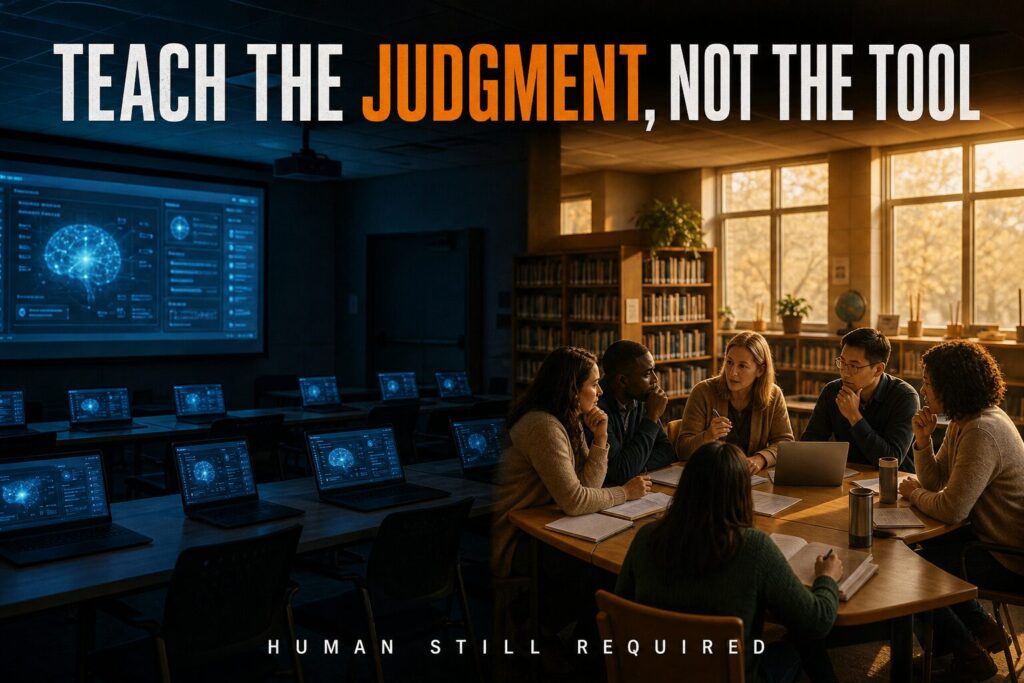
More schools are offering AI professional development than ever. That’s the good news. The harder news is that the research and the training are pointing in two different directions. The evidence says the question that matters is how AI gets used. Most of the training is still answering a different question: what AI can do.
That gap is a leadership problem, not a technology problem.
This week brought two pieces of news that belong in the same conversation. Stanford released an updated review of the strongest research on AI in K-12, and Education Week published what teachers say is missing from the AI training they’re getting. Read side by side, they tell leaders exactly where to aim professional learning next.
Key takeaways
- Stanford’s November 2026 evidence review finds AI is more likely to support student learning when it helps students understand material than when it produces work for them, though neither use consistently improves learning.
- About two-thirds of educators now report at least one AI professional development session, but teachers say the training is often optional, demo-heavy and silent on drawbacks.
- AI professional development should teach the difference between AI that extends thinking and AI that replaces it, because that is the line the research keeps drawing.
- The skeptics who skip optional training are the people leaders most need in the room.
What’s happening
On Nov. 10, Stanford’s SCALE Initiative and its AI Hub for Education published The Evidence Base on AI in K-12: A November 2026 Review. The causal evidence base grew from 20 papers in the March review to 52, limited to randomized controlled trials and quasi-experimental studies. The headline finding is careful: student AI use “appears more likely to support learning when students use it to understand new material than when they use it to produce work for them, although neither type of use consistently improves learning.”
The educator findings are just as interesting. According to the review, educators given AI-generated drafts or suggestions provided more and higher-quality feedback without spending more time on the task. AI can save teachers time on lesson planning. But the review also flags unintended effects, including undermining student motivation, and one new study found a broader teaching-support AI tool reduced achievement among students of lower-performing teachers.
Chalkbeat’s Erica Meltzer covered the review on Nov. 13 and added a detail worth sitting with: in one study, students who believed a lesson was AI-generated were less motivated. She also quoted Susanna Loeb, the SCALE faculty director who led the report, on what districts should take from it: “You just have to use them thoughtfully and track how they are doing and whether they’re really benefiting students.” Loeb was blunter, too. For a district that doesn’t want to design its classwork and school day to use these tools well, her advice was simple: “I wouldn’t use them.”
Then on Nov. 16, Education Week’s Lauraine Langreo reported on what teachers say is missing from AI professional development. An EdWeek Research Center survey of 852 educators, conducted from Aug. 26 to Oct. 6, found about two-thirds of teachers, school administrators and district leaders reported at least one professional development session on using AI, up 11 percentage points from 56% last year. But the teachers interviewed described three gaps: training is often optional and reaches only the people who already seek it out; educators want hands-on practice and time with peers rather than demonstrations; and they want honest discussion of the drawbacks, from cheating to critical thinking. As West Virginia science teacher Jaime Moss put it: “Teachers don’t want another demonstration of what AI can do.”
Why AI professional development has to change
Put those two stories together and the pattern is hard to miss. The research is not saying “AI works” or “AI doesn’t work.” It’s saying the design of the use decides the outcome. Understanding versus producing. Drafts a teacher reviews versus plans a teacher hands over. Support for thinking versus a substitute for it.
And yet much of the training teachers describe is still built around the tool. Here’s the feature. Here’s the prompt. Here’s what it can make in thirty seconds.
In Chapter 12 of Human Still Required, I argue that this is exactly the trap schools fall into when the ground shifts:
Professional learning that centers on tools produces trained technicians. Schools need adaptive professionals.
Human Still Required
A trained technician knows which button generates a lesson plan. An adaptive professional knows when an AI-drafted lesson plan will quietly cost them something, like student motivation, or the thinking they would have done while building it. The Stanford review is, in a sense, a catalog of those trade-offs. That is the content professional learning should be built on.
This is also the core idea of Chapter 5. AI is a thinking scaffold, not a thinking replacement. The research now gives that distinction real weight. When students use AI to understand new material, the evidence leans more positive. When AI produces the work, it doesn’t. My one-line version from the book still holds:
AI should extend thinking, not finish it.
Human Still Required
If that is the line the evidence keeps drawing for students, it should be the line we draw in our training for adults. Teachers can’t design for “extend, don’t finish” if their own learning experiences only ever show AI finishing things.
The people who skip the training matter most
One detail from the EdWeek piece deserves its own section. Teachers said the people who get AI training are the ones who seek it out. The skeptics aren’t there.
I understand why districts make AI training optional. It feels respectful. It avoids forcing anything on anyone. But think about who that leaves out. The skeptical teacher often has the sharpest questions about cognitive offloading, about student motivation, about what happens to struggling learners. Those are the same questions the Stanford review is now putting evidence behind.
In Chapter 11, I write about fear and resistance as information, not obstruction. The line I return to most often is this one:
Fear isn’t the problem. Silence is.
Human Still Required
When teachers say they want AI professional development to discuss drawbacks, they aren’t being negative. They are asking to be treated as professionals who make judgment calls. A training that only shows upside asks them to trust the tool. A training that names the trade-offs asks them to think. Only one of those builds the judgment the research says we need.
What leaders can do now
- Rebuild one AI session around the evidence, not the tool. Share the Stanford finding about understanding versus producing, then have teachers sort their own recent AI uses into “helped students think” and “did the thinking for them.”
- Invite the skeptics on purpose. Ask two or three of your most cautious teachers to co-design the next session. Their questions about drawbacks are the curriculum teachers say they’re missing.
- Make practice hands-on and collaborative. Teachers asked for time to explore with peers and real materials. Trade the next demonstration for a working session where teams build, test and critique one classroom use together.
- Track whether it’s working. Loeb’s advice is to use these tools thoughtfully and track whether they benefit students. Pick one AI practice in your school and agree on what evidence you’ll look at in six weeks, including student motivation, not just time saved.
- Ask the reflection question every time. End each session with: “Where did AI support your thinking, and where did it get in the way?” Then actually use the answers to plan the next one.
If your leadership team wants a structure for working through these conversations together, the 5-Week Book Study is built for exactly that kind of shared thinking.
Frequently asked questions
What does the latest research say about AI and student learning?
Stanford’s November 2026 review of 52 rigorous studies found AI is more likely to support learning when students use it to understand new material than when it produces work for them. Neither use consistently improved learning. The researchers caution that the evidence base is still growing.
What should AI professional development for teachers include?
Teachers interviewed by Education Week asked for hands-on practice, time to learn with peers, and honest discussion of drawbacks such as cheating and critical thinking. I’d add one more: a clear framework for telling the difference between AI that extends student thinking and AI that replaces it.
Should AI training for teachers be mandatory?
Mandating a tool tutorial won’t help much. But leaving all AI learning optional means skeptical teachers, who often raise the most important concerns, never join the conversation. Aim for required conversations about judgment and trade-offs, with optional deep dives on specific tools.
The question underneath the training
The research is finally catching up to what many educators already sensed. AI isn’t good or bad for learning on its own. How we use it decides that.
Which means the most important thing we can teach adults about AI isn’t a feature. It’s a judgment.
So look at the last AI training your school offered. Did it teach people what the tool can do, or did it teach them when to use it?
Sources
- The Evidence Base on AI in K-12: A November 2026 Review, Stanford SCALE Initiative / AI Hub for Education, Nov. 10, 2026
- AI tools might help teachers. Students? Not so much, research review finds, Chalkbeat, Nov. 13, 2026
- Teachers Pinpoint What’s Missing in Professional Development About AI, Education Week, Nov. 16, 2026