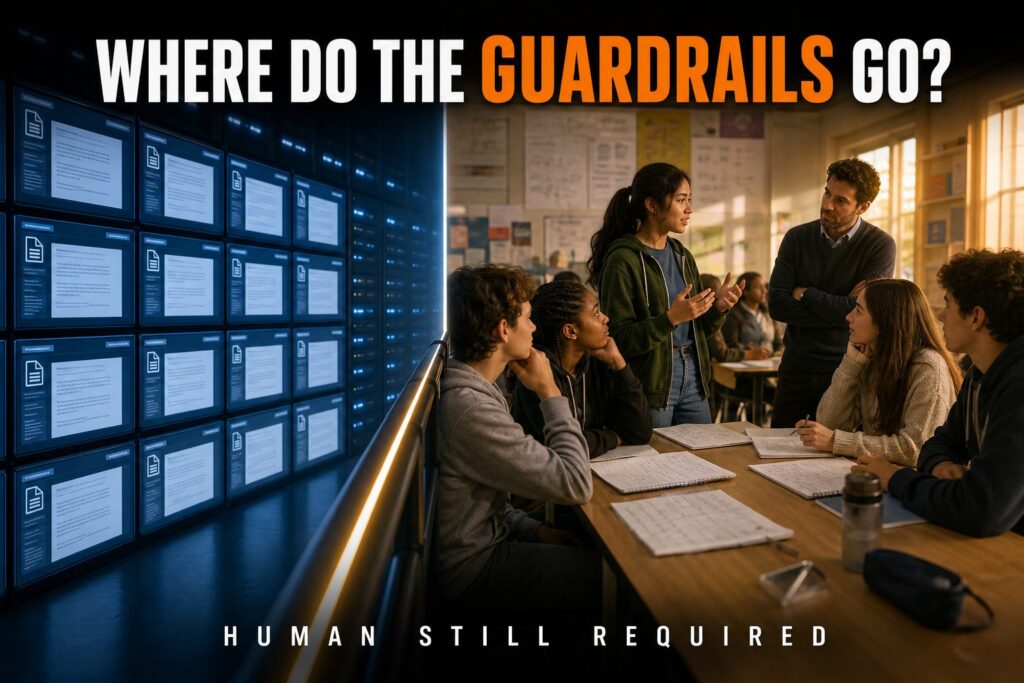
Most AI policy debates in K-12 are still stuck on one question: yes or no. The College Board just answered a better one. Its redesign of two AP courses is a working model of AI assessment guardrails: let students use AI where it supports learning, and draw a firm line at the exact moment we need evidence of what a student can do on their own.
That’s not a ban. It’s not a free-for-all either.
It’s a decision about where the thinking has to show up. And that is the decision school leaders are wrestling with right now.
Key takeaways
- The College Board will redesign AP Computer Science Principles and AP Seminar for 2027-28, building AI into learning while keeping scored AP Seminar writing free of generative AI.
- AI assessment guardrails work best at the point where you need evidence of independent thinking, not spread evenly across every assignment.
- Districts are landing in very different places on AI, from New York City’s moratorium to Boston’s AI fluency push to Petaluma’s grade-by-grade tiers.
- The question for leaders is not “Is AI allowed?” It is “Where must the thinking be the student’s own, and how will we see it?”
What’s happening
On September 28, GovTech reported that the College Board will redesign AP Computer Science Principles and AP Seminar beginning in the 2027-28 school year. The changes grow out of new College Board research on AP teachers and generative AI, released September 23, which drew on surveys and focus groups with thousands of AP teachers from April 2025 through June 2026.
The two courses are going in different directions, on purpose. In AP Computer Science Principles, AI and machine learning will be woven into core units, including algorithm development, data ethics and societal impacts, and students will complete a new “AI Create Project” in which they build an application that uses AI. More than 80% of surveyed CSP teachers said that kind of content would be useful.
In AP Seminar, students can keep using generative AI responsibly in their coursework, for research and for learning to write. But the independent writing that counts toward the AP score will be done in a secure, proctored setting without access to generative AI.
The teacher data behind those choices is worth sitting with. According to the College Board, 92% of the AP teachers surveyed worried that generative AI makes students over-dependent on technology, and 90% worried students won’t build critical thinking skills. Yet 90% also agreed schools must teach responsible use. Nearly half said they understood AI somewhat but still needed guidance themselves, and roughly a quarter worked in schools or districts with no generative AI policy at all.
Meanwhile, districts keep splitting. On October 2, GovTech republished a MassLive report on how Boston and New York City are taking opposite approaches to AI in school. New York City has paused student-facing generative AI for pre-K through eighth grade, affecting nearly 600,000 students, and disabled AI features in 38 software programs. Boston has set a goal that all students will graduate AI literate, backed by a $1 million partnership with UMass Boston and 25 “AI educator ambassadors.” MIT’s Justin Reich, quoted in the piece, suggested that despite the very different rhetoric, the day-to-day learning experiences in the two cities may not be that different, and that both approaches need careful evaluation.
And on October 1, GovTech carried a Petaluma Argus-Courier report on Petaluma City Schools drafting a tiered AI plan for students: no AI in K-2, learning how AI works without student-facing tools in grades 3-5, responsible use in closed, school-focused environments in grades 6-8, and teacher-guided use in grades 9-12. Students would disclose AI use, and teachers would keep responsibility for grading and assessment. The plan has not been adopted yet.
Why AI assessment guardrails matter more than AI bans
Here’s what stands out to me. The College Board didn’t ask, “Should students use AI?” It asked, “At what point do we need to know what the student can do without it?”
That is the question I keep pushing leaders toward. In Chapter 6 of Human Still Required, I argue that AI didn’t create a learning crisis. It exposed a measurement problem. When a machine can produce the essay, the essay alone stops being proof of anything. So schools have to get clear about what still counts as evidence of learning.
Who did the thinking?
Human Still Required
That’s the whole game. The D.E.C.I.D.E.R. framework in Chapter 6 lays out what still counts: Decision-making, Explanation, Critique, Inference, Development, Evaluation and Relocation, the ability to transfer learning to a new context. Notice that none of those are about whether a tool was in the room. They’re about whether the student can show their reasoning.
In Chapter 5, I write about AI as a thinking scaffold, not a thinking replacement. Scaffolds are temporary by design. You use them while you build, and then you take them down to see if the structure stands. The AP Seminar change is basically that idea turned into policy: use AI to learn, then show what you’ve learned on your own.
Drafts are allowed. Final thinking must be human.
Human Still Required
I’ll add one caution. In Chapter 2, I warn against retreating to harder tasks or paper-and-pencil just to outsmart AI. A proctored essay can become exactly that if it’s the only move a school makes. What makes the AP approach different is that it’s paired with something: AI is taught and used inside the course, and the guardrail sits at one deliberate point. The secure essay isn’t hiding from AI. It’s protecting a specific piece of evidence.
The district stories show why this matters. New York City, Boston and Petaluma are all drawing lines. But a line about access is not the same as a line about evidence. You can ban a tool in eighth grade and still have no idea whether students can explain their thinking. You can teach AI fluency in tenth grade and still grade work that tells you nothing about who did the thinking.
These aren’t anti-AI rules. They’re pro-thinking rules.
Human Still Required
What leaders can do now
- Map your evidence points. For each course or grade band, name the two or three moments where you truly need to see independent student thinking. Put your guardrails there, not everywhere.
- Separate learning from proof. Make it explicit, in writing, which work is practice where AI may help and which work is evidence where it may not. Students should never have to guess.
- Don’t stop at a proctored essay. Pair secure writing with conferences, oral explanations and revision conversations. A student can generate an answer, but explaining and defending it is much harder to fake.
- Close the guidance gap for teachers. If nearly half of AP teachers say they still need guidance, your staff probably do too. Build time for teams to design assessments together, not just learn tools.
- Ask what your policy actually changes in classrooms. Reich’s point about Boston and New York applies everywhere. Before the next board vote, ask what students will experience differently on a Tuesday, and how you’ll know if it’s working.
If your leadership team wants to work through these questions together, the 5-Week Book Study is a good place to start.
Frequently asked questions
What is changing in AP Seminar and AP Computer Science Principles because of AI?
Starting in 2027-28, AP Computer Science Principles will embed AI and machine learning across core units and add an “AI Create Project.” AP Seminar will keep allowing responsible AI use in coursework, but scored independent writing will happen in a secure, proctored setting without generative AI.
Should our district ban AI or teach it?
That framing is too narrow. The more useful question is where you need evidence of independent student thinking and how you’ll gather it. Many schools will both teach AI and restrict it, at different grades and at different points in the learning process.
What are AI assessment guardrails?
AI assessment guardrails are clear limits on AI use at the specific moments when a school needs to see what a student can do independently, such as a scored essay, a performance task or an oral defense. Outside those moments, AI can support practice, research and feedback.
The real line
Every district is drawing a line on AI right now. Some are drawing it around a grade level. Some around a tool. Some around a time limit.
The College Board drew theirs around the evidence. That’s the line I’d study first.
So here’s my question for you: in your school, where is the one moment you most need to see a student’s own thinking, and is your AI policy protecting it?
Sources
- AI Spurs College Board Redesign of 2 AP Courses — GovTech, September 28, 2026 (based on College Board research released September 23, 2026)
- Boston and New York City Take Opposite Approaches to AI in School — GovTech (via MassLive), October 2, 2026
- Petaluma City Schools Draft Tiered AI Plan for Students — GovTech (via Petaluma Argus-Courier), October 1, 2026