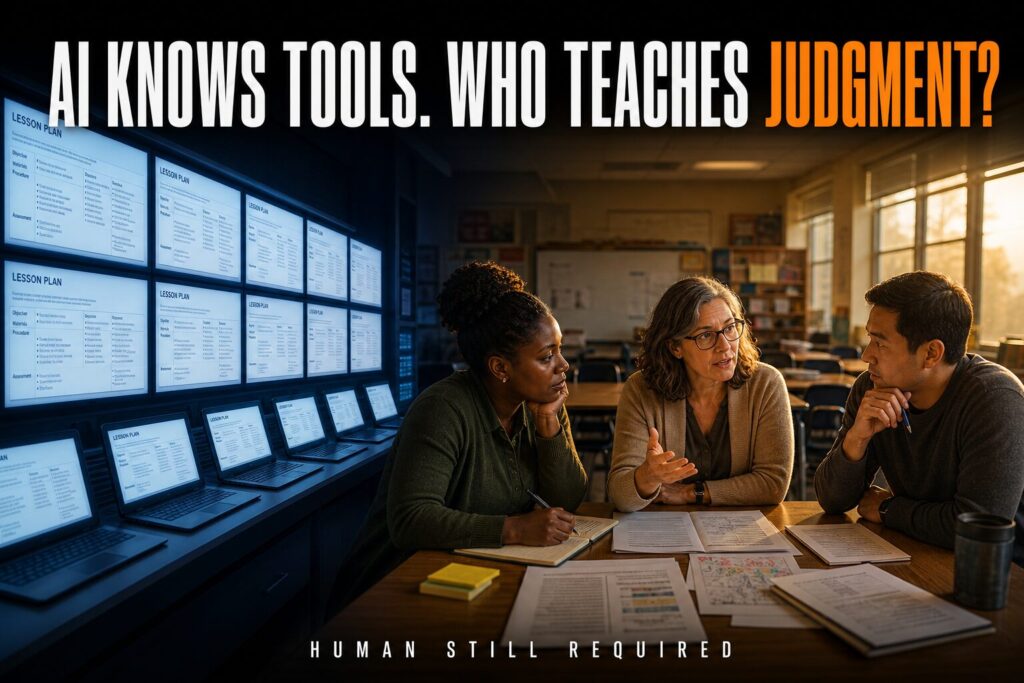
AI teacher preparation is happening. It just isn’t happening the same way twice. Depending on which program a new teacher attended, and often which professor they happened to get, they will show up at your school next fall with a thoughtful framework for AI, a few tips, or nothing at all.
That’s not a criticism of teacher educators. Most of them are learning this alongside everyone else. But it does mean something school and district leaders can’t ignore.
The preparation pipeline won’t settle this for us. Our hiring, induction and coaching will.
Key takeaways
- Teacher preparation programs are adding AI, but a new Education Week survey finds 60% leave the decision to individual instructors.
- New teachers will arrive with uneven AI preparation, so induction and coaching become the place where shared thinking gets built.
- The skill that matters most is not prompting. It’s judgment: knowing when AI helps instruction and when it quietly makes it worse.
- Leaders should coach new teachers on noticing and deciding, not on tools, and model that thinking themselves.
What’s happening with AI teacher preparation
On November 16, Education Week published a look at how AI is raising big questions for teacher education, built on a new EdWeek Research Center survey of 268 teacher educators conducted in August and September 2026. The picture is mixed. More than half say their programs prepare candidates to use AI for generating teaching ideas or developing and revising assignments, and nearly two-thirds say they prepare candidates to teach digital and AI literacy to K-12 students.
But the structure underneath is thin. Sixty percent say individual instructors decide whether to include an AI focus, and most programs have no stand-alone AI course. About a third say their programs struggle because faculty don’t support AI, and nearly a quarter say candidates themselves don’t want the preparation. The teacher educators aren’t getting much support either: only 14% report ongoing professional development on AI, while 68% say they want ongoing training or multiple sessions. And 57% name AI’s rapid development as a hurdle for the prospective teachers they serve.
One line in the piece stuck with me. Tisha Greene of UNC Charlotte described working with “12 different school districts, with 12 different superintendents, and they are approaching it 12 different ways.” That’s the world new teachers are walking into.
The same day, Education Week ran a companion story from a George Mason University teacher-prep class. Professor Jered Borup opens with an old microwave ad and asks his students who has cooked a Thanksgiving turkey in one. Nobody has. His point: AI is useful for brainstorming and rote tasks, the equivalent of reheating leftovers, but it won’t replace the conventional oven of teacher judgment. He showed students how a chatbot can agree with a bad idea, and he backed a future special education teacher’s worry about putting IEP data into an AI tool. The college’s dean, Ingrid Guerra-López, put it simply: “The conversation about AI and education is more about education than about AI.”
Then, on November 18, EdSurge published a conversation about grading the chat, not just the answer. Molly Fisher of Rowan University studies “professional noticing,” the ability of teachers to see what’s happening in students’ thinking. Her past research found teachers can learn to notice, but feedback is slow. Starting in spring 2027, her team will test whether AI can score teachers’ written responses to classroom video and get each teacher a report within a day. In the same episode, former teacher Mike Kentz describes grading students’ AI conversations themselves, building the criteria with students by comparing strong and weak chats.
What this reveals: tools are easy to teach, judgment is not
Put these three pieces together and a pattern shows up. The easy part of AI preparation is the tool. Anyone can show a new teacher how to generate a lesson plan. Justin Reich of MIT’s Teaching Systems Lab said it plainly in the Education Week piece: “Anybody can make these things spit stuff out.”
The hard part is knowing whether what came out is any good, for these students, in this room, on this day. That’s judgment. And judgment is exactly what a one-off workshop or an optional module can’t build.
In Chapter 12 of Human Still Required, I make this argument about professional learning, and it applies just as much to preparation:
Professional learning that centers on tools produces trained technicians. Schools need adaptive professionals.
Human Still Required
A new teacher who learned five AI tools in a methods course is a trained technician. A new teacher who learned to ask “Does this actually help my students think?” is an adaptive professional. The second one will still be useful when the tools change next year.
Chapter 7 is about why that second teacher matters. AI can produce a confident, polished lesson plan in seconds. It cannot know that half your third period just transferred in, that a student just lost a grandparent, or that the last unit didn’t land. As I write there:
Context is lived, not labeled.
Human Still Required
Borup’s microwave is a good image for this. The machine is fast and handy. It’s also why nobody in that room had ever cooked a real meal in it.
Fisher’s research points to the piece leaders often skip. Noticing is a learnable skill, and it improves with faster, more specific feedback. In Chapter 9, I ask leaders to reflect on a question that belongs in every new-teacher conversation, too:
When was the last time I changed a decision because of something I noticed, not something I measured?
Human Still Required
If AI eventually helps teachers get feedback on their noticing within a day, good. That’s decision support. But the noticing itself, and the decision that follows, has to stay human. That’s the line I draw throughout Part II of the book: let AI prepare you to decide, not decide for you.
What leaders can do now
If teacher preparation is uneven, then your induction program is where consistency gets built. Not consistency of practice. Consistency of thinking. Here’s where I’d start.
- Ask about AI judgment in hiring. Don’t ask candidates which tools they know. Hand them an AI-generated lesson plan and ask what they’d keep, change and throw out, and why. You’ll learn more in five minutes than from any résumé line.
- Build AI into induction, not as a tool session but as a thinking routine. In mentor meetings, use one recurring question: “Where did AI help your planning this week, and where did it get in the way?”
- Coach noticing directly. Walk-throughs with new teachers should focus on what they noticed about student thinking and what they did about it. That’s the skill AI can’t supply and the one that grows fastest with good feedback.
- Set clear guardrails early. New teachers shouldn’t have to guess. Make sure they know what student data never goes into an unapproved tool, especially IEP and other sensitive information, before their first week.
- Partner with your preparation programs. The survey found about half of faculty already partner with districts on AI. If you host student teachers, tell the programs what your schools expect, and invite their faculty into your own learning.
If your leadership team wants to work through these questions together, the 5-Week Book Study is built for exactly that kind of shared thinking.
Frequently asked questions
Are teacher preparation programs teaching AI?
Many are, but unevenly. In an EdWeek Research Center survey of 268 teacher educators, more than half said their programs prepare candidates to use AI for teaching ideas or assignments, yet 60% said individual instructors decide whether AI is included, and most programs have no stand-alone AI course.
What should principals look for in new teachers’ AI skills?
Look for judgment, not tool fluency. The strongest signal is whether a new teacher can evaluate AI output critically, explain what they would change for their specific students, and protect student data. Tool skills can be taught in an afternoon. Judgment takes coaching over time.
How should districts support new teachers with AI?
Treat induction as the place where shared thinking about AI gets built. Use mentoring routines that ask where AI helped and where it got in the way, coach teachers on noticing student thinking, and make data and privacy guardrails clear from day one.
The work that’s still ours
It’s tempting to wait for teacher preparation to sort this out. It won’t, at least not quickly, and the teachers starting next fall can’t wait for it.
The good news is that the most important part of AI readiness was never about the technology. It’s the same thing great mentors have always taught new teachers: look closely, think about who’s in front of you, and own your decisions.
So here’s my question for you: when your next new teacher uses AI to plan a lesson, who in your building will help them decide whether it’s actually good?
Sources
- AI Raises Big Questions for the Future of Teacher Education — Education Week, November 16, 2026
- Why AI Won’t Replace Teacher Judgment: A Professor’s Microwave Lesson — Education Week, November 16, 2026
- A New Classroom Use for Artificial Intelligence: Grade the Chat, Not Just the Answer — EdSurge, November 18, 2026