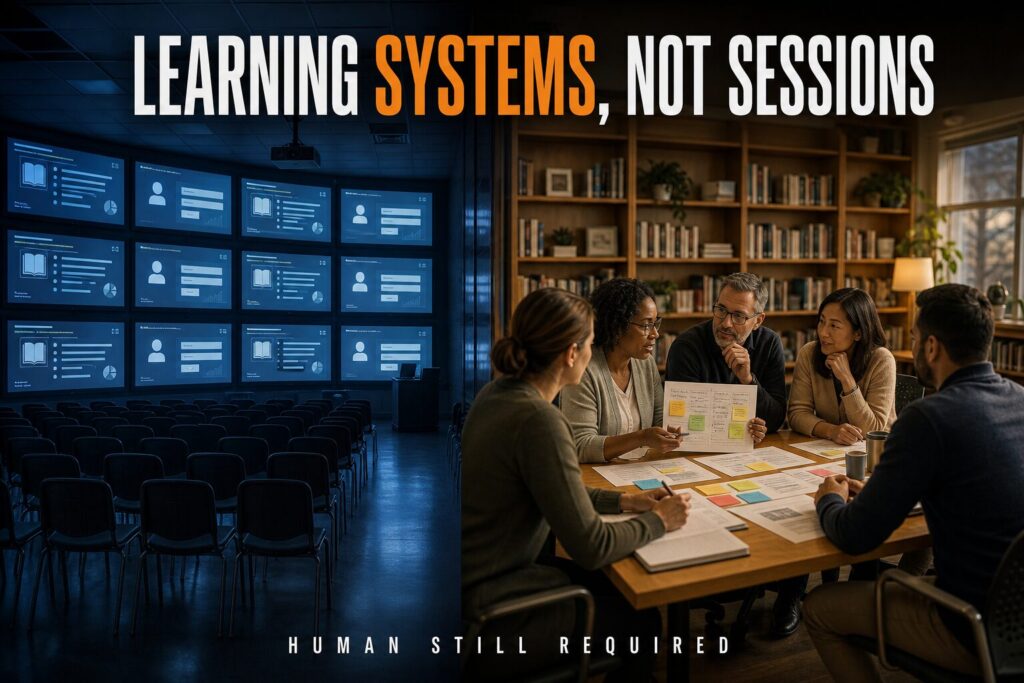
Teachers figured out AI faster than most school systems did. That’s not a complaint. It’s the situation. And it means AI professional learning can no longer be a session on the calendar. It has to be a system leaders build on purpose.
Two reports this week make the gap hard to miss. One comes from a 28-state leadership network in the U.S. The other comes from a national education research institute in South Korea. Different countries. Same pattern.
Use has outrun understanding. And when that happens, the weight lands on individual teachers.
Key takeaways
- Teachers are already using AI routinely, but shared understanding of the rules and responsibilities has not kept pace.
- One-time, opt-in AI training introduces tools. It does not build lasting capacity.
- Buying AI licenses is not the same as having an AI strategy; someone has to own each decision.
- Effective AI professional learning starts with leaders, builds over time, and aims for consistency of thinking, not consistency of tools.
What’s happening
On October 16, GovTech published an opinion piece from ILO Group’s Julia Rafal-Baer and former superintendent Scott Muri drawing on two school years of their AI Strategy and Leadership Network. The network included 68 systems in 28 states, including 15 state agencies, and more than 215 leaders serving 15 million students.
Their headline finding is that the questions have changed. Leaders have moved past “How do we get staff comfortable with AI?” Now they’re asking how to keep students safe, how to know if something works, who owns the decision, and whether the capacity they’re building will last.
A few details stood out to me:
- More participating districts have bought enterprise AI licenses than have a board policy, an approved tool list or a dedicated budget. The authors put it bluntly: licenses do not create strategy.
- One-time, opt-in training is still the most common model. The authors say it introduces a tool without building lasting skill.
- Almost none of the participating systems have role-specific AI training yet.
- Ector County ISD in Texas spent a full year building AI understanding among principals, the school board and the leadership team before extending training to teachers by grade band.
Then, on October 19, the Korea JoongAng Daily reported on a new Korean Educational Development Institute survey of 271 teachers. More than half (54.6%) use AI for work at least weekly. Their top uses are lesson ideas and planning, creating and revising materials, and drafting documents and reports. Use was much lower for evaluating student work, which the researchers attributed to teachers preferring tasks where they can verify and refine the output.
But only 17.3% said they were familiar with the laws, policies and guidelines governing AI use. 45.4% said they were unaware of them. The researchers warned that responsibility for AI problems falls disproportionately on individual teachers, and they recommended clearly defining who oversees AI use and where responsibility lies.
Closer to the ground, KTXS reported on October 16 that staff in Clyde CISD in Texas took part in a hands-on AI training led by Region 14 consultants, focused on ethics and responsible use. The district is one of 10 area districts working with Region 14, and its CTO said an AI committee reviews tools before staff can use them. That is real work, and it’s the kind of starting point many districts are at right now. The question is what comes after the session.
Why AI professional learning has to be a system, not an event
Read those three stories together and you see the same thing from three angles. Teachers are already using the tools. Most of them are being thoughtful about it, choosing work they can check. What’s missing isn’t effort. It’s shared understanding, clear ownership and a way to keep learning together.
In Chapter 12 of Human Still Required, I argue that one-size PD is over, and that tool-centered training produces the wrong outcome:
Professional learning that centers on tools produces trained technicians. Schools need adaptive professionals.
Human Still Required
A trained technician knows which buttons to push in a specific product. An adaptive professional knows how to think when the product changes, when the output is wrong, or when the situation isn’t covered by the guidance. Given how fast these tools change, only one of those is a durable investment.
This is why the one-time, opt-in session falls short. It assumes the problem is knowledge. Show people the tool, and they’ll use it well. But the Korean data shows teachers are already using it. Knowledge of the tool isn’t the gap. Understanding of the rules, the risks and who is responsible is the gap. That’s a thinking problem, and thinking gets built over time, in community.
The Ector County example matters because of its order. Leaders first. Board included. A full year. Then teachers, by grade band. That sequence says something: the people making decisions need to understand what they’re deciding about before they ask others to carry it out.
It also connects to Chapter 7. When responsibility for AI quietly drifts down to individual teachers, the system is asking them to carry decisions no one made out loud. As I write there:
Judgment isn’t about being right. It’s about being accountable.
Human Still Required
Accountability can’t be accountable to no one. If a district has licenses but no named owner for the decision, no policy and no budget line, the decision still got made. It just got made by default, one classroom at a time.
The goal isn’t that every teacher uses AI the same way. Context matters. A kindergarten teacher and an AP chemistry teacher should not have identical practice. The goal, as I put it in Chapter 12, is shared reasoning: everyone weighing the same values, the same risks and the same lines, even when their choices look different.
Learning sessions don’t build capacity. Learning systems do.
Human Still Required
What leaders can do now
- Start with yourselves. Before the next teacher session, put your leadership team and board through sustained learning on AI. Not a demo. Ask: What decisions are we making about AI, and do we understand them well enough to own them?
- Name an owner for every AI decision. For each tool or initiative, write down who is accountable, what success looks like and when you’ll decide to scale, revise or stop. If the answer is “each teacher,” make that a deliberate choice, not an accident.
- Close the rules gap. If teachers don’t know the guidance, the guidance doesn’t exist in practice. Put it on one page, talk it through in staff meetings and ask teachers where it’s unclear.
- Make learning role-specific and ongoing. Counselors, special educators, office staff and principals face different AI decisions than classroom teachers. Build recurring time, in teams, where people bring real cases and talk through them.
- Ask the reflective question regularly. In PLCs and leadership meetings, ask where AI supported people’s thinking this month, and where it got in the way. Then listen to the answers.
If your leadership team wants a structured way to do the first step together, the 5-Week Book Study is built for exactly that kind of shared learning.
Frequently asked questions
What is AI professional learning for teachers?
AI professional learning is ongoing work that helps educators use AI with sound judgment: understanding the tools, the rules, the risks and where responsibility sits. It goes beyond tool training. The aim is shared reasoning across a staff, so people make good decisions even when the tools change.
Is a one-time AI training session enough?
Usually not. ILO Group’s network found one-time, opt-in training is still the most common model, and the authors say it introduces a tool without building lasting skill. A session can be a good start. Capacity comes from repeated, collaborative learning over time.
Who should be trained on AI first in a school district?
Leaders. Ector County ISD spent a year building AI understanding among principals, the board and the leadership team before extending training to teachers by grade band. People who set policy and approve tools need to understand those decisions before asking teachers to carry them out.
The work behind the tools
None of this is a criticism of teachers. The data says they are adopting AI carefully and choosing tasks they can verify. That is good professional judgment.
The issue is that they’re often doing it alone. When the system hasn’t built shared understanding, every teacher becomes their own policy office. That’s not fair to them, and it’s not leadership.
So here’s my question for you: if I asked five teachers in your building who is responsible when an AI tool gets something wrong, would they give the same answer?
Sources
- Opinion: 4 Questions School Leaders Are Asking About AI — GovTech (Julia Rafal-Baer and Scott Muri, ILO Group), October 16, 2026
- Korean teachers embrace AI, but only 17% know the laws and policies behind it — Korea JoongAng Daily (reporting on a Korean Educational Development Institute survey), October 19, 2026
- Clyde CISD educators get hands-on AI training — KTXS, October 16, 2026