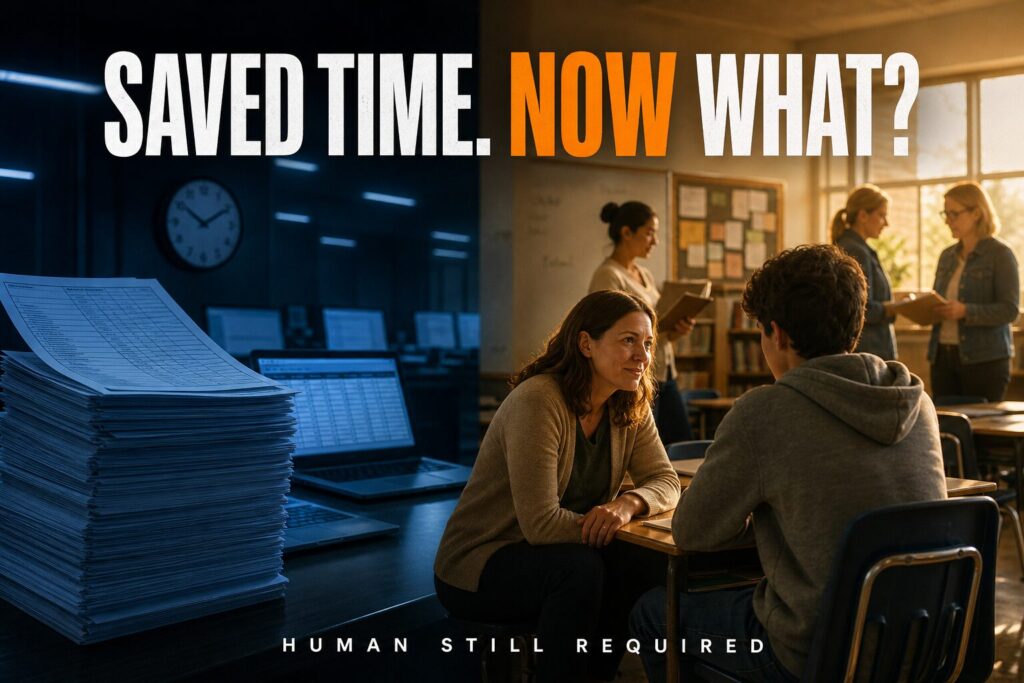
AI time savings are real for a lot of teachers. A new Gallup survey says so, and the number is not small. But the same survey holds a second finding that matters more for school leaders: the work that makes teachers feel they matter is almost never the work AI is saving them from.
That’s the part we can’t skip.
Saving time is a tool question. What happens to that time is a leadership question.
Key takeaways
- In a new Gallup survey, 64% of K-12 educators who used AI said it gave them more time for the parts of teaching that matter most to them.
- Educators said they feel they matter most when helping a student through something difficult (85%), and least when completing paperwork (9%).
- Only about one in three educators say they matter a great deal at their school, so time saved is not the same as people feeling valued.
- AI time savings only count if leaders protect the reclaimed time and point it toward students, feedback and relationships.
What’s happening
On October 14, Gallup published new survey results on teachers, AI and the time that matters most, written by Megan Brenan. The research comes from the Walton Family Foundation and Gallup, in partnership with The Mattering Institute. Gallup surveyed 1,952 U.S. K-12 educators, including teachers, paraprofessionals and other staff who work directly with students, from July 28 to August 14, 2026.
Here is what stood out to me:
- 59% of educators used AI tools in the 2025-2026 school year, for things like lesson preparation, creating materials and assessments, grading, feedback and administrative tasks.
- Among those users, 13% said AI gave them “a lot more time” for the parts of teaching that matter most to them, and 51% said “somewhat more.” That’s 64% combined. Another 29% said it made no difference, and 7% said it actually cost them time.
- When asked what makes them feel they matter “a great deal,” 85% said helping a student through something difficult. 74% said seeing students perform well academically. 57% said giving individual feedback on student work.
- Completing administrative or required paperwork? 9%.
- Only 35% of educators said they feel they matter a great deal at their school. And 50% said they get recognition from a supervisor at least a few times a month.
Keep in mind these time savings are self-reported. They are perceptions, not stopwatch measurements. And Gallup’s write-up doesn’t say what educators actually did with the time they got back. That gap is exactly where leadership lives.
The same day, Education Week’s Olina Banerji published a look at principals using AI to tackle some of the biggest challenges in their schools. Derek Cantrell, principal of Allegheny High School in Covington, Virginia, built custom tools with AI to track teacher observations, plan professional development and monitor student progress toward graduation, plus a system for absences and tardies that warns students as they near a limit and lets them earn back good standing. He also warns against putting student data into public tools. His summary is one I’d put on a wall: “My philosophy is, people over paperwork.”
Sterling Seeman, principal of Springer Middle School in Wilmington, Delaware, built AI prompts, an idea that came from a Delaware Department of Education pilot, to help teachers draft yearly goals, because wordsmithing the goals was eating his limited time with teachers. He also avoids AI for emails and newsletters because they lose their personal touch. Rachel Jensen, principal of Idaho Home Learning Academy, where teachers oversee more than 90 students per grade, uses automated tracking sheets so teachers can spend less time on clerical work and more on relationships.
Why AI time savings are a leadership question
Put the two stories next to each other and the pattern is hard to miss. Educators say AI is freeing time. Educators say they matter most in moments with students. And the principals in the Education Week piece are using AI on the paper so they can get back to the people.
That’s the argument I make in Chapter 4 of Human Still Required. Let the machine handle the structured, administrative, first-draft, easily repeatable work. That’s the SAFE framework. Tracking sheets, attendance flags and goal templates are textbook SAFE tasks. But Chapter 4 doesn’t stop at the tool. It ends with what happens next:
Time saved only matters if it is reinvested wisely.
Human Still Required
Here is the uncomfortable part. Time that isn’t protected doesn’t stay free. It gets absorbed. Another meeting. Another form. Another initiative. In my work with districts, I’ve seen how quickly a reclaimed hour turns into a new expectation when no one has said out loud what it’s for.
Chapter 9 is about where trust actually gets built: in the margins. The hallway conversation. The follow-up. The few minutes after a hard meeting. Efficiency has a blind spot, because it strips away exactly the friction where those moments live. That chapter includes a question I think every leader should ask this month:
Where has AI saved me time—and what have I actually done with that time?
Human Still Required
Now look at the Gallup mattering numbers again through that lens. The moments that make educators feel they matter, helping a student through something hard and giving real feedback, are margin work. They don’t show up on a dashboard. They need time and presence. Paperwork, the thing AI is best at absorbing, ranks last.
So AI isn’t threatening the work teachers value most. It’s handing leaders a choice about whether to protect it.
And there’s a second signal in the data. Only about a third of educators say they matter a great deal at their school. Half get regular recognition from a supervisor. A tool can free an hour. It can’t make someone feel seen. In Chapter 8, I put it this way:
If tools take the busywork, people get the leader.
Human Still Required
That only holds if the leader actually shows up in the time that’s been freed. Otherwise the busywork leaves and nothing human replaces it.
What leaders can do now
- Name what the time is for, out loud. If your school is rolling out AI tools for planning or grading, say plainly where reclaimed time should go: individual feedback, small-group time with students who are slipping, conversations with families. If you don’t name it, the system will.
- Promise not to fill it. Tell staff that time saved with AI will not become a new expectation. Then keep the promise when the next request lands on your desk.
- Ask the Chapter 9 question at your next staff meeting. “Where has AI saved you time, and what have you done with it?” Listen for the honest answers, including the 7% for whom AI added work.
- Apply it to yourself first. If an AI tool saves you an hour on observation notes or attendance tracking, spend that hour on a walk-through that ends in a real coaching conversation. Staff will notice what you do, not what you announce.
- Keep the human words human. Like Seeman, draw a line around the messages that carry relationship weight. Recognition, hard news and thank-you notes should sound like they came from someone who knows the person.
If your leadership team wants to work through these questions together, the 5-Week Book Study walks through the SAFE framework, the margins and the reinvestment question one week at a time.
Frequently asked questions
Does AI actually save teachers time?
Many teachers say it does. In Gallup’s survey of 1,952 K-12 educators, 64% of those who used AI said it gave them more time for the parts of teaching that matter most to them, 29% saw no difference and 7% said it cost them time. These are self-reported perceptions, not measured hours.
What should teachers do with time saved by AI?
Point it toward the work only humans can do. Gallup found educators feel they matter most when helping students through something difficult and giving individual feedback. Leaders should name those priorities and protect the time so it isn’t absorbed by new tasks.
How can principals use AI without losing the personal touch?
Use AI for structured, repeatable work like tracking sheets, templates and data summaries, and keep relationship-heavy communication human. Principals in Education Week’s reporting used AI for tracking and goal drafting while avoiding it for emails and newsletters, and warned against putting student data into public tools.
The real test
AI time savings will keep growing. That part is coming whether we plan for it or not.
What isn’t guaranteed is that the time goes anywhere good. A minute saved on paperwork is only worth the conversation it makes room for.
So here’s my question for you: if AI gave your staff back an hour this week, would anyone be able to tell where it went?
Sources
- Teachers Using AI Say It Frees Up Time for What Matters Most — Gallup (Megan Brenan), October 14, 2026
- Can AI Crack the Code on Some of the Biggest Challenges in Schools? — Education Week (Olina Banerji), October 14, 2026