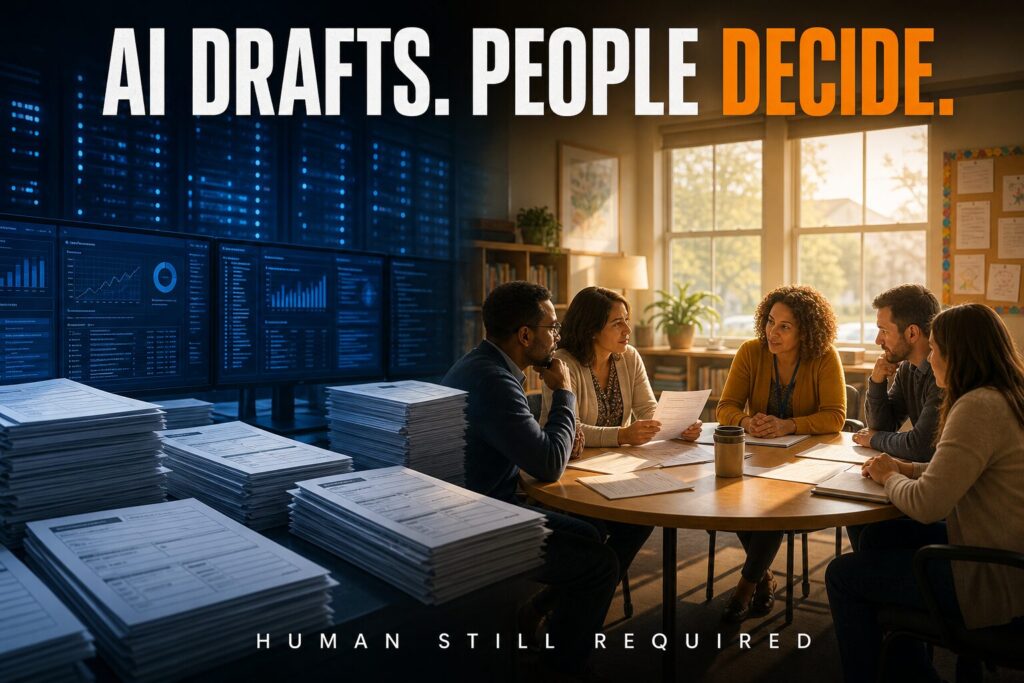
Using AI for IEPs is no longer a hypothetical. In one Texas district, teachers say an AI tool has cut the time it takes to draft an Individualized Education Program from as much as three hours per student to about 45 minutes. That is real time handed back to special educators, some of the most overloaded people in any building.
Here is the reframe I want leaders to sit with. The draft was never the hard part of an IEP. The hard part is the table: the family, the teacher, the specialists, the student, and the decisions they make together about a child’s next year.
AI can shorten the paperwork. It cannot sit at that table.
Key takeaways
- AI for IEPs can save special educators hours per student when it drafts, flags and organizes rather than decides.
- The IEP is a legal and human commitment to a child; the decisions in it must stay with the team, not the tool.
- Student data privacy and family notification are leadership decisions, not technical settings.
- The time AI saves only matters if leaders protect it for the human work: listening to families and planning with colleagues.
What’s happening
On October 28, Education Week reported on how AI tools halved IEP prep time in Mesquite Independent School District, a district of about 38,000 students east of Dallas. The district built the tool with Panorama Education and rolled it out last school year. It pulls attendance and classroom performance data from district platforms to surface trends, which helps special educators write more specific goals.
What caught my attention were the design choices. According to Matthew Morris, the district’s executive director of special education, the tool is trained on an IEP template and flags fields teachers may have missed instead of generating content on its own. It flags trends but does not dictate interventions. The district chose a secure platform rather than letting staff paste student information into public chatbots, and the tool went through the district’s standard review for compliance and student data privacy.
The same story notes that the district did not send families a separate notice when the tool launched. Amelia Vance, president of the Public Interest Privacy Center, recommends that districts proactively notify families and allow them to opt out, warning that “the more places that information sits, the more places it can be breached from.” James Basham, a special education professor at the University of Kansas, put the core principle plainly: “You cannot take away the human-first approach.”
The article also cites a 2025 Center for Democracy and Technology survey in which 57% of special education teachers said they used AI for IEPs or 504 plans in 2024-25, up from 39% the year before. And it points to a 2025 study led by Olivia Coleman of the University of Central Florida that found no significant quality difference between AI-assisted and teacher-only IEPs, while the AI-assisted process took significantly less time.
Two days later, Education Week published new EdWeek Research Center data showing that nearly 1 in 3 district and school leaders skip AI for operations entirely. Among leaders who do use it, the top uses were communications, translation, strategic planning, employee evaluation and class scheduling. Ronn Nozoe, CEO of the National Principals Association, said privacy is the field’s main concern. Both he and Krestin Bahr, superintendent of Washington’s Peninsula School District, named the same barrier: not every district has staff who know how to use AI well.
Put those two stories side by side and you see the real picture. Teachers are already using AI for some of the most sensitive documents schools produce. Many leaders are still deciding whether AI belongs in their own operational work at all.
Why AI for IEPs is a leadership question
In Chapter 4 of Human Still Required, I describe the SAFE test for work AI should take on: tasks that are Structured, Administrative, First-draft and Easily repeatable. Much of IEP paperwork fits. Templates are structured. Compliance fields are administrative. A present-levels summary is a first draft. Checking for missing sections is repeatable.
But Chapter 4 also draws a line I think every special education leader should post on the wall. Decision-support is not decision-making.
Let AI prepare you to decide. Do not let AI replace the act of deciding.
Human Still Required
Mesquite’s design, as described, lands on the right side of that line. The tool flags; people decide. That is not a small detail. It is the whole point.
Chapter 7 explains why. An IEP is not a data report. It is a judgment about one child, made by people who know that child. Attendance trends and classroom scores can tell a team something is happening. They cannot tell the team why. The reason might be a new medication, a hard month at home, a bus route that changed, or a teacher relationship that finally clicked.
Context is lived, not labeled.
Human Still Required
A dashboard can label a pattern. Only the people at the table can supply the context. When teams start treating flagged trends as answers rather than questions, responsibility blurs. And in special education, blurred responsibility is not just a leadership problem. It is a legal and moral one.
There is a trust issue here too. In Chapter 8, I argue that relationships are the infrastructure everything else runs on. Families walk into IEP meetings wanting to know their child is seen. If they learn after the fact that an AI tool helped shape their child’s plan, even a well-designed and secure one, the question they ask will not be about encryption. It will be: why didn’t anyone tell us? Telling families early is not a compliance step. It is relationship work.
Time saved has to go somewhere
The most hopeful number in the Mesquite story is the time. Going from up to three hours to about 45 minutes per IEP, across a full caseload, adds up to days. The question is where those days go.
Time saved only matters if it is reinvested wisely.
Human Still Required
If the hours AI saves simply become room for larger caseloads or more forms, we have automated the paperwork and kept the burnout. If those hours go toward calling a parent before the meeting, observing a student in a general education class, or planning with the classroom teacher who will carry out the accommodations, then AI has done what it should. It has given the time back to the human work.
That choice does not belong to the tool. It belongs to leaders.
What leaders can do now
- Find out what is already happening. If more than half of special education teachers nationally report using AI for IEPs or 504 plans, assume some of your staff are too. Ask without blame, and learn which tools are in use before you write a rule.
- Approve a secure path, and say why. Give staff a vetted tool with clear data rules instead of leaving them to public chatbots. Make the guardrail simple: no student identifiers in unapproved tools.
- Write the human line into your process. State plainly that AI may draft, summarize and flag, but goals, services, accommodations and placement are decided by the IEP team. Ask teachers to review and revise every AI-drafted section.
- Tell families before they ask. Explain what the tool does, what data it uses, and who makes the decisions. Consider an opt-out, as privacy experts recommend.
- Decide in advance where the reclaimed time goes. Protect it for family contact, collaboration with general educators and time with students, and check back in a semester to see if that actually happened.
If your leadership team wants to work through questions like these together, the 5-Week Book Study was built for exactly that kind of conversation.
Frequently asked questions
Is it legal to use AI to help write IEPs?
Districts are already using AI to help draft IEPs, but the decisions in the plan still belong to the IEP team. Experts quoted by Education Week advise reviewing whether a tool’s privacy policy addresses FERPA and IDEA, checking encryption and data deletion practices, and keeping identifiable student information out of generic AI tools. Check with your district’s legal counsel and state guidance before adopting a tool.
Does AI make IEPs better or just faster?
The research so far suggests faster without a loss in quality. A 2025 study led by Olivia Coleman at the University of Central Florida found no significant quality difference between AI-assisted and teacher-only IEPs, while the AI-assisted process took significantly less time. Quality still depends on teachers reviewing and revising what the tool produces.
Should schools tell parents when AI is used in their child’s IEP?
Yes. Privacy experts recommend proactively notifying families and giving them a way to opt out. Beyond the privacy case, early transparency protects the trust that makes IEP meetings work. Families should hear about it from the school, not discover it later.
The table is the work
I am encouraged by what Mesquite is trying. A tool that flags what a teacher missed and surfaces trends, without pretending to make decisions, is the kind of AI use schools should want. Machines handle the paper. People handle the child.
But the success of AI for IEPs will not be measured by how fast the draft gets done. It will be measured by what happens at the table, and by whether the families sitting there feel more heard than they did before.
So here is my question for you: if AI gave your special education team back hours every week, do you already know what you would protect that time for?
Sources
- How AI Tools Halved This District’s IEP Prep Time — Education Week, October 28, 2026
- Nearly 1 in 3 District and School Leaders Skip AI for Operations. Here’s What the Rest Do — Education Week, October 30, 2026