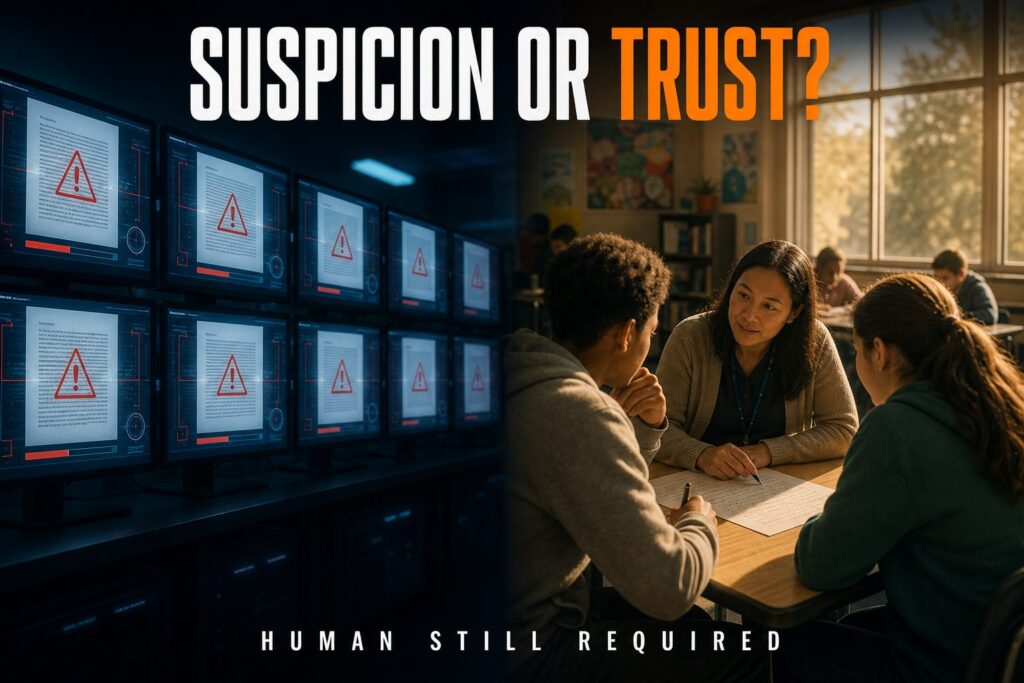
Some students are now turning in weaker work on purpose. Not because they can’t do better, but because better work might look like it came from a machine. That single detail tells me more about AI cheating suspicions in our schools than any detection tool ever will.
We set out to protect learning. In too many classrooms, we are protecting the rules and losing the relationship.
AI didn’t create the trust problem between students and teachers. It exposed how thin that trust already was, and it is making the gap wider every week we treat AI as a policing problem instead of a leadership one.
Key takeaways
- New research from the Center for Digital Thriving at Harvard finds that a focus on catching AI cheating is eroding trust between students and teachers.
- When educators described an AI dilemma in their own words, 74% of teachers and 69% of principals named an issue related to cheating.
- Some teens report deliberately underperforming so they won’t be falsely accused of using AI.
- The fix is not better detection. It is more conversation, more visible thinking, and students and teachers at the table when AI policy is written.
What’s happening: AI suspicion is dividing classrooms
On September 30, Education Week’s Arianna Prothero reported on a new Center for Digital Thriving report on how AI suspicions are undermining student-teacher relationships. The center is based at the Harvard Graduate School of Education. Its researchers surveyed nationally representative samples of teachers and principals in spring 2025, then conducted in-depth interviews with 31 teenagers, ages 15 to 19, between April and June 2026.
The survey result is the headline. When educators were asked to describe an AI dilemma they are facing, 74% of teachers and 69% of principals cited an issue related to cheating. Cheating is not one concern among many. For most educators, it is the concern.
The student interviews show the cost. Teens described fears of being falsely accused, pressure to use AI because peers do, and, in some cases, deliberately underperforming on assignments so they would not be suspected. The report also found students bypassing their teachers and going to chatbots with questions about lessons and assignments. And students told researchers they see hypocrisy when teachers police student AI use while relying on the same technology to create and grade assignments.
Beck Tench of the Center for Digital Thriving put it plainly to Education Week: “Learning is a process that is relational. Having tools arrive in the classroom without any sort of understanding of what effects they’ll have, it’s dividing teachers and students.”
ABC News covered the same report the same day in a Good Morning America story on how AI is affecting trust between students and teachers, describing a “two-way suspicion” in which students and teachers each suspect the other of using AI, eroding trust whether or not anyone actually did. The survey behind the report included more than 1,000 U.S. public school teachers and principals. Tench told ABC News, “Teachers can’t see their students anymore. They have a hard time understanding what their students know.” A 12th grader interviewed for the story, Lydia Bach, offered the line every leader should hear: “I have a lot more faith in teachers when they’re willing to just openly discuss things.”
Why AI cheating suspicions are a leadership problem
Read those findings again and notice what is missing. Nobody is saying detection is working. Nobody is saying suspicion made the learning better. What the research describes is a loss of two things schools cannot run without: trust, and a clear view of student thinking.
In Chapter 9 of Human Still Required, I argue that trust is built in the margins. It lives in the hallway conversation, the follow-up, the way a teacher responds when a student takes a risk. It rarely breaks in one big moment. It wears down quietly.
Trust doesn’t collapse loudly. It erodes quietly, in the absence of attention.
Human Still Required
That is exactly what this report describes. No one decided to damage the relationship between students and teachers. It happened one suspicious comment, one flagged essay, one unasked question at a time. A student who dumbs down their writing to avoid suspicion is not cheating the system. They are telling us the system no longer feels safe.
The second loss matters just as much. Tench’s point that teachers can no longer see what their students know is, at its core, an assessment problem. In Chapter 6, I make the case that when a machine can produce the output instantly, the output stops being good evidence of learning. That is why I built the D.E.C.I.D.E.R. framework around what still counts: decision-making, explanation, critique, inference, development, evaluation, and relocation, or transfer, to new contexts. None of those are things you catch with a detector. All of them are things you see in a conversation.
A student can generate an answer. They cannot fake understanding in a conversation.
Human Still Required
If our main tool for knowing what students understand is a finished product, we will keep playing the cat-and-mouse game this research describes. If our main tool is talk, drafts, conferences and oral defense, the game largely goes away. Not because students stopped using AI, but because the evidence we care about was never in the product alone.
There is a third thread here, and it comes from Chapter 11. Students are carrying a quiet question into every assignment: am I allowed to use this, or am I just not supposed to get caught? When adults avoid answering that question clearly, students fill the silence with guesses, and teachers fill it with suspicion.
Fear isn’t the problem. Silence is.
Human Still Required
The students in this report are not asking for no rules. They are asking for honesty. So are most teachers I work with. Both groups are trying to figure out what fair looks like, and both are doing it alone.
What leaders can do now
You cannot mandate trust back into a classroom. You can change the conditions that are wearing it down. Here is where I would start this week.
- Ask before you assume. The report recommends that educators move from assuming how students use AI to asking them open-mindedly. Model that yourself. Sit with a group of students and ask how they use AI, where it helps, and where they feel unsure. Then share what you heard with staff.
- Put students and teachers in the policy room. The researchers recommend including teachers and students in developing AI policy. If your guidance was written only by adults in the central office, it is missing the people who live with it every day.
- Shift the evidence, not just the rules. Ask each department to identify one major assignment this semester where students explain, defend, or revise their thinking out loud. Use D.E.C.I.D.E.R. as the lens: which of these seven moves does the task actually require?
- Be transparent about adult AI use. If teachers use AI to plan or give feedback, say so, and say how. Students noticed the double standard. Naming our own use closes that gap and models the kind of honesty we want back.
- Move teachers from referee to coach. The report suggests teachers act as coaches who teach students to use AI safely and ethically, taking an “us-and-them” approach rather than “us-versus-them.” Give teachers time and permission to teach AI use, not just police it.
If your leadership team wants to work through the trust and assessment questions together, the 5-Week Book Study is built for exactly this kind of conversation.
Frequently asked questions
Should our school stop using AI detection tools?
Yes. The Center for Digital Thriving research found that a focus on catching cheating erodes trust and leaves students fearing false accusations. If a tool drives suspicion more than learning, it deserves hard scrutiny.
How can teachers know what students understand if AI can write the work?
Make thinking visible. Conferences, drafts, oral explanations and in-class revision show understanding in ways a finished product cannot. The D.E.C.I.D.E.R. framework in Chapter 6 of Human Still Required names the kinds of evidence that still count.
How do we rebuild trust between students and teachers around AI?
Start with conversation, not enforcement. Ask students how they use AI, be open about how adults use it, and include both students and teachers when you write or revise AI guidance. Trust grows when expectations are clear and shared.
The real question
Every school leader wants students to do their own thinking. That goal is right. But suspicion is not a strategy for getting there. It only teaches students to hide, and teaches teachers to doubt the very students they are trying to reach.
The report’s message is simple. Talk more. Assume less. Build assessment around thinking you can see, and build policy with the people it affects.
So here is my question for you: if you asked five students in your building tomorrow whether they trust their teachers to believe their work is their own, what do you think they would say?
Sources
- How AI Suspicions Are Undermining Student-Teacher Relationships, Education Week, September 30, 2026
- New report looks at how AI is impacting trust between students and teachers, ABC News (Good Morning America), September 30, 2026