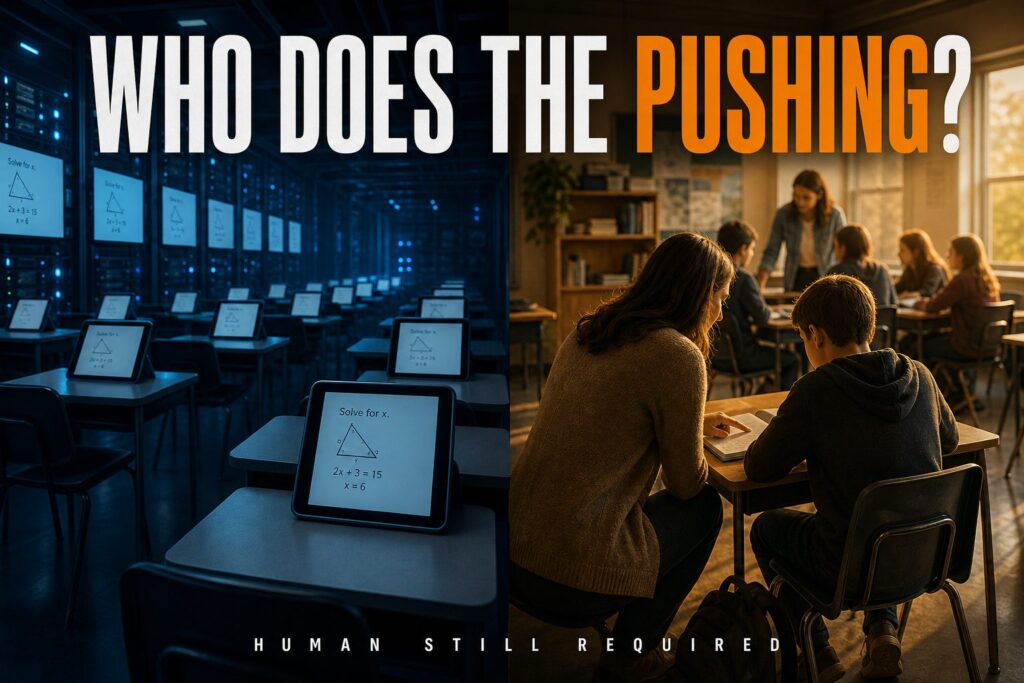
Every few months, someone asks me some version of the same question: can AI replace teachers? This week, two pieces of reporting gave the clearest answer I have seen in a while. And one of them came from the person who has done more than almost anyone to put AI tutors in front of students.
The answer isn’t about the technology. It’s about what was doing the work all along.
It was never just the explanation. It was the relationship.
Key takeaways
- AI can deliver explanations at scale. The accountability and push that come from a relationship with a teacher do not scale the same way.
- Sal Khan told Chalkbeat that the real power of one-on-one tutoring with his cousins was “the accountability and the pushing,” not just the videos.
- A guest column in Education Week argues that AI-first school models like Alpha School rest on mistaken ideas about how humans learn.
- For school leaders, the question is not whether AI can replace teachers. It is which human work your school is deliberately protecting.
What’s happening
On September 23, Education Week ran a guest column in Larry Ferlazzo’s Classroom Q&A on why the author is not betting on the future of Alpha School. The guest author is Benjamin Riley, founder of Cognitive Resonance. Ferlazzo introduced it as a perspective he happens to share.
Riley’s argument is simple. The belief that software can do the core work of teaching keeps coming back, and it keeps running into the same wall. In his words, “teaching does not scale the way that technology can.” And, he adds, “humans prefer learning from other humans—it’s how we’ve culturally evolved.”
He also points to results. Citing educator Dan Meyer’s analysis, Riley writes that Unbound Academy, the Arizona charter connected to Alpha’s model, “projected 60% proficiency in math off a baseline of 34% and ended the year with 10% compared to an Arizona state average of 34%.”
His conclusion is not that we should give up on reaching every child. It’s the opposite: “Of course, we can scale good teaching, if we choose to invest in it.”
The next day, Chalkbeat’s Matt Barnum published a Chalkbeat Ideas roundup that included a conversation with Sal Khan revisiting his own origin story. For years, Khan has told the story of tutoring his younger cousins and making videos to explain math. In his 2011 TED Talk, he said his cousins preferred the videos to live tutoring.
Now, Khan says there was more to it. According to Barnum, Khan told him it was not only that he explained math well. It was that he had a relationship with his cousins that encouraged them to work hard. “The real power of the one-on-one is the accountability and the pushing,” Khan said. As Barnum notes, that cannot easily be done by video or AI chatbot.
The two were talking about a recent study showing students are not engaging much with Khan Academy’s AI bot. Khan said the company is working to better integrate the AI so students use it more.
Two very different voices. One is a critic of AI-first schooling. The other built one of the best-known AI tutors in the world. They land in the same place.
Can AI replace teachers? What this reveals for leaders
In Chapter 1 of Human Still Required, I argue that AI didn’t break school. It exposed it. This week is a good example. The AI tutor didn’t fail because the explanations were bad. It surfaced something we have always known but rarely named: the explanation was never the whole job.
A teacher explains, yes. But a teacher also notices. Expects. Follows up. Pushes when a student is about to quit. Knows when to back off. That is the part Khan is now naming, and it is the part that doesn’t show up in a product demo.
In Chapter 8, I put it this way:
Relationships don’t run on speed. They run on presence. And presence has no shortcut.
Human Still Required
That is why the “scale” argument keeps missing. Information scales. Explanations scale. Practice problems scale. Accountability that a student actually feels comes from someone who knows them. It is built one student at a time, and there is no version of it that runs faster just because the software does.
This is also why I don’t think the right response is to panic about AI-first schools, or to dismiss every AI tool as a threat. Both of those are ways of avoiding the real leadership question.
In Chapter 13, “What Schools Must Protect,” I argue that every school is already making choices about what stays human, whether it says so out loud or not:
What schools protect reveals what they value. What they automate reveals what they’re willing to lose.
Human Still Required
When a model reduces the teacher to a supervisor of software, it is making a choice about what it is willing to lose. When a district adopts an AI tutor and quietly hopes students will use it on their own, it is making a choice too. The choice is just less visible.
The leaders I respect most are making that choice on purpose. They use AI for what it does well: explanations on demand, extra practice, drafts, feedback that a teacher reviews. And they protect the human work that makes students actually do the learning: the relationship, the expectation, the follow-up, the push.
Pro-thinking. Not anti-AI. And very clear about which part is which.
What leaders can do now
- Name the human work out loud. Ask your leadership team to list what teachers do that no tool in your building does: noticing, encouraging, holding students to a standard, following up. Put that list where your AI decisions get made.
- Evaluate AI tools by engagement with a human in the loop, not just features. Before you expand any AI tutor or learning platform, ask: who checks in with the student, and how often? If the answer is “no one,” expect low use.
- Reinvest time into relationships, not more coverage. If AI saves teachers time on planning or practice sets, decide in advance where that time goes: conferences, small groups, conversations with students who are drifting.
- Prepare a clear answer for your community. Families and board members are hearing about AI-first schools. Be ready to say what your school uses AI for, what it will not hand to AI, and why.
- Ask students. Who pushes them to keep going when work gets hard? If they can’t name an adult, that is the gap to close first, before any new tool.
If your team wants to work through what your school should protect together, the 5-Week Book Study walks leadership teams through these chapters with discussion questions built for this kind of conversation.
Frequently asked questions
Can AI replace teachers in K-12 schools?
AI can handle parts of teaching, such as explanations, practice and first-draft feedback. It cannot replace the relationship that drives students to work hard. Even Sal Khan now says the real power of one-on-one tutoring is “the accountability and the pushing,” which is difficult for a chatbot to provide.
Why don’t students use AI tutors more?
Chalkbeat reports that a recent study found students are not engaging much with Khan Academy’s AI bot. Access alone rarely creates effort. Students tend to engage when an adult they trust expects them to, checks in and follows up.
How should school leaders respond to AI-first school models like Alpha School?
Neither panic nor dismissal helps. Leaders should be clear about what their own schools use AI for and what they protect as human work. Critics such as Benjamin Riley, writing in Education Week, argue that teaching does not scale the way technology does, which is a useful lens for evaluating any model.
The work that doesn’t scale
I find it encouraging that one of the most influential voices in AI tutoring is revisiting his own story in public. That is what good leaders do. They look at the evidence and say, “Here’s what I missed.”
The tools will keep getting better at explaining. That was never the hardest part of teaching. The hardest part is being the person a student doesn’t want to let down.
So here is my question for you: in your school, who is doing the pushing—and are you protecting their time to do it?
Sources
- Why I’m Not Betting on the Future of Alpha School (Opinion) — Education Week, Classroom Q&A With Larry Ferlazzo (guest post by Benjamin Riley), September 23, 2026
- Is AI eroding the college payoff? Plus more from the Chalkbeat Ideas roundup — Chalkbeat, Matt Barnum, September 24, 2026