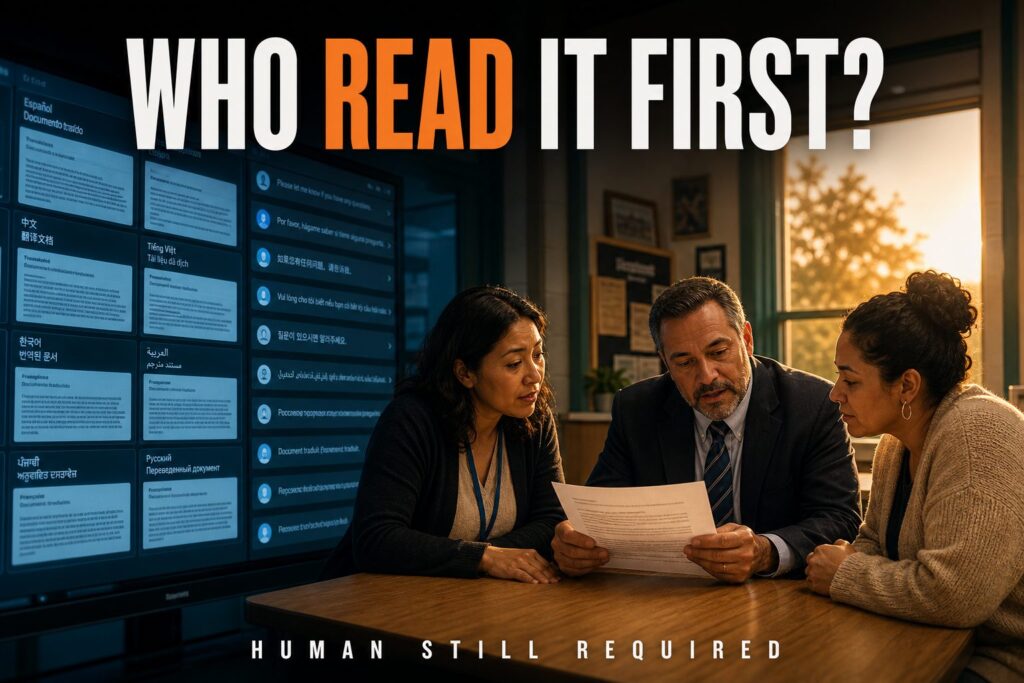
Two stories landed this week that belong side by side. One is a Virginia principal explaining why AI for school leaders isn’t really about saving time. The other is a close look at schools using AI to translate messages for families who don’t speak English, and at what happens when nobody checks the translation.
Read together, they say something simple. The machine can prepare the message. It cannot be the relationship.
The value of AI isn’t the minutes it hands back. It’s what leaders do with the attention it frees, and whether they keep a human between the tool and the people who have to trust what it produces.
Key takeaways
- AI for school leaders pays off when it protects attention for people, not when it simply shortens a task list.
- AI translation can help schools reach more families, but the level of human review should match the stakes of the message.
- Anything consequential, such as special education, placement or health information, needs a human read before it goes home.
- Trust with families is built by people. Tools can extend a leader’s reach. They can’t stand in for the leader.
What’s happening
In a September 23 essay for EdSurge, “Why AI Made Me a Better Principal”, Monika Vereb, a principal in a large Virginia school division, describes how her thinking about AI changed. She writes that she is “no longer looking at AI to determine how many minutes it can cut from my task list.” Instead, she uses conversational AI as a reflection partner on her commute, turns dense weekly memos into short audio overviews for staff, and uses approved school documents to surface patterns, gaps and contradictions before leadership meetings.
Her central line is worth reading twice: “The scarce resource in school leadership is not simply time; it is attention.” She is also clear about her boundaries. She keeps confidential student and personnel information out of these tools, verifies what AI produces and sticks to division-supported tools. In her words, “AI can organize the evidence, but it cannot replace professional knowledge, context or accountability.”
Two days earlier, Education Week’s Alyson Klein asked whether schools can trust AI to translate for non-English-speaking parents. The stakes are real: about 1 in 5 children in the United States speaks a language other than English at home. Schools are using chatbots, Google Translate, parent communication apps and real-time earbud devices to close that gap.
The piece shows both the promise and the cracks. A school nurse in New York’s Croton-Harmon district had been using a free personal app to reach families about urgent health matters until the district’s technology director moved him to a platform with a proper data-sharing agreement. That director, Ellen Moskowitz, put it plainly: “There is a little bit of blind faith that we’re putting into this.” In rural Virginia, a COVID-era sign thanking parents for remaining in their cars came out in Spanish as a thank-you for keeping “the remains” in the car.
Researchers quoted in the story go deeper. Purdue’s Belle Li notes that AI can soften or intensify tone and that “the boundary between translation and rewriting is becoming blurry.” Her recommendation is practical: “the level of human oversight should depend on the stakes.” Experts in the piece suggest a bilingual reviewer check AI translations before they go home, and Li adds that educators should be transparent with families about using AI. Sharon Mofield-Boswell, who leads family and community engagement in Kentucky’s Fayette County schools, summed it up: “AI can generate and translate content, but it can’t give context.”
What this reveals about AI for school leaders
In Chapter 4 of Human Still Required, I lay out the SAFE framework for deciding what AI should take on: tasks that are Structured, Administrative, First-draft and Easily repeatable. A first-pass translation of a lunch menu fits that description. So does turning a memo into an audio summary. That’s exactly the work AI should be doing so humans don’t have to.
But the point of Chapter 4 was never the time savings on their own. It was the reinvestment.
We’re not chasing tools. We’re protecting human attention.
Human Still Required
Vereb arrives at the same place from inside a school building. Her measure isn’t minutes. It’s whether the tool helps her show up more present for the people she leads. That’s the shift I hope every leadership team makes.
Chapter 4 also names the guardrails that make this work. No AI-written communication goes out without a human read. No sensitive student data goes into unapproved tools. Drafts are starting points. The Croton-Harmon nurse story is that second guardrail playing out in real life. And every translation example in the Education Week piece is an argument for the first one. A machine translation is a first draft. Treating it as a final product is where trust starts to leak.
Vereb’s approach to evidence also reflects the line I draw between decision-support and decision-making:
Let AI prepare you to decide. Do not let AI replace the act of deciding.
Human Still Required
Translation is where this gets personal. In Chapter 8, I argue that relationships are the real work, and that trust doesn’t scale the way information does. Families don’t trust a school because a message was clear. They trust it because of this:
They trust leaders because the message sounds like it came from someone who knows them.
Human Still Required
A translated message that shifts the tone, garbles a term or quietly rewrites the meaning doesn’t sound like anyone. For a family already working across a language barrier, that message isn’t neutral. It tells them nobody checked. Over time, that is how distance grows between a school and the families it most needs to reach.
This isn’t an argument against AI translation. Reaching a family in their home language with a reviewed draft is far better than not reaching them at all. It’s an argument for leadership. Someone has to decide which messages carry high stakes, who reviews them and what happens when no one on staff speaks the language. That decision can’t be delegated to the tool.
What leaders can do now
- Sort your family communications by stakes. Build a simple tiered list with your team. Routine reminders may need a light check. Special education documents, placement decisions and health notices need a qualified human reviewer every time.
- Name your reviewers. Inventory the bilingual staff, district interpreters and community partners you can call on, by language. Be honest about which home languages have no reviewer yet, and plan for them.
- Close the personal-account gap. Ask staff what tools they are actually using to reach families. Move that work into approved tools with data agreements, and make it easy rather than punitive.
- Tell families when AI is involved. A short note that a message was translated with AI help, and how to ask a question, builds more trust than a polished message that hides its source.
- Track the reinvestment. When AI saves your office time, decide on purpose where that time goes. More family conversations, more time in classrooms, more listening. If the saved time simply disappears into more email, the tool hasn’t helped your leadership.
Frequently asked questions
Should schools use AI to translate messages to families?
Yes, with guardrails. AI translation can help schools reach families they might otherwise miss. Researchers quoted by Education Week recommend matching the level of human review to the stakes of the message and being transparent with families about AI use.
Which school communications need human review before they go home?
Anything with real consequences for a student or family: special education documents, placement decisions, health information and other sensitive notices. Experts recommend that a bilingual staff member or official translator review AI translations of these materials before they are sent.
How can principals use AI without losing the human side of leadership?
Use AI for structured, repeatable, first-draft work, keep confidential data out of unapproved tools and verify what it produces. Then reinvest the time and attention it frees into people: classrooms, coaching conversations and families. The tool prepares the work. The leader owns the decision and the relationship.
The human part of the message
AI will keep getting better at drafting, summarizing and translating. That’s good news for leaders who use it well. But the thing families remember isn’t whether a message was efficient. It’s whether it felt like it came from someone who knew their child. If your leadership team wants a structured way to talk through where those lines sit, the Human Still Required leadership guide is a good place to start.
So here’s my question for you this week: which message leaving your school right now is too important to send without a human read?
Sources
- Why AI Made Me a Better Principal, EdSurge, September 23, 2026
- Can Schools Trust AI to Translate for Non-English-Speaking Parents?, Education Week, September 21, 2026