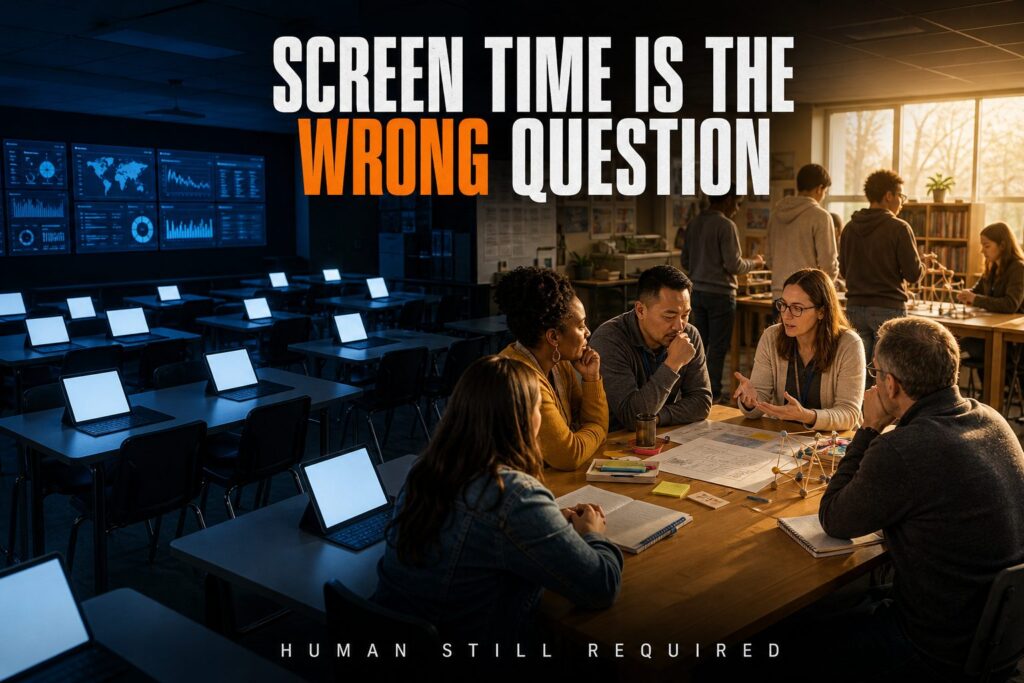
The debate over classroom screen time has become a tug-of-war over minutes. More screens or fewer. Laptops or paper. A new national survey of teachers suggests leaders are asking the wrong question.
Teachers are not simply saying screens are bad. They are saying something more useful: devices work when someone is clearly in charge of how they are used, and they struggle when no one is.
That is not a technology finding. It is a leadership finding.
Key takeaways
- Nearly every K-12 teacher reports students using devices in class, and most teachers want students using them less often.
- Teachers are split on whether devices help learning. The dividing line in the new Gallup data is oversight, not the device itself.
- Retreating to paper can reduce distraction, but it does not fix tasks that were never designed around student thinking.
- Leaders should replace the screen-time question with a design question: what is this device doing for learning, and who is making that call?
What’s happening: new data on classroom screen time
On September 16, Gallup and the Walton Family Foundation released the latest findings from their Teaching for Tomorrow research, reporting that screens are ubiquitous in classrooms but teachers are split on whether they work. The survey reached 2,101 U.S. K-12 public school teachers in May 2026.
The headline numbers are striking. Ninety-six percent of teachers say students use learning devices in class. Sixty-one percent say students should spend less time on them. Only 59% agree that devices help students learn effectively. Twenty-nine percent say devices do more harm than good, and 52% say they do equal amounts of harm and good.
The part I keep coming back to is the oversight gap. Among teachers who report substantial oversight of what students do on their devices, 67% say digital tools help students learn effectively. Among teachers with minimal oversight, that drops to 49%. Same devices. Very different experience.
Teachers’ policy preferences point the same way. According to Gallup, the most popular option was more investment in high-quality print-based or hands-on materials (58%), followed by stronger filtering or monitoring requirements (54%). Blanket limits on time drew far less support (34%).
On September 21, K-12 Dive’s Naaz Modan looked closely at what the report says about elementary classrooms. Ninety-five percent of elementary teachers say their students use laptops, tablets or other devices, and a quarter say devices are used in all or most class periods for main lessons. About 46% of elementary teachers say devices are a distraction during instruction to some extent, yet 61% say digital tools help students learn more effectively. K-12 Dive also reports that two-thirds of teachers overall would support making device-based classes paper-based instead, and that wealthier districts were much more likely than higher-poverty districts to agree the tools they use are a good fit for their students.
Put those together and you get a profession that is not anti-technology. It is tired of technology that shows up without a clear purpose.
What this reveals for school leaders
I worked in schools through the 1:1 era, from roughly 2005 to 2020. The pattern in this survey is familiar. Devices were purchased and deployed at scale. The harder work of deciding what they were for, lesson by lesson, was often left to individual teachers to figure out on their own.
Now generative AI has arrived on those same devices, and the questions have gotten sharper. That is why the introduction of Human Still Required starts with a simple line:
Different tools. Same leadership work.
Human Still Required
The screen-time debate is the same leadership work in a new outfit.
In Chapter 2, I write about the temptation to respond to AI by retreating: harder tasks, locked-down tests, a return to paper and pencil to outsmart the tools. I understand the pull, and there are real reasons to put more print and hands-on materials in students’ hands. Teachers asked for exactly that, and they should be heard. But if a paper worksheet asks for the same low-level completion as the digital one, we have changed the medium and kept the problem.
AI doesn’t expose a digital problem. It exposes a design problem.
Human Still Required
The oversight gap in the Gallup data is design showing up in the numbers. When teachers have real control over what students are doing on a device, the device is more likely to serve the lesson. When they don’t, the device serves whatever is most engaging in the moment.
Chapter 10 is about the leadership skill set this moment requires, and one of the questions I return to most is this one:
What are we optimizing for here?
Human Still Required
If the answer is minutes, we will get a minutes policy. If the answer is learning, we have to look at tasks, oversight and fit. That is harder to write into a board policy, but it is the part that matters.
Chapter 10 also asks who benefits from a decision and who bears the cost. The equity finding here deserves attention. If wealthier districts are more likely to say their tools fit their students, then a one-size screen-time rule may land very differently in a higher-poverty school. A blanket cut is simple. It is not automatically fair.
Chapter 14 pushes in the same direction. It argues that schools have to let go of outdated measures of success. Screen minutes, like seat time, are easy to count and easy to report. They tell us very little about whether students did the thinking.
What leaders can do now about classroom screen time
- Audit purpose before minutes. Pick one grade level and ask teachers to sort a week of device use into three buckets: tasks where the device clearly improves learning, tasks where it is simply the delivery method, and tasks where it gets in the way. Start decisions from that list.
- Invest in oversight, not just hardware. The Gallup data links teacher oversight to better outcomes. Ask your teachers what visibility and control they actually have over student devices, and what support would change that.
- Fund the print and hands-on materials teachers are asking for, and pair them with task redesign so paper does not become a new home for the same completion work.
- Check fit through an equity lens. Ask principals in your highest-poverty schools whether the tools they have actually fit their students. If the answer differs from your other schools, the fix is not the same policy everywhere.
- Bring AI into the same conversation. Do not write a screen policy and an AI policy as if they were separate problems. Both come down to the same question: who is doing the thinking?
If your leadership team wants a structured way to work through questions like these together, the 5-Week Book Study is built for exactly that kind of conversation.
Frequently asked questions
Should our district reduce classroom screen time?
Most teachers in the Gallup survey think students should use devices less often, so it is worth taking seriously. But the same data shows that blanket time limits were far less popular with teachers than better materials and stronger oversight. Start by identifying which device uses support learning and which do not, then reduce the ones that do not.
Why do some teachers think devices help while others think they hurt?
In the Gallup data, oversight made a big difference. Teachers with substantial oversight of student device activity were much more likely to say digital tools help students learn effectively than teachers with minimal oversight. How devices are managed and used shapes the result as much as the devices themselves.
Is going back to paper the answer to AI and distraction?
Paper can help, especially for focus and for hands-on work, and teachers are asking for more of it. But paper does not fix a task that only asks students to complete, copy or recall. The durable fix is designing work where students have to explain, apply and defend their thinking, on any medium.
The question under the question
Teachers have given leaders a clear signal. They are not asking for a war on devices. They are asking for purpose, oversight and materials that fit their students.
That is a design conversation, and design is leadership work. The minutes will take care of themselves once we are clear about what the tools are for.
So here is my question for you: if you removed every screen-time number from your next device conversation, what would you ask instead?
Sources
- Screens Ubiquitous in Classrooms; Teachers Split on Efficacy — Gallup (Walton Family Foundation–Gallup Teaching for Tomorrow research), September 16, 2026
- 1 in 4 elementary school teachers say students use devices for main lessons — K-12 Dive, September 21, 2026