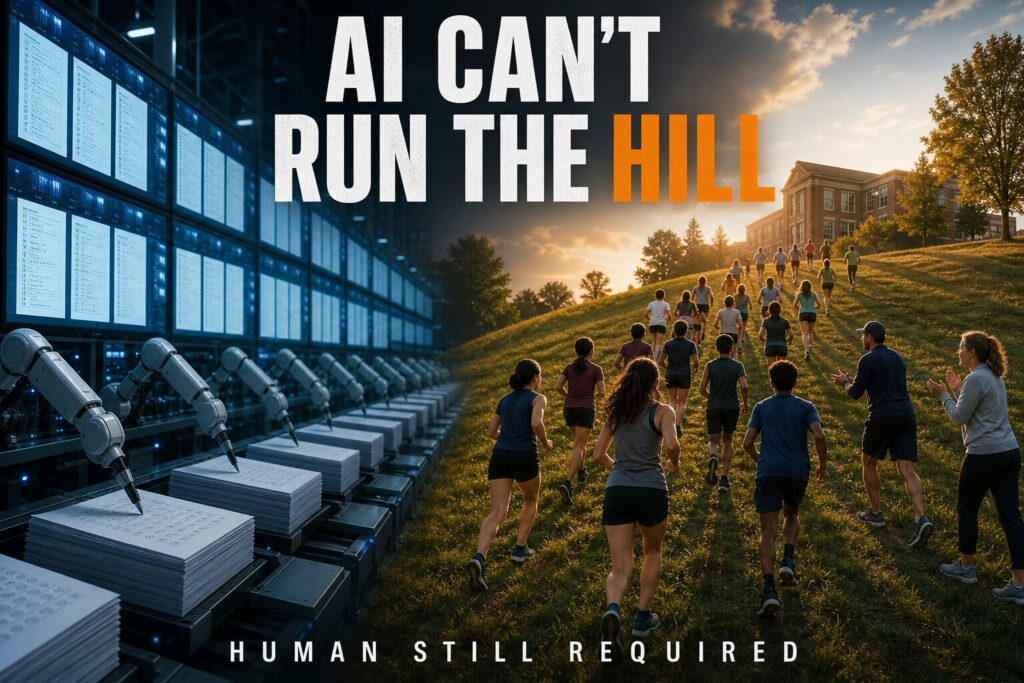
At back-to-school night this fall, parents keep asking teachers the same question: what’s your AI policy? Nobody asks the cross-country coach. That contrast says more about AI and productive struggle in school than most of the policy documents I’ve read.
Nobody asks the coach because everyone already understands what the hill sprints are for. The point was never to get up the hill. The point was what climbing it builds.
In the classroom, we’ve been far less clear about that. And AI is making the gap impossible to ignore.
Key takeaways
- Most schoolwork has two purposes: the visible product and the hidden capacity it builds, such as persistence, focus and judgment.
- AI can complete the visible product. It cannot build the hidden capacity for a student who skips the work.
- Even career programs are shifting from “can you produce it” to “can you explain it, manage it and work with people” as AI absorbs entry-level tasks.
- School leaders should help teachers name the purpose of each major task, so AI decisions follow from purpose instead of fear.
What’s happening
In an opinion piece for The 74 published October 9, 2026, researcher and former first-grade teacher Conor P. Williams describes a middle school back-to-school night where parents pressed teachers about AI. Teachers gave careful answers. Some parents pushed back, asking whether students could use AI for practice, brainstorming or research. Then he turns to the gym, where nobody is asking whether athletes could have AI run their hill sprints. As he puts it, “ChatGPT runs a lousy mile and Gemini’s hill sprints are pathetic.”
His deeper point is the one I want leaders to sit with. Williams argues that “the indirect elements of most of the tasks we present to kids matter at least as much as the direct elements.” Middle schoolers don’t run a 5K to win a medal. They run it to learn how to set a goal and grind through the boring work it takes to reach it. The same is true of a lab report or an argumentative essay. He doesn’t claim AI can’t help a student work through a hard problem. He concedes it absolutely can. His worry is cumulative: the shortcuts add up.
A day earlier, on October 8, Chalkbeat Philadelphia reported on how AI is forcing a youth coding program to rethink what it teaches. Launchpad Philly, run by the nonprofit Building 21, opened in 2022 to train high school students and recent graduates to code and land tech jobs. As AI has cut into entry-level tech hiring, the program reviewed job descriptions and shifted its curriculum. It now adds AI skills, data security and workflow management, offers certifications in generative AI and project management, and spends more time teaching participants to explain technical tools to people in other business roles. It also created paid project work so participants build real experience.
Executive director Dannyelle Austin described the moment candidly: “It was like, oh, actually we don’t know what the jobs are, what the skills are” that help people get hired.
Two very different stories. One about a 5K and a back-to-school night. One about a coding program and a tough job market. They land in the same place: the visible output is no longer the point.
What AI and productive struggle reveal about our tasks
In Chapter 1 of Human Still Required, I argue that AI didn’t break school. It exposed it. Many of our tasks were built for a world where producing the output was hard, so the output could stand in for the learning. Once a tool can produce the output in seconds, we’re left with a question many of us never had to answer out loud:
Was the work meaningful—or just manageable?
Human Still Required
That’s the question Williams is really asking. If an assignment exists to build persistence, attention and confidence, then a student who hands it to a chatbot hasn’t saved time. They’ve skipped the workout. But if we can’t say what the assignment builds, we can’t explain to a parent, a student or ourselves why it matters who does it.
Chapter 2 pushes this further. Coverage-driven school trained many students to play “the game of school,” optimizing for completion rather than thinking. I wrote that what AI replaces easily is not a threat to hide from. It’s information:
Leaders should pay attention to what AI replaces easily. That’s diagnostic data.
Human Still Required
The Launchpad story is that diagnostic in real time. The part of coding a machine now does well is shrinking as a career on-ramp. What’s left is the human layer: understanding a workflow, protecting data, explaining a tool to someone who doesn’t speak its language, working on a real project with a real client. That is a shift from content-first to skills-first, which is exactly the shift Chapter 2 calls for: judgment, analysis, transfer, communication and adaptation.
And Chapter 13 names what schools must protect: critical thinking, productive struggle and reflection. Not because struggle is noble on its own. Difficulty is not rigor. Struggle matters when it’s aimed at something, when the climb builds a capacity the student will need long after the content fades.
Here’s the leadership challenge. Teachers are being asked for AI policies before many schools have done the harder work of naming what each task is for. Without that, every AI rule sounds arbitrary. With it, most AI decisions become obvious.
What leaders can do now
- Run a “hill sprint audit” with one department. Take three common assignments and ask two questions of each: what is the visible product, and what capacity is it meant to build? If the team can’t name the second, that’s your redesign list.
- Let purpose drive the AI rule. If a task exists to build persistence or independent reasoning, AI stays out of that part. If it exists to produce a polished final artifact, AI may have a role in drafting. The rule should follow the purpose, and teachers should be able to explain it in one sentence.
- Give teachers language for families. Parents asking “what’s your AI policy?” deserve a better answer than a list of banned apps. Help staff explain what a task builds and why skipping it costs the student. That conversation lowers anxiety on both sides.
- Make the thinking visible, not just the product. Build in checkpoints such as conferences, short oral explanations and reflections on revisions, so students experience the struggle as part of the grade rather than an obstacle to it.
- Look at your career pathways through the Launchpad lens. Ask your CTE and pathway leaders the same question that program asked: what will employers actually need from a young person when AI handles the entry-level task? Then check whether students practice explaining, collaborating and managing work, not just producing it.
If your leadership team wants to work through these questions together, the 5-Week Book Study is built for exactly this kind of conversation.
Frequently asked questions
Does AI undermine productive struggle in school?
It can, when students use it to skip the part of a task that was meant to build a capacity like persistence or reasoning. It doesn’t have to. When teachers are clear about what a task builds, AI can support preparation or feedback while the student still does the climb.
Should schools ban AI to protect productive struggle?
A ban treats every task as if it had the same purpose. Most don’t. A better approach is to name the purpose of each major assignment and decide where AI helps and where it short-circuits the learning. That gives teachers and families a reason, not just a rule.
How should principals answer parents who ask about AI policy?
Start with purpose. Explain what the work is meant to build in students, then explain where AI fits and where it doesn’t. Parents tend to respond better to “here’s what this assignment builds” than to a list of prohibited tools.
The work behind the work
Coaches never needed an AI policy for hill sprints, because everyone understood the purpose of the climb. Our classrooms deserve the same clarity. Not harder work. Clearer work.
AI didn’t create this question. It just made it urgent.
So here’s mine for you: if a parent asked you tomorrow what your students’ hardest assignment is actually building in them, could you answer in one sentence?
Sources
- AI & Back-to-School Night: Anxious Parents, Nervous Teachers and Chill Coaches — The 74 (opinion, Conor P. Williams), October 9, 2026
- Teaching kids to code used to be a path to good jobs. AI has changed that. — Chalkbeat Philadelphia (Rebecca Redelmeier), October 8, 2026