Most students already have a trusted adult in school. The problem is that the trusted adult usually isn’t the one opening the door. That is the finding I can’t stop thinking about from new research on trusted adults in schools, and it matters more now that so many districts are building dashboards that promise to tell us which students are ready for more.
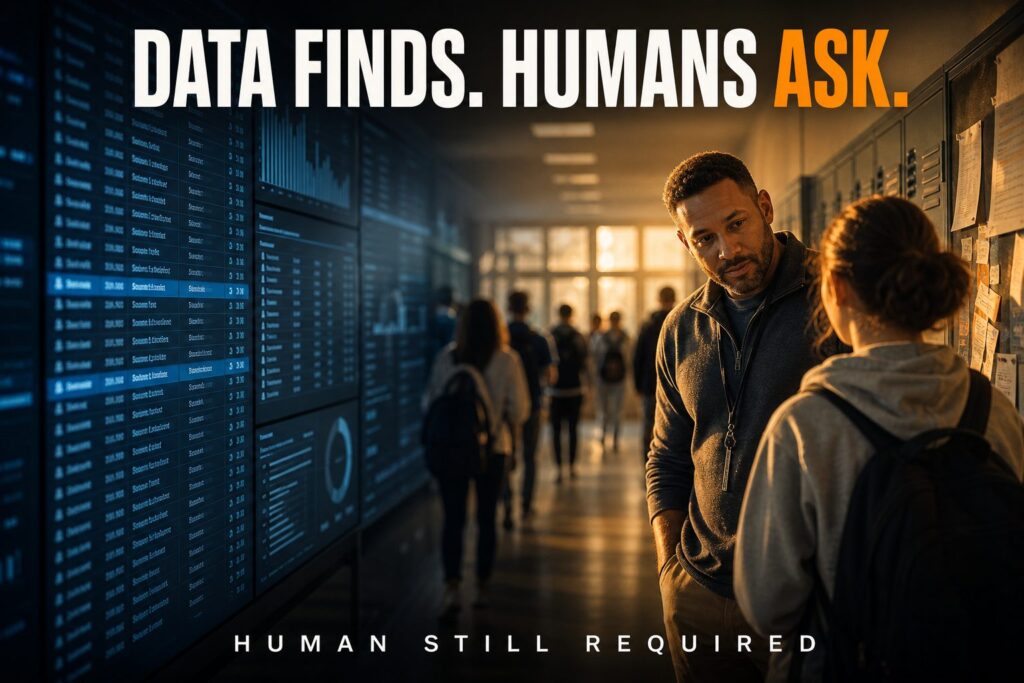
The data can find the student.
It still takes a human to ask.
Key takeaways
- A study of more than 1.8 million student records found students with a trusted adult at school were 10 to 20 percent more likely to be enrolled in advanced courses.
- Only about 12 percent of trusted adult relationships also included a recommendation for advanced coursework from that adult.
- Data and AI tools can identify students who are ready for more. Trusted adults are the ones who can turn that information into an invitation a student will accept.
- School leaders should connect their data systems to their relationships, not treat them as separate work.
What’s happening: new research on trusted adults in schools
On September 16, 2026, Equal Opportunity Schools and the Center for Trust and Transformation released The Adults Students Already Trust, written by AJ Gutierrez, Alaina Boyle and Elizabeth Sykes. K-12 Dive’s Kara Arundel reported on the study on September 25. The analysis covers more than 1.8 million student records, 77,000 staff records, 1,404 schools and 450 districts in the Equal Opportunity Schools network, drawing on data from 2016 to 2020.
A few findings stand out:
- An average of 77 percent of surveyed students reported having a trusted adult in at least one year.
- Teachers were named most often. But students also named counselors, coaches, school leaders, office staff and custodians.
- Students who identified a trusted adult were 10 to 20 percent more likely to be enrolled in advanced courses, and their GPAs were about 0.2 points higher on average.
- Access was not equal. Black, Indigenous, Latinx and Hawaiian or Pacific Islander students reported having trusted adults at lower rates than White and Asian students.
- Here is the gap: only about 12 percent of trusted adult relationships also included a recommendation from that adult, and only 19 percent of educators who recommended a student were identified as trusted by that same student.
K-12 Dive also points to a related Learning Collider analysis of more than 284,000 observations of 10th and 11th graders with at least a 3.0 GPA who were not in AP classes. About 45 percent did not receive a teacher recommendation for more rigorous coursework. About 24 percent had neither a recommendation nor a trusted adult connection.
The authors’ recommendation is practical. Connect what schools already have, relationships, programs and data, more strategically. Equip trusted adults with relevant student information so they can have real conversations with students about opportunities like advanced coursework, dual enrollment and attendance.
What this reveals: trust and data are working in separate rooms
Read those two numbers again. The adults students trust are rarely the adults who recommend them. The adults who recommend them are rarely the adults they trust.
That isn’t a failure of caring. It’s a design problem. In most schools, the relationship lives in one place and the decision lives in another. The coach knows the kid. The counselor has the transcript. The AP teacher signs the form. Nobody has been asked to put those pieces together.
This is exactly where AI and analytics are going to show up in the next few years. Tools are getting very good at scanning a roster and surfacing the student with a 3.0 GPA who has never taken an advanced class. That is useful. In Chapter 4 of Human Still Required, I call this decision-support, and I think schools should want more of it.
But in Chapter 7, I push on what happens next. A list is not a decision, and it is certainly not an invitation.
Data informs. Humans decide.
Human Still Required
A dashboard can tell you a student is ready. It can’t tell you whether that student believes it. It can’t tell you what happened the last time someone suggested they reach higher, or who they’ll actually listen to. That knowledge lives with the person the student trusts. Sometimes that’s a teacher. Sometimes it’s the custodian who says good morning every day.
Why it matters for school leaders: trust lives in the margins
Chapter 9 of the book is called “Trust Is Built in the Margins.” The argument is that trust rarely forms inside the formal structures we design. It forms in hallways, before practice, at the front desk, in the follow-up after a hard conversation. This study puts real data behind that. Students named coaches, office staff and custodians. None of those people are in the room when course recommendations get made.
AI can help leaders be available. It cannot help leaders be felt.
Human Still Required
The same is true for every adult in the building. A system can make an opportunity available. A trusted adult makes it felt. When a student hears “I think you can do this” from someone who knows them, it lands differently than a form letter or an automated course suggestion.
There is also an equity warning here. If students of color are less likely to report a trusted adult, then any system that relies only on existing relationships will quietly reproduce the gap. And any system that relies only on data will produce lists that never turn into enrollment. Leaders need both, deliberately connected.
Efficiency has a blind spot. The more we automate identification, the easier it is to believe the work is done when the list is generated. It isn’t. The list is where the human work starts.
What leaders can do now
- Ask students who their trusted adults are. If you don’t know, you can’t use those relationships. A simple survey question is a place to start, and it should include every adult in the building, not just teachers.
- Put the data in the hands of the trusted adult. When your systems flag a student as ready for advanced coursework, route that information to the adult the student trusts, with a short guide for the conversation. Let the machine prepare the list. Let a human make the ask.
- Widen who gets to recommend. Look at your course recommendation process. If only the current content teacher can open the door, you are leaving most trusted relationships out of the decision.
- Check your gaps by student group. Look at who has a trusted adult and who doesn’t. Then look at who is being recommended. If the same students are missing from both lists, that is where your leadership attention belongs.
- Protect the margins. If AI tools save your staff time this year, ask where that time is going. Hallway time, advisory time and after-school time are not extras. This research suggests they are where opportunity starts.
If your leadership team wants to work through these questions together, the 5-Week Book Study spends real time on Chapters 7 through 9.
Frequently asked questions
Why do trusted adults in schools matter for student outcomes?
In research released by Equal Opportunity Schools and the Center for Trust and Transformation, students who identified a trusted adult were 10 to 20 percent more likely to be enrolled in advanced courses and had GPAs about 0.2 points higher on average. The relationship appears to be connected to whether students step into more rigorous opportunities.
Can AI identify students who are ready for advanced courses?
Data tools and AI can help flag students who meet criteria, such as a strong GPA without advanced coursework. That is useful decision-support. But identification is not the same as enrollment. A student is far more likely to act on an invitation from an adult they trust.
How can principals build more trusted adult relationships?
Start by asking students who they trust, and include every adult role in the building. Protect unstructured time where relationships form, such as hallways, advisory and activities. Then look at which student groups report fewer trusted adults and focus your efforts there.
The work only humans can do
I’m not worried that data will get better at finding students. I hope it does. I’m worried that we’ll mistake the finding for the work.
Trust doesn’t show up on a dashboard. It shows up when a student hears their name from someone who has been paying attention. Tools can shorten the distance to that moment. They can’t replace it.
So here’s my question for you: in your school, when the data says a student is ready, whose voice does that student actually hear?
Sources
- The Adults Students Already Trust: Research with the Center for Trust & Transformation — Equal Opportunity Schools, September 16, 2026
- Trusting relationships in schools support student outcomes, study says — K-12 Dive, September 25, 2026