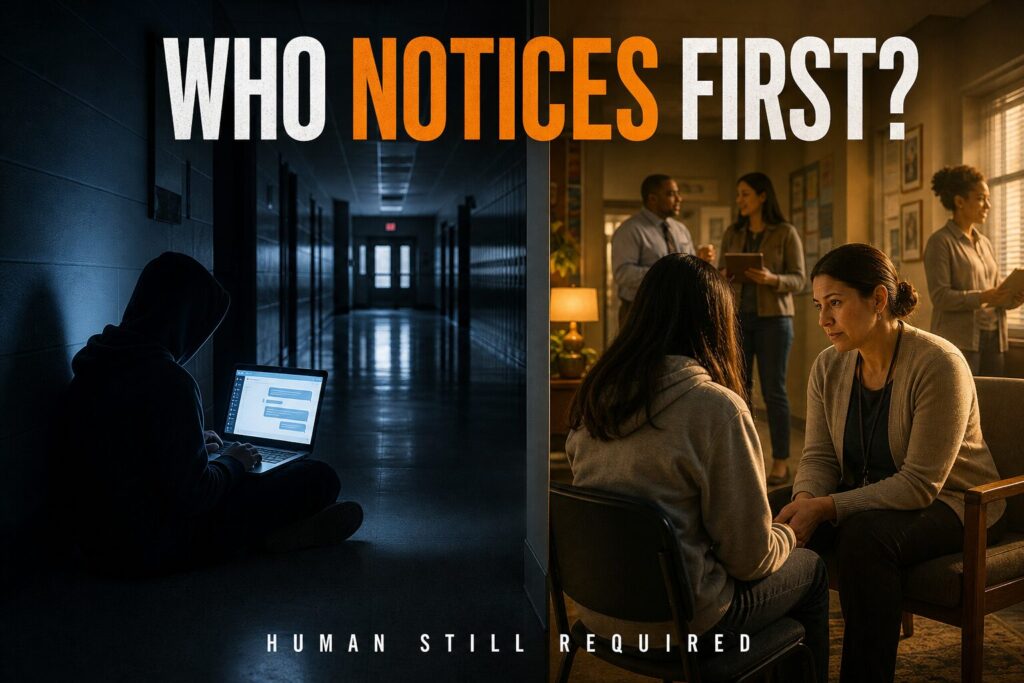
Most of the AI conversation in schools is about schoolwork. Cheating. Essays. Policies. But a new report on students, AI and emotional support points somewhere much closer to the heart of the job. When students feel sad, stressed, lonely or overwhelmed, a lot of them are turning to a chatbot.
That isn’t a technology story. It’s a relationship story.
And it asks every school leader a question no tool can answer for us: when a student is struggling, who notices?
Key takeaways
- A new JED Foundation survey of 5,560 middle and high school students found that 57% used AI when they felt sad, stressed, lonely or overwhelmed, but only 8% said they used it to get help in those moments.
- Students who used AI for companionship or while emotionally struggling reported worse mental health outcomes, though the data cannot show whether AI causes distress or distressed students seek out AI.
- Students turning to a chatbot in hard moments is a signal about human connection in our schools, not just a signal about technology.
- Leaders can respond by protecting presence, naming the issue openly with staff, students and families, and making sure every student has a trusted adult.
What’s happening: new data on students, AI and emotional support
On November 10, Education Week’s Lauraine Langreo published an interview about a new JED Foundation report on AI use and student mental health. JED, a nonprofit focused on youth mental health, surveyed 5,560 middle and high school students in 21 U.S. schools between October 2025 and April 2026.
The JED Foundation report, Exploring Artificial Intelligence: Understanding Relationships between AI Use and Mental Health Among Middle and High School Students, found that AI is already part of students’ daily lives. According to the report, 81% of students had used AI, 58% used it for schoolwork, 28% used it for relationship or problem-solving advice, and 12% used it for friendship or companionship.
The number that stopped me: 57% of students said they used AI when they were sad, stressed, lonely or overwhelmed. Only 8% said they used it to get help in those moments. Middle school students (65%) were more likely than high school students (about 50%) to turn to AI when struggling.
The report found that certain uses, including using AI for companionship and turning to it while emotionally struggling, were associated with worse mental health and well-being outcomes, including a greater lifetime history of suicidal thoughts and attempts. JED is careful about what the data can and cannot say. The survey is cross-sectional and not nationally representative, and the report states it is unclear whether AI use contributes to poorer well-being or whether students already in distress are more likely to turn to AI.
Kayla Anderson, JED’s vice president of research and evaluation, told Education Week, “It’s not a black and white conversation,” and that early research suggests “it really does seem to matter what young people are doing with AI.”
A few days earlier, on November 6, Education Week’s Jennifer Vilcarino reported on a lawsuit that blames a school-issued Chromebook in part for a student’s mental health crisis. The parents of a 13-year-old girl sued Google, alleging that the Gemini chatbot she used on her school device gave her responses that led her to believe she had several psychological disorders. According to the article, a third-party monitoring alert reached a former counselor, who notified her parents. These are allegations in a complaint, not findings, and Google did not immediately respond to Education Week’s request for comment.
Inge Esping, principal of McPherson Middle School in Kansas, offered the question I think every leader should be asking about every tool: “Is this enhancing my students’ learning or not?”
What this reveals: AI didn’t create loneliness. It made it visible.
In Chapter 1 of Human Still Required, I argue that AI didn’t break school. It exposed it. This report is that idea in its most human form.
A chatbot is available at 11 p.m. It never looks busy. It never seems disappointed. For a student who feels unseen, that can feel like enough. The question for leaders isn’t only “What is the chatbot saying?” It’s “Why was a chatbot the easiest place to go?”
That’s the heart of Chapter 8, Relationships Are the Real Work. AI scales information. Trust doesn’t scale. A tool can respond instantly. It cannot know a student’s history, notice a change in their face at the door, or follow up three days later.
Relationships don’t run on speed. They run on presence. And presence has no shortcut.
Human Still Required
I want to be careful here. This is not a reason to panic, and it is not a reason to blame students for using the tools in front of them. Students reach for what’s available. The leadership work is making sure a caring adult is also available, and easier to reach than we might assume.
Chapter 11, Staff, Students, and the Fear Question, matters here too. Students are carrying questions they don’t always say out loud. Teachers are worried about what they’re seeing and not sure what they’re allowed to say. Families are hearing headlines about lawsuits. When leaders stay quiet, people fill the gap with their worst guesses.
Fear isn’t the problem. Silence is.
Human Still Required
The answer isn’t a louder ban or a softer one. It’s an honest conversation, led by adults who are present.
What leaders can do now about students, AI and emotional support
- Ask the question directly. In advisory, counseling groups or student focus groups, ask students when and why they turn to AI. Listen without judgment. You can’t lead what you haven’t heard.
- Audit for trusted adults. Work with counselors and teachers to identify students who may not have a single adult they would go to when struggling. That list is more important than any tool inventory.
- Brief staff before the headlines do. Share what the JED data says and what it doesn’t. Give teachers simple language for responding when a student mentions using AI for emotional support, and a clear path to connect that student with a counselor.
- Review what student-facing tools can do on school devices. Know which chatbots students can reach on school-issued devices and what your monitoring and response process is when an alert appears. Then ask Principal Esping’s question about every one of them.
- Protect the margins. If AI is saving staff time anywhere, put some of that time back into hallways, lunch tables and check-ins. As I argue in Chapter 9, being available is not the same as being present.
If your leadership team wants to work through these questions together, the 5-Week Book Study is built for exactly this kind of conversation.
Frequently asked questions
Are students using AI for emotional support?
Many are. In the JED Foundation’s survey of 5,560 middle and high school students, 57% said they used AI when they felt sad, stressed, lonely or overwhelmed, and 12% said they used it for friendship or companionship. Middle schoolers were more likely than high schoolers to turn to AI in those moments.
Does using AI cause worse mental health in students?
The data doesn’t show that. JED found that using AI for companionship or while struggling was associated with worse mental health outcomes, but the report says it is unclear whether AI contributes to poorer well-being or whether students already in distress are more likely to turn to AI. Either way, it is a signal worth paying attention to.
What should principals do if a student says they talk to a chatbot when they’re upset?
Treat it as an opening, not an infraction. Listen, stay calm and connect the student with a counselor or another trusted adult. Make sure staff know that path ahead of time so no one has to improvise.
The work only humans can do
Relationships aren’t extra. In Chapter 8, I put it this way:
Relationships aren’t a ‘soft skill.’ They’re the infrastructure everything else runs on.
Human Still Required
A chatbot can answer at midnight. It can’t sit with a student the next morning. That part is ours.
So here’s my question for you this week: if one of your students were struggling right now, would they think of a person in your building before they thought of a screen?
If you or a student needs immediate support, call or text 988 to reach the 988 Suicide & Crisis Lifeline in the U.S.
Sources
- Students Who Turn to AI for Emotional Support Report Worse Mental Health, Education Week, November 10, 2026
- Exploring Artificial Intelligence: Understanding Relationships between AI Use and Mental Health Among Middle and High School Students, The Jed Foundation, October 2026 (covered November 10, 2026)
- Lawsuit Blames a School-Issued Chromebook for Student’s Mental Health Crisis, Education Week, November 6, 2026