Most conversations about a school deepfake policy start in the same place: what are the consequences for the student who made it? That matters. But two things published this past week tell me most schools are starting in the wrong place.
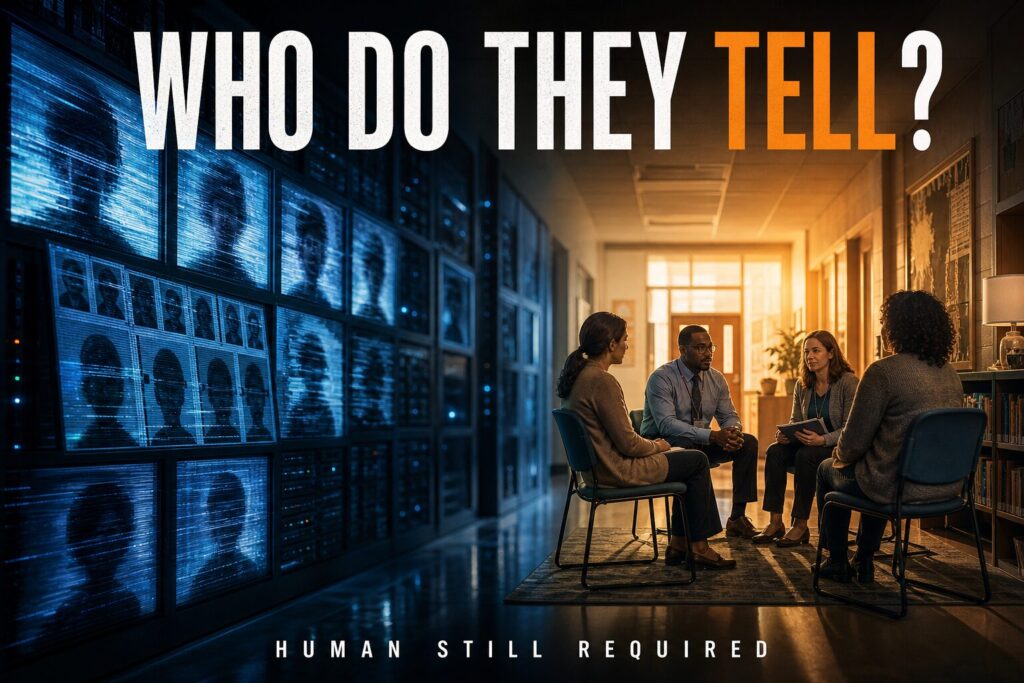
The harder question isn’t what happens to the student who created the image. It’s what the adult who first sees it does in the next ten minutes.
That’s not a technology question. That’s a people question.
Key takeaways
- Most educators have not been trained to recognize or respond to AI-generated fake images, and many don’t know whether their school even has a policy.
- Laws mostly target the individual who creates or shares a deepfake, which means schools can’t wait for legislation to solve this for them.
- A school deepfake policy only works if the adults expected to carry it out know exactly what to do, and what not to do, before an incident happens.
- The first response is a leadership decision about care and clarity, not a technical decision about whether an image is real.
What’s happening
On November 4, Education Week’s Olina Banerji reported on new EdWeek Research Center survey data in a story on how fake AI images are targeting students and teachers. The center surveyed 852 educators nationwide this summer. One in three said they don’t know whether their school or district has a policy on AI-generated fake images and videos. Another 22% said their school or district has no such policy, and 2% said one is being considered.
The training numbers are starker. Nine in 10 educators said they had not been trained on detecting or responding to deepfakes in the last two years.
The same story cites a 2024 student survey from the Center for Democracy and Technology finding that one in four K-12 students know someone who has been depicted in a nonconsensual, sexually explicit deepfake. And when asked what schools would do if a student made or shared a harmful deepfake, educators most often said they would inform parents (56%), followed by suspension (48%) and restorative practices (33%), with another quarter saying they would expel.
The experts EdWeek spoke with didn’t focus on punishment. Erin Mote, founder and CEO of InnovateEDU, urged districts to write an incident response plan before anything happens, to train teachers to follow clear protocols, and to make sure educators never move these images onto their personal phones. Kristin Woelfel, policy counsel at the Center for Democracy and Technology, said schools may not need a brand-new policy so much as specific language added to existing technology, harassment and cyberbullying policies. She also said that figuring out whether an image is real is less important than deciding what to do about it.
Then, on November 9, Brown University published research on why the legal fight against deepfakes feels like whack-a-mole. Computer scientists from Brown’s Center for Technological Responsibility, Reimagination and Redesign, led by Ph.D. student Michelle Ding and assistant professor Harini Suresh, mapped 11 categories of technology across five roles that make AI-generated nonconsensual intimate images possible, from the AI models that create them to the platforms that distribute them and the payment systems that monetize them. The team analyzed 64 state and federal laws and found that more than 92% target the individual creators and distributors, while barely addressing the broader ecosystem. The study was presented November 7 at an ACM conference on equity and access in algorithms.
Suresh put it plainly: “Current mitigations are all very reactive — taking images down once they’re out there.”
Why a school deepfake policy is a leadership problem
Put these two pieces side by side and the picture is clear. The law is aimed at the person who made the image. The technology ecosystem is moving faster than the law. And the adults standing closest to the harm, the teachers and counselors and assistant principals who will be the first to hear about it, mostly haven’t been prepared.
Schools can’t control the ecosystem. They can’t out-detect it either. In Chapter 3 of Human Still Required, I write about the illusion of control: the belief that if we just write the right rule or block the right tool, the problem goes away. Deepfakes are the clearest example I’ve seen of why that doesn’t work.
Control does not scale.
Human Still Required
What does scale is judgment. A teacher who knows what to do when a student comes to them upset at 7:45 in the morning. A counselor who knows how to support a student who has been targeted. An administrator who knows the order of the calls to make and the things not to do.
That is professional learning work, which is where Chapter 12 comes in. Nine in 10 educators untrained is not a teacher failure. It’s a system gap. And the instinct will be to fill that gap with a one-hour session on spotting fake images. I’d push back on that. Detection tools change every few months, and Woelfel’s point stands: whether the image is real matters less than how the adults respond.
Professional learning that centers on tools produces trained technicians. Schools need adaptive professionals.
Human Still Required
Adaptive professionals can handle the incident that doesn’t look like the last one. They know the values behind the protocol, not just the steps.
There’s one more piece, and it comes from Chapter 11. When leaders aren’t sure what to say about something this painful, the temptation is to say nothing until there’s an incident. Students notice that silence. So do families. Woelfel told EdWeek that, at the very least, schools should tell people this is wrong, and that doing so is part of prevention. Mote said districts owe students plain language about the consequences. I agree with both.
Fear isn’t the problem. Silence is.
Human Still Required
A student who has been targeted needs to know before it ever happens that the adults in the building will take them seriously, protect their privacy and act. That trust isn’t built in the moment of crisis. It’s built in the weeks and months before, in how adults talk about technology, harm and respect when nothing is wrong.
What leaders can do now
- Find out what your staff actually knows. Ask a few teachers, counselors and front-office staff a simple question: if a student showed you a fake explicit image of a classmate tomorrow, what would you do? Their answers are your baseline.
- Write the incident response plan before you need it. Start from your existing harassment, cyberbullying and technology policies, as Woelfel suggests, and add specific language. Name who gets called, in what order, and how the targeted student will be supported.
- Make the “do not” list explicit. Staff should know never to request, forward or store these images on personal devices. That one line protects students and adults alike.
- Train for judgment, not detection. Use scenarios. Walk through a case together and ask what matters most for the student in front of you. Then ask what you’d do differently if the details changed.
- Say it out loud to students and families. Plain language, early: this is harmful, this is wrong, here’s what happens, and here’s who you can come to. Don’t wait for the first incident to have that conversation.
If your leadership team wants a structured way to work through questions like these together, the 5-Week Book Study is built for exactly that kind of conversation.
Frequently asked questions
Does our school need a separate deepfake policy?
Not necessarily. Experts quoted by Education Week said many schools can add specific language to existing technology, harassment and cyberbullying policies. What matters more is a clear incident response plan that every adult understands.
Should we buy deepfake detection software?
Detection may have a role, but it shouldn’t be the center of your plan. The tools change quickly, and the first response to a student who has been harmed is the same whether or not an image can be proven fake. Invest first in preparing people.
What should a teacher do first if a student reports a deepfake?
Follow your district’s protocol, report it to the designated administrator, and never ask the student to send the image to a personal device. Focus on the student’s safety and privacy. If your district doesn’t have that protocol yet, that’s the first thing to fix.
Won’t new laws take care of this?
Laws help, but Brown University researchers found that more than 92% of the 64 laws they analyzed target individual creators and distributors rather than the wider technology ecosystem. Schools will still have to respond to what happens in their buildings.
The work only humans can do
AI made it easy to create a fake image of a real student. It did not make it any easier to be the adult that student trusts enough to tell.
That part is still on us. It always was.
So here’s my question for you: if a student in your school were targeted tomorrow, would every adult they might turn to know what to do?
Sources
- Fake AI Images Are Targeting Students and Teachers. Schools Aren’t Prepared — Education Week, November 4, 2026
- To end ‘whack-a-mole’ war on AI deepfakes, address the ‘ecosystem,’ researchers urge — Brown University, November 9, 2026