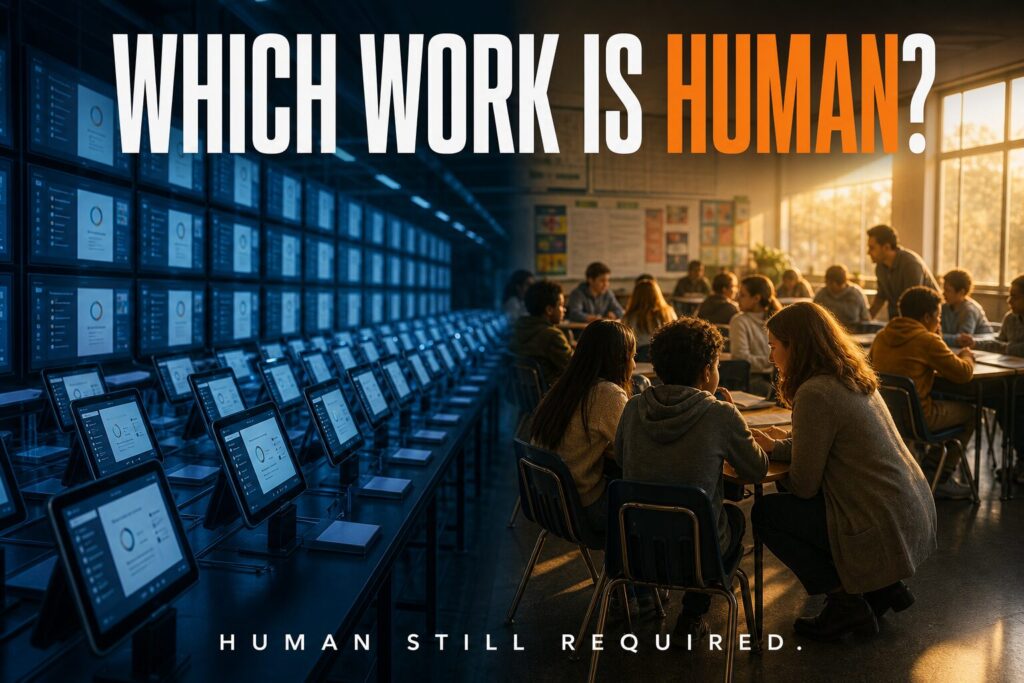
Every few months the same question comes back around: is AI replacing teachers? This week it came back with two very different answers. In Boston, a private school where students spend two hours a day learning academics with AI tutors has teachers worried. Outside Buffalo, a superintendent is using AI to plan bus routes so his people can spend more time with kids.
Same technology. Opposite bets about where it belongs.
I don’t think “Will AI replace teachers?” is the question leaders should be answering. The better question is the one I keep coming back to in my work with districts: which work are we handing to the machine, and which work are we protecting for people?
Key takeaways
- The debate about AI replacing teachers is really a debate about which work schools hand to machines.
- Using AI for structured, repeatable operations like bus routing frees human time; using it as the main instructor changes who is in the relationship with the student.
- Teaching is relational work, and relationships do not scale the way information does.
- Leaders should name, in writing, the work only humans will do, and show where reclaimed time actually goes.
What’s happening
On November 6, GBH’s All Things Considered aired an interview with Boston Teachers Union president Erik Berg about Alpha School, an AI-powered private school founded in Austin, Texas, that opened a K-8 campus in Boston in September. As GBH describes it, students learn at their own pace with AI tutors for two hours, then spend the rest of the day in entrepreneurial workshops. Adults on staff are called “guides,” described as mentors who motivate students to complete their academics rather than traditional teachers.
Berg was blunt. He argued that relationships are central to teaching, that schools also teach socialization, teamwork and citizenship, and that a screen cannot recognize a frustrated child the way a person can. His closing line: “I think it is outsourcing, frankly, part of what makes us human.”
Alpha School responded in a statement printed with the story, saying people not involved with its schools first-hand “do not have accurate impressions” and that Berg had not personally seen the school. GBH said it planned to interview one of the school’s guides in the coming days. That matters. Leaders should hear both sides before drawing conclusions about any specific school.
Three days earlier, Education Week published a Q&A with Sweet Home Central superintendent Mike Ginestre, who leads a district of about 3,800 students near Buffalo, New York. His example was not glamorous. Laying out the routes for a single after-school bus run took staff about six hours, and students had to sign up two weeks ahead. The district built an AI routing tool to do it instead. “We took a task that took us two weeks to do and six hours of time to build a run, and we’ve reduced it into minutes,” he told Education Week. The district is also looking at departments like transportation, special education and finance for similar help.
Asked whether AI would take teachers’ jobs, Ginestre said: “Absolutely not. This is only going to enhance their jobs.” He also told Education Week that teachers in his district are not required to use AI.
Why the AI replacing teachers debate misses the point
Put these two stories side by side and the real difference is clear. It isn’t about how much AI each school uses. It’s about where the AI sits.
In one model, AI handles the paperwork around school so humans can do more of the human work. In the other, AI takes on a large share of the instruction itself, and the human role is redesigned around it. Whatever you think of either, those are not the same decision, and they should not be debated as if they were.
In Chapter 2 of Human Still Required, I argue that AI exposes a design problem more than a digital one, and I ask leaders a question I think every board and cabinet should answer out loud:
What work should only humans be trusted to do?
Human Still Required
Bus routing is an easy call. In Chapter 4, I describe the SAFE test for work that belongs with AI: tasks that are Structured, Administrative, First-draft and Easily repeatable. A bus route checks every box. Nobody became an educator to spend six hours drawing routes on a map. When AI takes that on, the district isn’t replacing anyone. It is buying back human time.
Instruction is a different kind of work. Some of it is structured and repeatable, and AI can help there. Practice, feedback on a first draft and pacing through skills can all be supported by a tool. But learning also depends on someone noticing that a student is stuck, bored, scared or ready for more. That is what Berg was pointing at, and it is the center of Chapter 8, where I argue that AI scales information but trust does not:
Relationships don’t run on speed. They run on presence. And presence has no shortcut.
Human Still Required
This is not an argument against AI tutors or against any particular school model. It’s an argument for being honest about the trade. If a school decides AI will carry more of the academic instruction, then leaders need to be clear about who carries the relationship, how that person is prepared for it, and how the school will know whether students are being known, not just progressing through software.
The superintendent’s story has its own test, too. Saving six hours on a bus run only matters if those hours go somewhere that counts. Time saved is a promise. Leaders still have to keep it.
What leaders can do now
- Write down your “human-only” list. Before your next AI purchase or pilot, have your leadership team name the work that will stay with people no matter what the tool can do: relationships, judgment calls about students, feedback that matters, family conversations. Publish it.
- Run every AI use case through the SAFE test. Ask whether the task is Structured, Administrative, First-draft and Easily repeatable. Operations work like routing, scheduling and drafting usually passes. Work that depends on knowing a child usually does not.
- Follow the reclaimed time. When an AI tool saves staff hours, decide in advance where those hours go and report it. If the answer is “more paperwork,” the tool didn’t help.
- Ask instructional AI the relationship question. For any tool that teaches students directly, ask who notices when a student is struggling, how often a human checks in, and how you will know.
- Talk to teachers before they read it in the news. Stories like the one in Boston land in staff rooms everywhere. Say plainly what your district will and won’t hand to AI, and why.
If your leadership team wants to work through these questions together, the 5-Week Book Study is built for exactly this kind of conversation.
Frequently asked questions
Will AI replace teachers?
AI can take on parts of the work around teaching, especially structured and repeatable tasks. What it cannot do is be in a relationship with a student, notice what isn’t being said, or carry responsibility for a child’s growth. The more useful question for leaders is which tasks to hand to AI and which to protect for people.
What school work is safe to give to AI?
Use the SAFE test: Structured, Administrative, First-draft and Easily repeatable. Bus routing, scheduling, first drafts of routine communication and data summaries are strong candidates. Anything that requires judgment about a specific student or family should stay with a human, with AI as support at most.
How should a district respond to AI-first schools opening nearby?
Don’t react with panic or dismissal. Get clear about your own model: what students get from the adults in your buildings, and how you protect that while using AI where it helps. Families are comparing options, so be specific about the human work your schools do.
The work only humans can do
AI is going to keep moving into schools, through the district office and through the classroom. Leaders don’t get to decide whether that happens. They do get to decide where it goes and what it is for.
Different tools. Same leadership work.
So here is my question for you: if you had to list the work in your schools that only a human should ever do, what would be on it, and does your budget, your calendar and your AI plan actually protect it?
Sources
- “AI-powered youth education has come to Boston. Teachers aren’t happy.” — GBH News (All Things Considered), November 6, 2026
- “Can AI Take on the Grunt Work So Educators Can Focus on Student Learning?” — Education Week, November 3, 2026