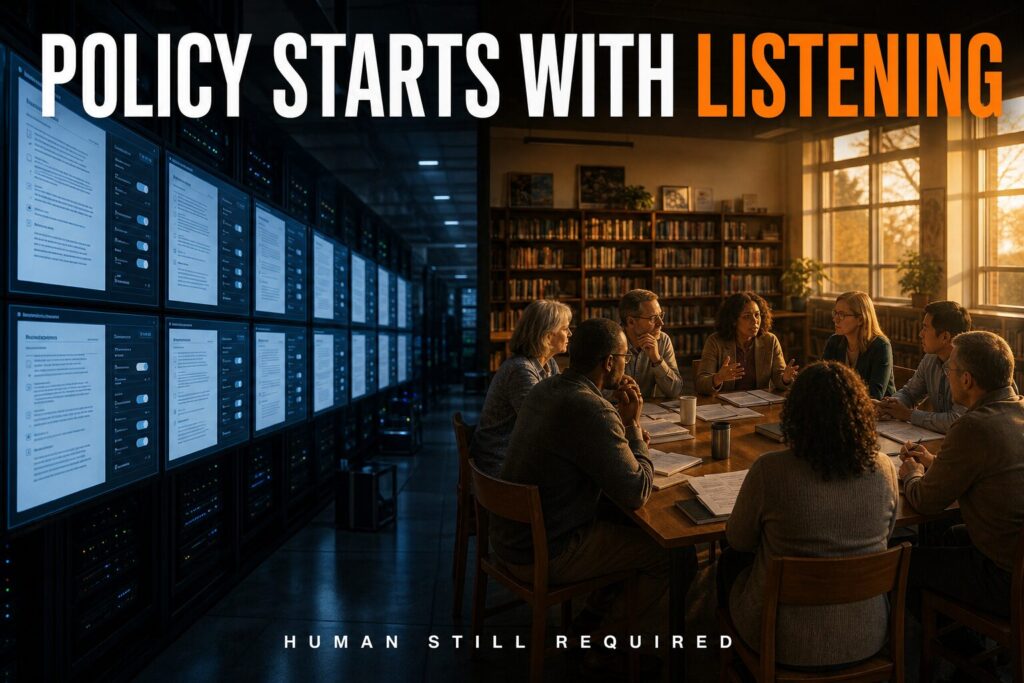
A lot of districts hit pause on AI this fall. This month, a few of them started doing the harder thing: building a school AI policy that can last. And the ones getting it right aren’t starting with the rules. They’re starting with people.
In Austin, the school board adopted its first-ever AI policy and then gave the district 18 months to write the details. In Los Angeles, the district that paused student AI use on school devices in September is now asking parents, students and staff what they think before its board votes on anything.
That’s not slow. That’s the work.
Key takeaways
- A pause on AI buys time. It is not a school AI policy, and it can’t replace one.
- Austin ISD adopted a broad AI policy on November 12, 2026, and gave itself 18 months to write detailed rules for students, teachers and staff.
- Los Angeles Unified is surveying parents, students and staff and has scheduled an ad hoc committee through April 2027 before a full board vote.
- Durable AI policy is built by listening first, naming what matters most, and being honest about what isn’t decided yet.
What’s happening with school AI policy right now
As the Austin Chronicle’s Sammie Seamon reported on November 19, 2026, the Austin ISD board voted to adopt its first local AI policy. All eight trustees present voted for it on November 12. The policy is intentionally broad. It sets an 18-month clock for the district to adopt more specific rules.
Even broad, it draws some clear lines. Students may use only district-approved AI tools, with teacher permission, for classwork. Their work must be original and must credit the AI tools they used. Teachers can’t assign or require AI tools that aren’t on the approved list. The more detailed rules still to come must address students’ understanding of and safeguards against AI’s potential harms, including bias, “cognitive surrender” and mental health risks. Bullying and harassment through AI platforms were added to the disciplinary code.
The board got there after weeks of public comment, mostly from parents. Board President Lynn Boswell put it plainly at a November 5 meeting: “I think we have been kicking this down the road for three years.” Trustee Arati Singh added, “I just hope we don’t lose the human touch in the process of adopting AI in the organization.”
In Los Angeles, LAist’s Elly Yu reported on November 16, 2026, that LAUSD is surveying its community to shape its generative AI policy. In September, the district put a surprise moratorium on student use of generative AI on school-issued devices for this school year. Before that, students 13 and older could use it under supervision. Now an ad hoc committee will meet in December, January, March and April and make recommendations for a full board vote.
School leaders are taking the same concern to Washington. Education Week’s Olina Banerji reported on November 20, 2026, that principals lobbied Congress for more school funding and limits on AI at a two-day advocacy summit of about 300 school leaders and students. Guardrails on schools’ use of AI were part of the agenda, alongside funding for student mental health services.
Three different stages. Same signal. The emergency phase is ending, and leaders now have to decide what they actually believe.
Why a pause is not a school AI policy
I understand why districts paused. When something moves this fast, stopping can feel like the only responsible move. But a pause answers one question: “What do we do right now?” It doesn’t answer the questions that matter over time. What do we want students to be able to do? Where does AI support learning, and where does it get in the way? What will we protect no matter what the tools can do?
In Chapter 3 of Human Still Required, I write about the illusion of control. Bans and restrictions feel responsible. Sometimes they’re necessary for a season. But they don’t build understanding, and they don’t build judgment. The shift leaders need to make is from the rule to the reason.
Instead of asking, ‘What’s the rule?’ Leaders ask, ‘What matters most here?’
Human Still Required
Look at what Austin chose to name. Not just which tools are allowed. Original work. Crediting AI honestly. Teacher permission. Safeguards against cognitive surrender. Those are statements about learning and trust, not settings in a dashboard. That’s what makes a policy last longer than the tool it was written about.
What this reveals: listening is the policy work
The most important part of both stories isn’t the policy text. It’s the process.
Austin’s board heard from parents for weeks. A librarian at one of its schools told the board, “We need to know about changes that they’re making to their tools before our students are facing them.” A science teacher said she doesn’t want her students, or her own kids, “to think that AI will always have the answers.” Those comments aren’t noise around the decision. They are the decision taking shape.
In Chapter 8, I argue that relationships are the real work of leadership, and that trust doesn’t scale the way information does. One line from that chapter fits this moment exactly:
Listening is the decision-making process.
Human Still Required
LAUSD sending a survey to families and staff, with a public meeting calendar that runs into spring, is a version of that. A survey alone isn’t listening, of course. What matters is whether people can see their input in what comes next. When leaders ask and then go quiet, distrust fills the gap. When leaders ask and then explain what they heard and what they decided, trust grows, even among people who disagree.
The 18-month clock is a leadership choice
Some people will read an 18-month timeline as a district dragging its feet. I read it differently.
In Chapter 15, I write about embracing uncertainty and restraint as an underdeveloped leadership skill. Leaders feel enormous pressure to have the complete answer now. But the honest position on AI in K-12 is that the tools, the research and the risks are all still moving. A policy that pretends otherwise will be outdated before it’s printed.
This isn’t indecision. It’s maturity.
Human Still Required
Setting clear principles now and committing to detailed rules on a public timeline is a way of being decisive about values while staying humble about specifics. The risk, and it’s a real one, is that 18 months becomes the new “kicking it down the road.” A timeline only builds trust if people can see progress along the way.
What leaders can do now
- Name the difference between your pause and your policy. If you restricted AI this fall, say out loud what the restriction is for, how long it is meant to last, and what will replace it.
- Write principles before rules. Draft three to five statements about what matters most, such as original thinking, honest disclosure of AI use, and student safety, before you debate specific tools.
- Make listening visible. Survey, hold sessions, invite public comment. Then publish what you heard and how it shaped the draft. People don’t need to win the argument to trust the process.
- Put a public timeline on the details. If the full rules will take a year or more, share the calendar and report progress at each step so the timeline reads as commitment, not delay.
- Bring teachers and librarians in early. They see tool changes first and they live with the policy every day. Their questions will make your policy better.
If your leadership team wants a structured way to work through these questions together, the 5-Week Book Study is built for exactly that kind of conversation.
Frequently asked questions
Should our district pause student AI use while we write a policy?
A short pause can be reasonable while you gather input and set principles. The mistake is treating the pause as the policy. Be clear about why you paused, how long it will last, and what process will replace it.
What should a school AI policy include?
Start with principles: what counts as original work, how students and staff disclose AI use, who approves tools, and how you protect students from harm. Austin ISD’s new policy, for example, requires district-approved tools, teacher permission, original work and credit for AI use, with more detailed rules to follow.
How do we involve parents in AI policy without losing control of the process?
Give families real ways to weigh in, like surveys, listening sessions and public comment, and be clear about how decisions will be made and when. Then report back on what you heard. Transparency about the process matters as much as the final document.
The work in front of us
The fall of pauses is giving way to a winter of policy. That’s a good thing. It means leaders are moving from reacting to deciding.
But the districts that get this right won’t be the ones with the longest list of approved tools. They’ll be the ones whose communities can say, “We were heard, we understand the reasons, and we know what happens next.”
So here’s my question for you: if your community read your AI policy, or your pause, tomorrow, would they recognize their own voices in it?
Sources
- AISD Writes AI Policy Into the Books — The Austin Chronicle, November 19, 2026
- AI in LAUSD schools: District surveying community about AI policies — LAist, November 16, 2026
- Hopeful Principals Lobby Congress for More School Funding, AI Limits — Education Week, November 20, 2026