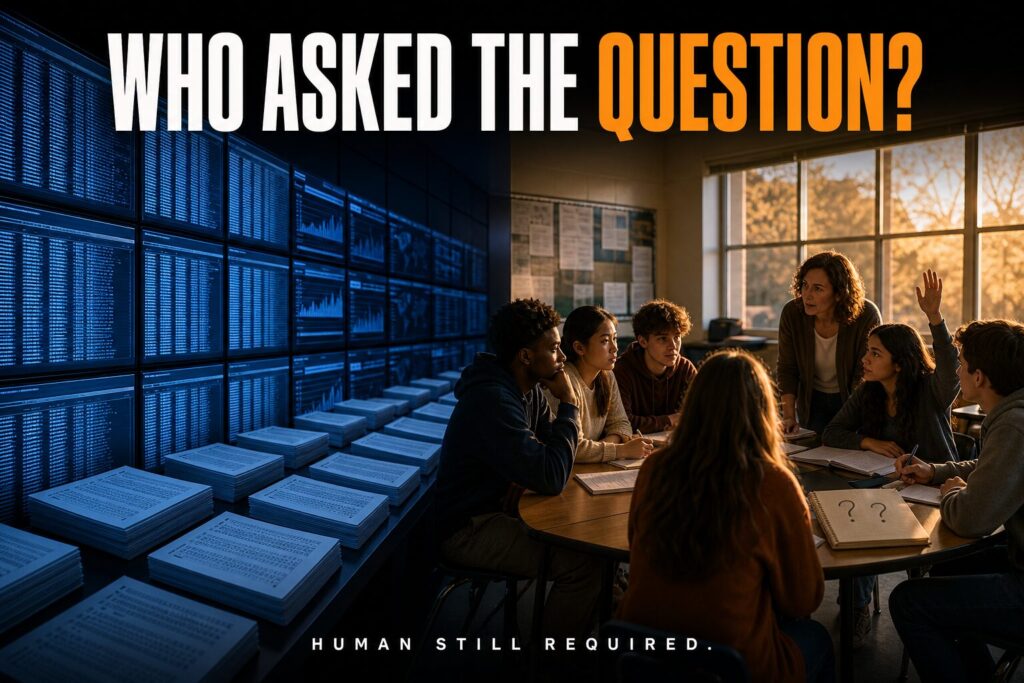
For most of the history of school, we have asked students to do one thing well: answer. Answer the worksheet. Answer the test. Answer the essay prompt someone else wrote. Student questioning skills were nice to have. Answers were what counted.
Now a machine can produce a decent answer to almost anything in seconds. That doesn’t make thinking obsolete. It moves the thinking to a different place. It moves it to the question.
Two pieces this week, one from a university economist and one from two high school teachers in Newark, landed on the same point from different directions. The skill students need most right now is the one we have spent the least time teaching.
Key takeaways
- AI makes answers cheap, so the quality of a student’s question now shapes the quality of what they learn.
- Schools have long rewarded correct answers and rarely taught students how to ask good questions.
- Teachers are starting to assess questions directly and to have students define their own goal before they open an AI tool.
- Leaders can make questioning visible by assessing it, looking for it in classrooms and modeling it in their own meetings.
What’s happening
On November 2, The Hechinger Report published a Teacher Voice essay by Hiranya K. Nath, a Distinguished Professor of Economics at Sam Houston State University, titled students are trained to answer questions, but they are rarely taught how to ask them. Nath teaches at the university level, but his argument is aimed squarely at the whole system, from elementary school through college.
He describes an assignment he gave after several weeks on the U.S. economy and Federal Reserve monetary policy. Students played financial journalists and wrote three questions for a senior Fed official. He told them he would grade the questions, not the answers. The students who were most comfortable explaining concepts hesitated. Others, he writes, thought more carefully than they had all semester.
His broader point is that schools built a model that rewards answers, through tests and grades, and that model made sense when information was scarce. It makes far less sense when students can access more information in seconds than earlier generations could in years. He notes that AI’s answers depend on the questions and instructions it is given. Two lines from his essay stuck with me: “The tool does not define the problem. We do.” And: “A vague question produces a vague answer. A thoughtful question produces insight.”
A few days earlier, on October 29, The 74 published an opinion piece by Michael Taubman and Scott Kern, veteran teachers and AI innovation leads at Uncommon Schools’ North Star Academy Washington Park High School in Newark, New Jersey. They argue it is time to teach students to be drivers of AI, not passengers, and they describe the 12th-grade AI literacy course they built around that idea.
They cite Common Sense Media data showing that 7 in 10 teens report using AI for schoolwork, while fewer than 1 in 3 say they have been taught AI literacy skills. Their course responds with a deliberate sequence. Day One is analog, with no computers, phones or AI. Students audit their own AI use and ask whether they have been a driver or a passenger. Then, before any project begins, students reflect without AI on the issues they care about and decide on their goal. In the authors’ words, “AI literacy starts with students knowing themselves and the goal they have for using it — their destination.”
From there, students learn to give AI context and iterate with it, learn how language models work, and debate responsible use. The course ends with students writing their own AI-use principles and a class statement that says, in part, that where AI begins to diminish their honesty or creativity, “we have both the right and the responsibility to question it, to limit it.”
One is a college economist. The others are high school teachers. Both pieces put the same thing first: the student’s own question, framed before the tool gets involved.
Why student questioning skills matter more in the AI era
In Chapter 10 of Human Still Required, I write about the new leadership skill set, and one of its core shifts is that better questions beat better answers. Knowing more is no longer what sets people apart. Knowing what to ask, and what to do with what comes back, is.
Automation makes answers cheap. That’s not a threat—it’s a test.
Human Still Required
That test applies to students as much as to leaders. If answers are cheap, the scarce thing is the question that is worth answering. Nath’s Fed assignment shows how unpracticed many strong students are at producing one. That is not a failure of those students. They did exactly what school trained them to do.
This is the point I make in Chapter 2. When the system rewards a certain kind of work, people optimize for it.
If school rewards completion over cognition, students will optimize for completion.
Human Still Required
For decades, the most efficient path through school has been to find the answer someone wants and deliver it. AI did not create that habit. It made the habit faster. A student who has only ever practiced answering will use AI to answer. A student who has practiced asking will use it to explore.
There is also a direct link to Chapter 5, where I argue that prompting is not really a technical skill. It is clarity of thought made visible. A good prompt is just a good question with context attached. That is why the Newark course’s “choose a destination” step matters so much. The teachers are not teaching a prompting trick. They are making sure the student’s thinking comes first, so the tool has something real to serve.
And there is an assessment point. In Chapter 6, the D.E.C.I.D.E.R. framework lays out what still counts as evidence of learning when output is cheap: Decision-making, Explanation, Critique, Inference, Development, Evaluation and Relocation, or transfer to new contexts. A strong question touches almost all of them. To ask a sharp question of a Fed official, a student has to know what is settled, infer what is still uncertain and decide what matters most. A question is a window into understanding that a finished answer often hides.
What leaders can do now
- Assess a question, not just an answer. Ask one department or grade-level team to try Nath’s move this quarter: an assignment where the questions students generate are what gets evaluated. Then talk together about what the questions revealed about student understanding.
- Change one walk-through look-for. On your next set of classroom visits, track who is asking the questions. Not how many questions the teacher asks, but whether students are generating questions of their own. Share the pattern with staff as a conversation, not an evaluation.
- Put the destination before the tool. Encourage teachers to build a short, no-AI step at the start of projects where students name their goal or their question. It costs ten minutes. It makes everything that follows more intentional.
- Model it in your own meetings. Open your next leadership or faculty meeting with a question you don’t know the answer to, and ask the team to sharpen it before anyone tries to answer it. Students learn questioning from adults who visibly practice it.
- Ask what your grading system rewards. Look at a sample of report card standards or rubrics. How many reward a correct product? How many reward a good question, a stated uncertainty or a revised line of inquiry? The answer is diagnostic data.
If your team wants to work through these shifts together rather than one leader at a time, the 5-Week Book Study is built for exactly that kind of conversation.
Frequently asked questions
Why are student questioning skills more important now that AI is in schools?
AI can generate fluent answers almost instantly, but the quality of those answers depends on the question and context it is given. When answers are cheap, the ability to frame a good question becomes a better signal of understanding. It is also the skill that keeps students in charge of the tool.
How can teachers assess student questions?
One approach is the one Hiranya Nath describes: give students a realistic audience and grade the questions they write for it. Teachers can look at whether a question shows what the student already understands, what they recognize as uncertain and what they think matters most. Rubrics built on explanation, inference and critique work well here.
Should students ask AI questions or avoid it while learning to question?
Both have a place. The Newark teachers start with an analog step so students define their goal without AI, then teach them to use AI with context and to notice when it fails. The point is sequence: the student’s question comes first, and the tool serves it.
The question is the work
We spent a long time building schools that are very good at producing answers. That made sense in a world where answers were hard to find.
That world is gone. The answers are everywhere now. What is still scarce is the person who knows what to ask, why it matters and what to do with what comes back. That is human work, and it can be taught.
So here is my question for you: in your school this week, who did most of the asking?
Sources
- TEACHER VOICE: Students are trained to answer questions, but they are rarely taught how to ask them — Hiranya K. Nath, The Hechinger Report, November 2, 2026
- It’s Time to Teach Students to Be Drivers of AI, Not Passengers — Michael Taubman and Scott Kern, The 74, October 29, 2026