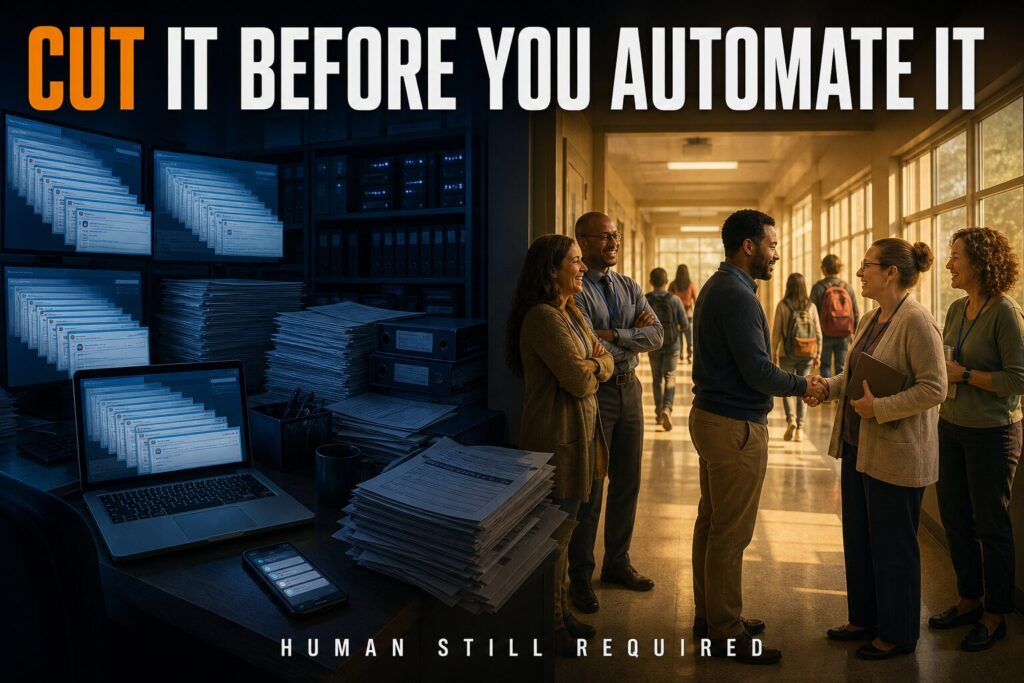
Principal workload is no longer staying at school. A new study of principals finds that the stress that follows them home, the emails at night and the calls on the weekend, is the stress most tied to anxiety and depression. That should change how every district thinks about AI for school leaders.
The obvious move is to hand the overflow to a machine. Draft the emails faster. Summarize the reports faster. Get the evening back.
Some of that is right. But speed is not the first question. The first question is whether the work should exist at all. The second is which work only a human should do.
Key takeaways
- Principal stress that spills into home life, such as after-hours email and calls, is the stress most strongly linked to anxiety and depression, according to a new study of 119 principals.
- Before using AI to do administrative tasks faster, district leaders should remove “phantom tasks” that have no clear purpose.
- AI can help principals with structured, repeatable paperwork. It should not stand in for a leader’s judgment about people.
- Staff can tell the difference between a message a leader thought through and one a tool produced. Specific, human recognition builds trust; polish alone does not.
What’s happening
On October 8, Education Week’s Olina Banerji reported on new research into what is driving principal stress. The study, “Not all stressors are equal,” published in Educational Management Administration & Leadership by Eleanor Su-Keene, Shaun Hutchins and Caitlin Samson, surveyed 119 principals in Texas and grouped their stressors into systems based on how close each one sits to a principal’s daily work and how much control the principal has over it.
The finding that stands out: work that spills into personal life, which the article calls “work spillage,” predicted anxiety and depression. School-based stressors did not show the same effect on mental health. About a third of respondents said their stress comes from the blurring line between work and home. Sixty-one percent pointed to student- and teacher-related issues, and about three in 10 named dealing with parents. Principals described taking work home and answering emails and calls after hours because there isn’t enough time in the school day.
Su-Keene, an assistant professor of teaching, learning, and culture at Texas A&M University, described the emotional weight of the job this way: “Your teachers are not doing well. You don’t have the resources to support them.” Her recommendation for districts was concrete. Alleviate “phantom tasks,” duties without a clear purpose, and figure out which tasks are actually necessary for improving student learning.
Two days earlier, eSchool News published an essay on AI, authenticity and trust in school leadership by Nesreen El-Baz, an ESL educator with more than 20 years of experience. She opens with a friend who got a promotion and suspected his boss had used AI to write the praise in the email. That suspicion made the praise feel less valuable. El-Baz draws a line between AI-assisted expression, where a leader who knows a teacher’s work uses AI to phrase that judgment, and AI-substituted judgment, where a leader asks a tool to appraise someone they barely know. Her summary is sharp: “Specificity builds trust; polish alone does not.”
Put these two stories side by side and you can see the trap. Overloaded principals are exactly the people most tempted to let a tool write the words that matter most.
Why principal workload is a design problem, not a stamina problem
In Chapter 4 of Human Still Required, I make the case that the machine should take the busywork so leaders can return to people. I use the SAFE framework to sort which tasks fit: work that is Structured, Administrative, First-draft and Easily repeatable. Schedules, templates, summaries of long documents, first drafts of routine notices. That is real relief, and principals deserve it.
Busywork is not ‘small work.’ It’s expensive work.
Human Still Required
But the study points to something AI can’t fix on its own. If a principal’s evening is full of tasks that serve no clear purpose, making those tasks faster just makes room for more of them. That is why I also write in Chapter 4 that “AI is here to reduce the load—not increase expectations.” Time saved only helps if someone protects it.
Chapter 14 goes a step further. There I take on compliance-driven documentation culture and offer three questions for any report, form or recurring task: Who is this for? What decision does this inform? What would happen if this didn’t exist? Su-Keene’s “phantom tasks” are what you find when you ask those questions honestly. Some work doesn’t need a faster process. It needs to stop.
So the order matters. Cut first. Then automate what’s left that fits the SAFE test. Then decide what the reclaimed time is for.
Where AI should stop: the words that carry judgment
El-Baz’s essay names the other half of the problem. Not every message a principal sends is paperwork. A recognition note, a reference letter, a hard conversation with a teacher, a reply to a worried parent. These are not administrative. They are relational.
In Chapter 8, I argue that AI scales information but trust doesn’t scale. Staff don’t trust a message because it is well written.
They trust leaders because the message sounds like it came from someone who knows them.
Human Still Required
This is where the overload and the authenticity question meet. A principal answering email at 10 p.m. is the person most likely to ask a tool to “write something nice” about a teacher they haven’t had time to observe. The words may be fine. The thinking isn’t there. And people notice.
This isn’t a reason to avoid AI. It’s a reason to be clear about what it is doing. A leader who knows exactly what a teacher did well and uses a tool to tighten the sentence is still leading. A leader who outsources the noticing has handed over the part that mattered.
What leaders can do now about principal workload
- Run a phantom-task audit. District leaders: list every recurring report, form and data request you send to principals. For each one, ask the three Chapter 14 questions. Retire or combine anything without a clear answer before you buy a tool to speed it up.
- Use the SAFE test for the rest. Principals: pick two or three tasks that are Structured, Administrative, First-draft or Easily repeatable and let AI take the first pass. Keep a human read on anything that goes out.
- Decide in advance where the time goes. If AI gives back an hour a week, name what it is for: classroom visits, a conversation with a struggling teacher, or simply not opening email after dinner. Unnamed time gets filled.
- Draw a line around judgment. Agree as a leadership team that appraisals, recognition and sensitive staff or family communication start with the leader’s own notes and evidence. AI can help phrase it. It cannot supply it.
- Borrow El-Baz’s self-check. Before sending an AI-assisted message about a person, ask: Could I explain the evidence behind these words without looking at the screen? Would I defend every sentence in person?
If your leadership team wants to work through these questions together, the 5-Week Book Study is built for exactly that kind of conversation.
Frequently asked questions
Can AI reduce principal workload?
It can help with structured, repeatable administrative work like drafting routine notices, summarizing long documents and building schedules. It won’t reduce workload if districts keep adding tasks without a clear purpose. Remove unnecessary work first, then use AI on what remains.
What are phantom tasks for principals?
In Education Week’s coverage of the principal stress study, researcher Eleanor Su-Keene used the term for duties without a clear purpose. Her recommendation is for districts to identify which tasks are actually necessary for improving student learning and lift the rest off principals’ plates.
Is it okay for principals to use AI to write staff communication?
Yes, for routine and logistical messages, as long as a human reads everything before it goes out. For recognition, appraisals and sensitive conversations, the judgment and specific evidence should come from the leader. AI can help with wording, but it shouldn’t replace knowing the person.
The work that has to stay human
Principals don’t need to work harder. Most are already working into the night. They need systems that stop asking for work that doesn’t matter, and tools that take the paper so they can show up for the people.
The machine can draft the newsletter. It can’t notice the teacher who stayed late with a student, and it can’t mean the thank-you.
So here is my question for district and school leaders: if you looked at everything you asked your principals to do this month, how much of it would survive the question “What would happen if this didn’t exist?”
Sources
- Principals Are Stressed Out. Here’s What’s Plaguing Them—and What Can Help, Education Week, October 8, 2026
- “My boss probably used AI”: What school leaders need to know about AI, authenticity, and trust, eSchool News, October 6, 2026