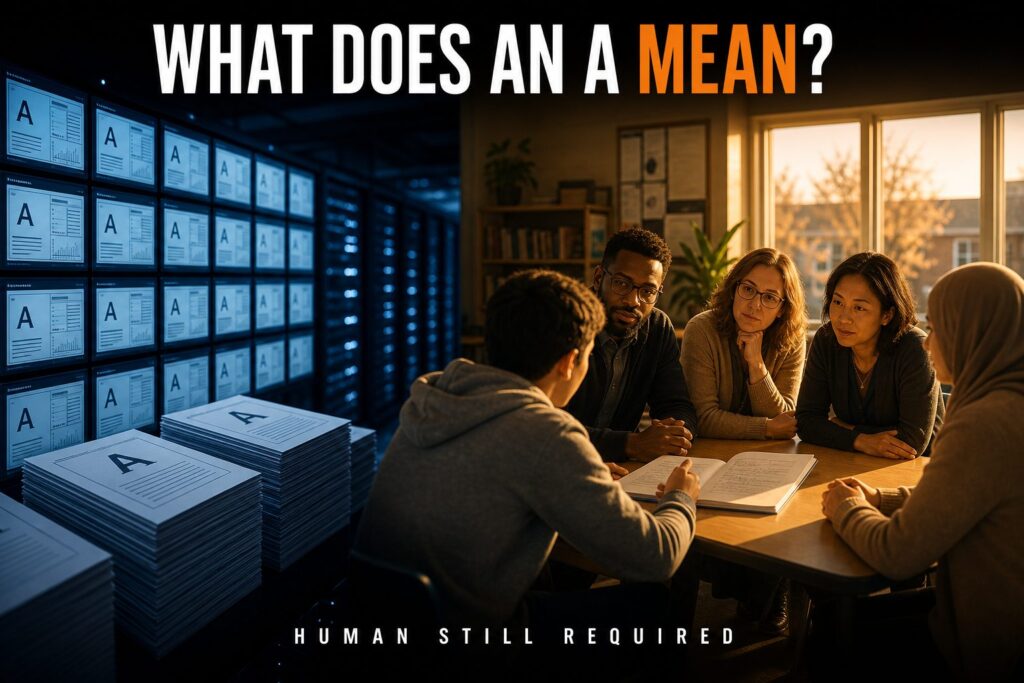
Parents are starting to notice grade inflation. That is the headline from new survey data this week. But I think the bigger story for school leaders is what comes next. If a report card was already a blurry signal before AI, it gets blurrier every time a grade rests on work a machine can produce.
This isn’t a story about lazy kids or soft teachers. It’s a story about what a grade is supposed to tell us—and whether ours still do.
A grade is a message. The question is whether anyone can still read it.
Key takeaways
- Parents are becoming more realistic about grades: fewer now believe their child is at or above grade level, according to new Learning Heroes data reported by The 74.
- Grade inflation is a signal problem, not just a standards problem. When grades and outside measures disagree, families and students lose the information they need.
- AI raises the stakes. Any grade built mostly on work AI can complete tells us less about what a student actually understands.
- The fix is not harsher grading. It is grading that reflects thinking students can explain, defend and transfer—plus honest conversations with families about what a grade means.
What’s happening with grade inflation and parent perceptions
On September 29, The 74’s Linda Jacobson reported on new Learning Heroes data showing parents are beginning to grasp the reality of grade inflation. According to that reporting, the share of parents who think their child is at or above grade level in math has dropped 9 percentage points since 2022, to 83%. In reading, it fell to 88%.
The same article lays out why trust in grades is slipping. Between 2016 and 2021, the average GPA of students taking the ACT rose from 3.22 to 3.39, while average ACT scores dipped from 20.8 to 20.3. It cites Fordham Institute research finding that 44% of students making all or mostly A’s score below 1,000 on the SAT. And it notes University of Washington researcher Dan Goldhaber’s finding that the number of Washington districts with no-zero grading policies grew from 30 to almost 70 between 2015-16 and 2024-25.
50CAN CEO Marc Porter Magee put it plainly: “I do feel like the drumbeat is causing parents to question more whether an A actually means mastery.”
The underlying report, Learning Heroes’ “Parents 2026: Shifting Mindsets in a Time of Disruption”, surveyed 1,982 K-12 public school parents between April 30 and May 27, 2026, with Edge Research. It found that 73% of parents now say their child gets mostly B’s or better, down from 84% in 2022. It also found that parent-teacher conference attendance “is at an all time low with just over half of parents participating.”
The report asked about AI, too. Just 26% of parents said they are “very comfortable” with AI in the classroom, and 7% said they are “very uncomfortable.” Most are somewhere in the middle. The researchers’ summary: “Parents are not signaling they want to get rid of technology in the classroom, but they want transparency.”
Meanwhile, K-12 Dive’s Kara Arundel reported on September 30 that SAT scores rose across the board for the class of 2026. The mean total score reached 1045, up 16 points from the class of 2025, and about 42% of test-takers met the college and career readiness benchmarks in both sections. The College Board also highlighted that more than 1.3 million students in the class of 2026 earned scores aligning with or exceeding their high school GPA. Participation dipped, to about 1.95 million students.
Look at how that last claim is framed. One measure is being used to vouch for another. That tells you how much work we are asking a GPA to do—and how little we trust it to do that work alone.
Why grade inflation in the AI era is a leadership issue
In Chapter 1 of Human Still Required, I describe school systems built for information scarcity. Homework was practice. Essays were proof. Grades were proxies. Those systems were never perfect, but they held together because the work itself was hard to fake at scale.
That’s no longer true. If a large share of a grade comes from take-home writing, worksheets or problem sets that a chatbot can complete in seconds, the grade can’t tell us much about who did the thinking. The parent sees a B. The teacher suspects something. The student isn’t sure whether the B means they learned it. Nobody has the information they need.
Chapter 14 takes this head on. One of the systems I argue schools must change is grading that confuses precision with learning. A 93.4 looks exact. It may be measuring compliance, completion and point accumulation more than understanding.
Grades were never meant to carry this much weight.
Human Still Required
Here’s where I want to be careful. The answer to grade inflation is not to grade harder. In Chapter 2, I warn leaders against retreating to tougher tasks or paper-and-pencil assignments to outsmart AI. Difficulty is not rigor. A tougher curve doesn’t make a grade more meaningful. It just makes it more stressful.
The answer is to change what the grade is built on. In Chapter 6, I lay out the D.E.C.I.D.E.R. framework for what still counts as evidence of learning in an AI world: Decision-making, Explanation, Critique, Inference, Development, Evaluation and Relocation, meaning transfer to new contexts. Those are the things a student has to show, in their own voice, in front of someone who knows them.
AI didn’t create a learning crisis. It revealed a measurement problem.
Human Still Required
The Learning Heroes findings point to the human side of this, too. Parents want to understand how their child is really doing, but fewer of them are showing up for the conversations that would tell them. A report card can’t carry that load by itself. It never could.
What leaders can do now
- Audit what your grades are built on. Pull a sample of gradebooks from a few courses. What percentage of each grade comes from work completed outside class that AI could produce? That number is diagnostic data, not an accusation.
- Shift weight toward visible thinking. Increase the share of grades tied to conferences, oral explanation, in-class drafting, revision histories and transfer tasks. The D.E.C.I.D.E.R. elements are a practical checklist for designing these.
- Ask what each grade is for. Before adding or keeping a grading practice, ask who it serves and what decision it informs. If no one can answer, it may be documentation, not feedback.
- Make grades explainable to families. Give parents a plain-language explanation of what an A or a B means in your school, how AI fits into coursework, and how teachers know what students understand. The Learning Heroes data suggests parents want that transparency.
- Rebuild the conference. With attendance at an all-time low, rethink timing, format and purpose. Put student explanation at the center: a short student-led conversation tells a parent more than a GPA.
If your leadership team wants to work through these questions together, the 5-Week Book Study is built for exactly that kind of conversation.
Frequently asked questions
Is AI causing grade inflation in K-12 schools?
The sources here don’t measure that directly. The grade-inflation trend they describe started well before generative AI. What AI changes is how much a grade can tell you: if grades rely heavily on work AI can complete, they become weaker evidence of what a student understands.
Should schools respond to grade inflation by grading harder?
No. Harder tasks and tougher curves don’t make grades more accurate; they mostly add stress. A better response is to base more of the grade on evidence of thinking—explanation, critique, revision and transfer—that a student has to demonstrate themselves.
How should principals explain grades to parents now?
Be specific and honest. Tell families what each grade level is meant to signal, how AI is and isn’t allowed in coursework, and how teachers check for understanding. Then create regular moments where students explain their own learning to their families.
What counts as evidence of learning in an AI world?
In Human Still Required, I use the D.E.C.I.D.E.R. framework: decision-making, explanation, critique, inference, development, evaluation and transfer to new contexts. The common thread is that students can explain, defend and revise their thinking.
The question worth asking
Parents are starting to ask whether an A means mastery. That’s a healthy question. School leaders should be asking it first.
AI didn’t break grading. It made it impossible to pretend a grade means something it doesn’t.
So here’s my question for you: if a parent in your school asked what their child’s B really means, could your teachers answer with evidence of the student’s thinking—or only with points?
Sources
- Parents Are Beginning to Grasp the Reality of Grade Inflation, New Data Shows — The 74 (Linda Jacobson), September 29, 2026
- Parents 2026: Shifting Mindsets in a Time of Disruption — Learning Heroes, September 2026
- SAT scores are up across the board for class of 2026 — K-12 Dive (Kara Arundel), September 30, 2026